
For something a little different in this blog I’ll begin by asking: If you shoot a PCP airgun, do you ever give much thought to that quick disconnect (QD) coupling, or fitting, you are trusting your well-being to every time you attach/detach that 4500psi High Pressure Air (HPA) hose? The answer, most likely, is probably not. And that is a good thing because modern airgunners must be doubly vigilant when pursuing our hobby. We are not only firing potentially lethal projectiles, but dealing with HPA as well – both inherently dangerous if all safety rules aren’t followed. So, if we don’t have to dwell too much on the QD fittings we are using, then we can concentrate on safely using our PCPs. Therefore, not having to give a second thought to the strength and lockup of that little coupling is one less thing to take away from the enjoyment of our hobby.

attached to a plug to quickly add to a line
A little background into these indispensable items takes us back to 1915 when a man named Fred Hansen developed his first QD coupling. He produced them in Michigan under the Hansen Manufacturing Company and they soon became the industry standard. The name continues on as a division of Danfoss Corporation. Since they were originally invented by a man named Hansen, why do we generally refer to them as Foster fittings? That’s because there is a Foster Manufacturing Company out of Missouri making these couplings that are commonly used by the airgunning community. In business for over 30 years, they are now known as ZSI-Foster and part of Ideal Tridon Group. There are at least 15 other U.S. manufacturers that make these couplers and many more overseas companies producing them as well.
They are a fast, accurate and secure way to repeatedly connect/disconnect just about any fluid line, but what makes them so effective? There are three basic types of QDs, a Single Shut-off, Double Shut-off and Straight Through, with the Straight Through being the type used for airgunning. It is relatively easy to manufacture as it doesn’t contain any internal valving like the other two types. That means that with a ST type, some sort of manual shut-off and purge valves must be in the line to safely disconnect from the supply. The ST types can be made for less cost and handle pressures in the range of 1000 to 5000psi in the stainless-steel versions. There is also less pressure drop due to the lack of internal flow obstructions. Within the ST type connectors there are two styles, a Push Style and Sleeve Style. The Sleeve Style being more dominant because it is less costly to produce, is slightly more compact in size and its safe, strong operation. The QDs in airgunning application are considered miniature due to the 1/8-inch diameter of the plug.
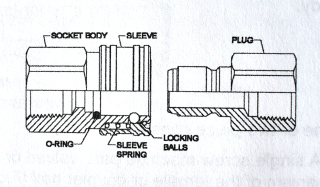
Obviously, they are comprised of two parts, the male plug (or nipple or tip) and the female socket (or coupler or body) which contains the locking mechanism. The objective is to provide a positive method of retaining the plug in the socket while minimizing the effects of pressure in the system. And, while there are at least ten locking methods or devices used in the fluid handling industry, the Ball lock is the most common and the one used in a Foster fitting. The Ball lock is relatively easy to manufacture and reliable as well as having good swiveling characteristics along with load distribution capability. The Ball lock is made up of a series of hardened Carbon, Chromium or Stainless steel balls arranged radially in a ball cage inside the socket body. A spring-loaded sleeve covers the balls to keep them contained and recesses on the inside allow the balls to move out of the way when the sleeve is retracted and the plug inserted. Releasing the sleeve forces the balls to lock into the plug groove to complete the connection. For HPA use the female socket should contain six locking balls for the most secure lockup, as do the Foster and Hansen connectors. They are also made in brass but keep in mind that brass cannot handle the higher pressures that the steel QDs can.

Like anything in your kit, visual inspection for excessive wear, metal galling or corrosion needs to take place regularly to stay safe. The same is true with your hose connectors. Keep safety in mind and that way you can enjoy this sport for a long time to come.
Sort of like Hiram Maxim and his invention of the silencer, pieces of engineering genius over 100 years old makes airgunning a more enjoyable endeavor today.

Leave a Reply