by Gordon Smith

The Mordax Venom is the most recent addition to the growing Western Airguns stable as a select-fire pistol.  The enhanced evolution of the Mordax air pistol, it is available in .22, .25 and .30 calibers and combines precision craftsmanship with cutting-edge upgrades. This American-made lead launcher should appeal to PCP aficionados that enjoy hunting, target shooting, casual plinking as well as those tactical enthusiasts. Thanks to Airguns of Arizona for the loan of this .30 caliber Venom to review.

The Mordax Venom with an American-made 8.5-inch barrel and folding stock

The Venom version grew from the short-barreled model having an underbarrel reservoir tube. Accomplished by adding the Venom Booster Plenum, a drop-block plenum that provides the extra room for a 300cc carbon fiber air tank.  Rated for 300 BAR working pressure, the User Guide indicates both HPA and nitrogen can be used in these airguns. This configuration not only boosts the available air, but optimizes air delivery to increase energy output up to 76 foot-pounds of energy in the .30 caliber. The tank pressure gauge is affixed to the left side of the booster and the fill port opposite it on the right side. The regulator pressure gauge is located on the left side above the trigger and a short picatinny rail is on the bottom of the Booster. Speaking of picatinny rails, a full-length one runs along the top incorporating a non-adjustable post sight on the front and an adjustable notch-type rear sight. The Venom arrived with a Hawke Vantage 1×20 red dot already mounted. A 4.2 ounce, 2.9-inch-long optic that was an excellent choice for this pistol with the 8.5-inch American-made barrel.

It sports a 10.5-inch long aluminum side-folding stock with a QD sling point that turns it into a carbine. The OAL of the Venom with its stock folded, is only 16 inches with the 300cc carbon fiber bottle configuration and without the compact (4.5 inches) 0dB silencer it ships with. Adding the silencer back brought the OAL to 17.75 inches. Unfolding the stock brought the OAL to 27.75 inches and the Venom with the Hawke red dot and compact 0dB silencer weighed in at 4.96 pounds. The Venom is imminently portable and, AofA  makes this point by delivering it in a very nice, light gray Savior backpack carrying case.

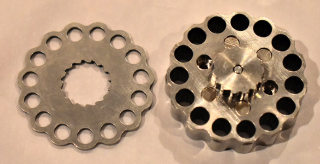
The Venom is fed by a rotary, two-piece steel magazine holding 12 rounds in .30 caliber. To load, the thin metal back plate is separated from the magazine body and pellets are dropped nose first into each opening. The back plate is replaced and held by magnets. The loaded magazine is inserted from the right side after retracting the magazine release lever, inserting the magazine into the breech, and rotating it counterclockwise slightly until the magazine release lever locks into place. A side benefit for those who already own a Western Airguns Sidewinder, your magazines will work in the Mordax as well.

The Mordax trigger is a two-stage, non-adjustable unit and the trigger pull measured an average of three pounds, 1.7 ounces across five pulls. The pull feels heavier, yet it is a new gun, and should smooth out after additional break in. To those unfamiliar with Western Airguns and their valveless construction, there is no charging handle or cocking bolt. So, extra caution is required once a loaded magazine is inserted into the gun. When the safety is off a trigger pull will discharge a round with no other action required. Conversely, there is no way to de-cock these airguns so the proper procedure to make certain it is unloaded is to remove the magazine, point the airgun in a safe direction, and dry-fire several times. Additionally, you must fully release the trigger on these SA/FA airguns in Semi-auto mode after each shot or potentially cause a misfire.

Directly behind the trigger is the Power Adjuster screw. Holding the airgun upside-down, turning it counterclockwise with a 3.5mm hex wrench increases the power and vice-versa. The User Guide recommends only adjusting the Power Adjuster knob if you have a chronograph as the gun was tuned at the factory for optimal performance. The grip is a mil-spec unit that has a nice, grippy feel, and can be swapped for your choice of grip.

Now to the “giggle switch” on the Venom. The selector is a three-position switch on the left side of the airgun. SAFE position blocks the trigger; SEMI is for discharging single rounds and rotating all the way over to FULL empties that twelve round magazine pretty quickly and is a bunch of fun! Full auto mode requires a minimum regulator pressure setting of 135 BAR and in full auto, you may get up to three full magazines before needing a top off.

This .30 barked loudly as you can imagine. Ear protection would be prudent when no sound suppression is involved. The compact 0dB did a decent job mitigating the bark, still, I wanted to play with a couple of other .30 silencers. A full-length 0dB was tried first. It added length and weight to the Venom without that much of a change in my humble opinion. Next I tried a Yokozuna by DonnyFL, which did seem to quiet the Venom a bit more at the expense of additional length and weight.  As expected, the POI shifted slightly with the different silencers.

The User Guide included with the Venom actually describes the original Mordax configuration. A lot of the information within it covers both platforms with exceptions such as the ability to swap the fill nipple from one side to the other by simply pulling it out and reinserting on the opposite side and adjustment of the regulator pressure. WAG strongly suggests the user not adjust the regulator as it has been factory set for optimal performance. The warranty can be voided if done incorrectly. For the tinkerers out there who just have to squeeze out the most FPS from their gun/pellet/slug combination, the regulator adjustment screw is in the center of the bottom picatinny rail. The gun must be depressurized in order to reduce regulator pressure.

Results at 25-yards were excellent with one ragged hole groups using JSB Exact .30s at 44.75 grains. My supply of .30 pellets was limited with the JSB Hades in the same weight. Of course, they performed equally well. Regulator pressure was at 150 BAR and the chronograph showed an average of 695fps with a spread of 30fps and SD of 10.2fps. Average FPE was around 48.5 without moving the Power Adjuster from how it was shipped. In that configuration I got three full mags before needing to top off. I had no .30 caliber slugs in inventory and wondered how this short barrel would handle them. That is something a new owner will have to experiment with. Should this short barrel not be up to the task, an optional 14-inch barreled version called the Long Strike Venom is available. Happily, the Long Strike still fits nicely into the Savior backpack that come with the gun.

Made in Sheridan, WY with almost entirely U.S. supplied parts, the MSRP lists at $2396 in either the short or long barrel configuration. The Hawke optic is not included, but can be added for an MSRP of $120. Some excellent accessories are currently available for the Mordax as well, such as a stock adapter to increase the LOP about two inches; but only for models sold after February, 2025. Also available is an adjustable cheekpiece. Additionally, for the .22 and .25 models, extra barrels may be purchased and easily swapped out. AofA is an authorized service center for Western Airguns and can help with any issues during the 12-month warranty period and beyond. Check out their website to place your order in time for Christmas!
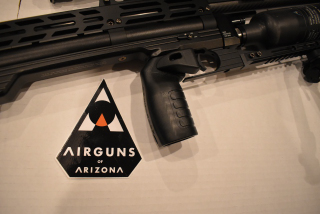
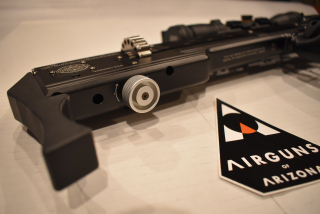
               When I left off in Part I, I discussed the features of, and details about the Western Airguns Sidewinder.  Now for some results of my informal shooting of the Sidewinder both at my home range and at the 100 yard range at my shooting club.

As mentioned in Part I, the trigger is not adjustable, however, it was light at just under two pounds. Also, the buttstock is not adjustable, so to gain as much accuracy advantage as possible, I swapped the mil-spec angled grip for my Long Shot Precision Vertical Grip.  Being a loaner airgun, there is only so much I feel comfortable doing to modify a test gun. I also heeded the User Guide and avoided adjusting the regulator from the factory setting of approximately 160psi although the manual indicates the Sidewinder will work properly as long as the regulator pressure is between 140 and 190psi should you want to tweak the regulator. Given that, all of the following results were made with the gun at that factory setting.  I did make adjustments to the Power Adjuster knob when switching from pellets to slugs.

The Long Shot Precision Vertical Grip

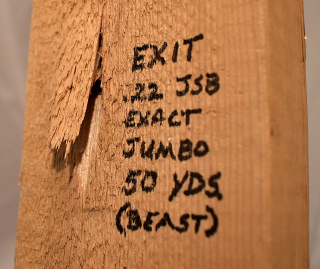
Accuracy results with pellets were very good at short ranges up to 50 yards. Pellets under 15.89 grains flew over 1100fps and did not produce good groupings although I’m sure if you experimented with the power adjuster more, a “sweet spot” for those pellets might be found.  However, when shooting pellets in the 15.89 to 18.1 grain range, the Sidewinder was producing excellent results for me at 50 yards.  In fact, the 18.1 grain JTS Dead Center pellets even landed 11 of 12 rounds in a 3-inch bull on full-auto! JSB Exact Jumbos (15.89 grains) yielded a five round single ragged hole when I did my part.

The Dead Center pellets averaged 1053fps with a high SD of 25.5fps yet the accuracy was good enough for hunting, target and plinking even so.  I’m certain more experimentation on my part could have evened the fps spread somewhat. Speaking of hunting uses, those 18.1 grianers were producing an average energy of 44.5 foot-pounds of energy. The Exact Jumbos averaged 1077fps with a SD of only 3.7fps. They produced an average slightly over 40fpe. Again, more tweaking of the power adjuster or even the regulator could give even better results in your shooting.

The Power Adjuster knob

I attempted shooting the heavy (33.96 grain) JSB Exact Jumbo Beasts out to 100 yards thinking their long skirt and more cylindrical shape might do well at longer ranges, but they did not. So, switching to slugs, of which I only had two brands available that day at my club range, here are my results: Daystate Howler slugs in 20.3 grains with a hollow-point nose, screamed out of the Sidewinder at an average of 1094fps and only had a SD of 2.0fps but they didn’t group well at that speed. They were hitting hard though, yielding an average of 54fpe. Again, with more time at the 100 yard range on a less windy day I’m confident that slowing down a slug that light would have given better accuracy. On the flip side, JSB Knock Out slugs of 25.39 grains, also a hollow-point, averaged 991fps with a SD of only 7.1fps. They kicked out a 55fpe average and five rounds grouped within two inches on a hot, windy day. Just for grins I emptied the magazine on full-auto because this gun is capable of doing it and it is a lot of fun! The group opened up, as could be expected, although the rounds still landed within a six-inch circle.

The Sidewinder gave an excellent shot count with pellets in that six full magazines could be fired before needing a top off. Slugs, of course, used more air and still an average of five full mags and still be in the green zone of the air reservoir.

The Western Sidewinder fills a niche for those looking for a bullpup style accurate and hard-hitting hunting and target air rifle that also offers full-auto capability.  Along with that comes a caveat. As mentioned in Part I, there is no cocking lever or charging handle on the Sidewinder. Once both safeties are off, there is no way to de-cock the mechanism. If the semi/full safety is not fully seated in position and the trigger is tripped, the gun doesn’t fire, and if the semi/auto selector is then moved, the gun can fire. To make sure the Sidewinder is empty and completely safe, the magazine must be removed and the gun fired several times in a safe direction.

I had good results with only a handful of heavier pellets and limited choice of slugs showing the potential of this unique air rifle. It was easy to load and fun to shoot and definitely worth pursuing if you are in the market for another airgun (and who isn’t???) To get your hands on one simply contact the good folks at AofA.

The very nice Savior case the Sidewinder ships in

Our friends at AofA have been selling Western Airguns for a while now and their latest offering is the Sidewinder – the first of its kind, a select-fire, hammerless bullpup air rifle.  Available in .22, .25 and .30, it only comes in a black finish, but its tactical styling plus lots of picatinny rail space means it is a good platform for customizing and adding accessories. 

An American company out of Sheridan, Wyoming, Western Airguns produces several models including the big bore Bushbuck and the big brother to the Sidewinder, the Rattler. There is also a compact version of the Sidewinder. U.S. and foreign sourced parts are used with assembly taking place in Wyoming.  The Sidewinder was introduced in 2023 and demand has outpaced the supply since then.

The Sidewinder in its nice Savior case

Besides being lighter and shorter than the Rattler, the Sidewinder now sports a removeable magazine and fits the niche that includes pest control, target and plinking as well as being very capable for some longer range/benchrest shooting – but probably not in full-auto mode!

Built around a billet aluminum breech block, the 23-inch U.S. made, hammer-forged barrel helps to stabilize both slugs and pellets. Its 580cc carbon-fiber under barrel bottle is removeable and fills to 300 bar (4350psi). Up front, adding to the sleek, tactical look is a carbon-fiber shroud around the barrel capped with a proprietary carbon-fiber suppressor to tame the bark of the Sidewinder. Those desiring to use another suppressor can purchase an adapter to use of any ½ UNF thread airgun silencer. The trigger is a non-adjustable two-stage unit due to the hammerless design and full-auto feature of the air rifle. There also is no charging/cocking handle on the Sidewinder so two safeties have been incorporated, one that blocks the trigger and the other that controls the semi or full-auto function. Both must be off before the Sidewinder will fire. The trigger on the sample gun loaned to me averaged a light one pound, 11.5 ounces.

Its removeable all-metal rotary magazine is a first for the Western bullpups. It is a two-piece unit that holds 15 rounds in .22 and the two sections are held together by strong neodymium magnets. The magazine is deep enough to handle most any pellet or slug. In full-auto mode, the magazine can be dumped in approximately three seconds.

The all metal removeable rotary magazine of the Sidewinder

The Sidewinder has an adjustable pressure regulator that is factory set. It is recommended that you have a good chronograph if you plan to adjust this. Regulator pressure can be increased while the airgun is charged with HPA, but the airgun must be degassed to reduce the regulator pressure. The other adjustment available to the user is the power knob located on the bottom rear of the Sidewinder. Adjusting this knob will provide a range of velocities when experimenting with different pellets/slugs. Use of a chronograph is also suggested when adjusting the power knob so as not to reach a point where HPA is being sacrificed with no gain in velocity.

The buttstock and cheekrest are also not adjustable. The angled pistol-grip is a standard AR type and I happened to have a Long Shot AR Precision Vertical Grip from Adjustable Bag Rider that I mounted. Produced by 3D printing, it comes with three different sized thumbrests so the user can install the one that positions the trigger finger optimally for accurate and consistent trigger manipulation.

There is also a generous amount of pic rail on the Sidewinder and I mounted a UTG bipod to the sturdy bottom rail. Two short rails, one on each side of the airgun, will allow mounting of accessories such as lights and lasers. On top is a nine-inch-long pic rail where an MTC Mamba Ultra-Lite 3-10x40mm scope is mounted in UTG quick-detach scope rings. The Ultra-Lite moniker comes from the use of a one-inch tube body to save weight. The lenses receive a special, superior multi-coat treatment and the version on my sample gun sported a duplex reticle with six illumination levels of the crosshair. It only adds approximately 19 ounces to the 7.7-pound Sidewinder.

The Sidewinder comes with a 12-month Limited Warranty provided to the original retail purchaser. It is delivered in a very nice Savior gun case protecting it. Airguns of Arizona has both the Sidewinder and Sidewinder-S Compact models priced at $2296. They also can hook you up with the Mamba Ultra-Lite for $ 290 and the LSP AR Precision Vertical Grip which lists at $60.

You can check it out here, and next posting will discuss my results with the Sidewinder. Until then, Happy Airgunning!

2×4 exit hole at 50 yards

The 46th annual SHOT Show, the 8th largest trade show in the U.S., has come and gone. Reports of its rapid demise because Covid forced companies to alter how they did business, seem premature as this year was the most attended to date. Over 55,000 attendees descended on Vegas to take in everything related to the Shooting, Hunting and Outdoor Trades.

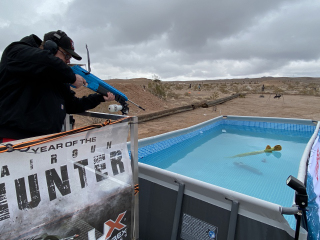
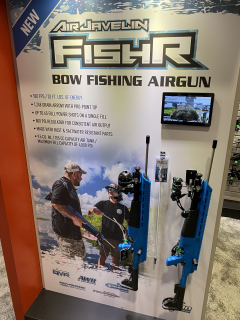
For media members it starts out with the Industry Day at the Range event the Monday before the show opens. At that event I was able to try out the new Umarex Air Javelin FishR. Taking bow fishing to the next level, Umarex altered their popular Air Javelin so it shoots a special, thick-shafted solid arrow and allows for attachment of your favorite reel. Also, to differentiate the FishR, its polymer body is molded in a bright blue. Umarex went above and beyond to show off their new FishR by bringing a 4,000-gallon swimming pool to the high desert shooting range used for Industry Day so it could be fired at a fake gar by participants. It will definitely appeal to those who cannot pull a regular bow set up for bow fishing and those who want to help eradicate invasive species in our waterways. Arrow-firing airguns also continue to be a growing segment as new ones were introduced by Hatsan and Airforce Airguns.

Other trending items found at the show were low price-point entry level PCPs being introduced by Crosman and Umarex. Crosman has taken their venerable Model 362 and recreated it in a PCP version to entice a whole new generation into the world of pre-charged pneumatics. Weighing less than four pounds with a reservoir that is easily filled via hand pump, along with the familiar lines of the 362 plus a $150 price point should help accomplish just that. Umarex brought out the Iconix, their entry-level PCP. Lightweight and easy to fill with a hand pump as well, this side-lever cocking repeater will retail under $200.

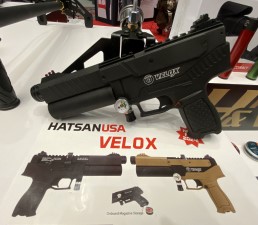
Some other items of note were a couple of high-power semi-auto PCP pistols from Korean manufacturer Evanix and Turkish manufacturer Hatsan. Interestingly, both pistols have names beginning with the letter “V” – the Evanix Viper and Hatsan Velox. Additionally, several companies released air rifles that incorporate the HPA reservoir into the barrel shroud. Eliminating an air reservoir under the airgun barrel or as part of the buttstock allows for a lighter and more “traditional firearm” look. This is anticipated to draw more firearms users into the PCP world who may otherwise be turned off by the look of modern air rifles. The Barra 250z and JTS StealthHawk are in this category.

Hatsan’s new semi-auto pistol

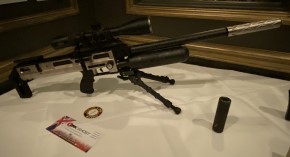
Another trend at the show this year that can be directly attributed to our friends at Airguns of Arizona is the expansion/proliferation of chassis systems and guns/accessories designed around long-range and benchrest shooting. AofA has been conducting the Extreme Benchrest competition for over ten years and my, how it has grown! It is said that imitation is the sincerest form of flattery so Robert and his team must be feeling very flattered as to how the sport has expanded the number of venues/competitions since the humble beginnings of the EBR.

Brococks are a favorite benchrest gun

Of course, many other new items related to our sport/obsession were on display at the show. Expanded lines of pellets and new slugs with high ballistic coefficients. More optics choices, including new thermal and night vision offerings, as well as a variety of red dots and even the first blue dot sight – said to be easier for the human eye to pick up and less fatiguing.

This time of year, thoughts can turn nostalgic for those of us that celebrate Christmas or had a birthday the last month of the year. Also, as an older American, perhaps I wax more nostalgically because I have such great memories that span more than six decades.  Of course, as an airgunner for a long time, many memories center around that interest/passion.

            The initial spark came for me as it did for many others with the Christmas gift of an air rifle when I was twelve years old. I don’t remember being a obsessive and insistent as Ralphie from “A Christmas Story”, however, I do remember pestering my folks and making my case that I could handle the heavy responsibility of gun ownership (and not shoot my eye out!). Believe it or not, I still have that original Daisy Model 1894 “Spittin’ Image lever-action BB rifle in my possession.

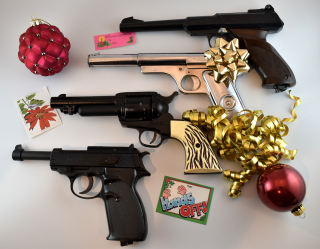
            A lot of airguns of all different ilk have passed through my hands in the ensuing years. I was fortunate enough to be able to add a number of them to my rather eclectic collection, including an old, nickel-plated Daisy Targeteer model. A spring-powered push-cocker pistol in .118 caliber (lead shot size #6) made at the Plymouth, Michigan plant between 1937 and 1952. The .118 caliber shot produced by Daisy was actually copper-plated steel shot and, of course, is no longer available. In 1957 Daisy updated the model to a BB (.177) caliber having walnut-looking plastic stocks with a thumb shelf. That model was produced until 1978. I have yet to shoot this Targeteer even though it is in remarkable shape with the exception of missing the rear sight. One of these days I will buy a box of shotgun shells containing #6 shot and cut one open for the ammo and give it a try. In the meantime, I am happy enough to have it as a wall hanger.

The antique Daisy models

            Another Daisy I acquired sometime in the late ‘60s was the CO2 200 model. My first CO2 powered acquisition, it was a sleek, semi-auto “James Bond” looking number modeled after the Colt Woodsman. James Bond movies were incredibly popular during this time and with this model you could fancy yourself an international spy while shooting it. Made between 1963 and 1976, I remember it being quite a shooter, although it hasn’t been charged up in years, so most likely will need some TLC to bring it back to shooting shape. Someday…

            Next up is the “Hahn .45”, a garage sale purchase that I snapped up for a song and it was even in a leather holster! An 18-shot single-action CO2 BB firing copy of the famous Peacemaker made by P.Y. Hahn and then Crosman as the Crosman 45, from 1958 to 1970. It was quite the coup. It closely resembled the Peacemaker in weight and came equipped with cool looking replica staghorn plastic grips. Although I’ve never attempted to fire it, someday I will – “when I have time” – to get into it and replace the seals I’m sure it needs. Ahh, the wishful thinking of an amateur airgunsmith.

            One last antique BB gun item to share is the Crosman Model 338 Auto in my collection. In the “Golden Age” I grew up in there were plenty of great war movies and Westerns on the big screen. Those movies showed me the Colt Peacemaker and Walther P38, both of which I found fascinating. So, those were must haves to add to my collection “someday.” As luck would have it, I came across this CO2 pistol in another garage sale and it became mine after giving some paltry sum that I can’t even recall at this point. A close copy of the famed Walther, only the winged piercing screw protruding out of the bottom of the grip gives it away as an air pistol. Again, it went into the collection without an attempt to fire it as, even though it appeared to be in very good shape, I was fairly certain it would need a reseal job. Alas, one more project gun to get to   “when I find the time.”

The antique Crosmans

So, the upshot of this trip down Memory Lane is to trigger (pun intended) some memories in you, dear reader, to recall warm thoughts of a favorite airgun from years past. Keep in mind our friends at Airguns of Arizona also have a webpage of pre-owned airguns for sale where occasionally a vintage item may show up so be sure to check there often if you are looking for that special airgun that will give you great memories down the road. Warm Wishes to all of you during the holidays and All the Best in the coming year!

Ahh, memories…

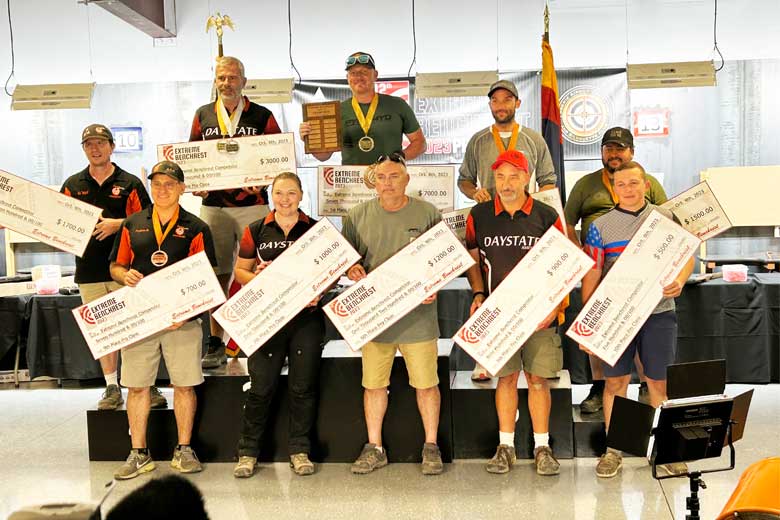
Daystate Dominates Overall At EBR 2023

While Extreme Benchrest is an “open” event with very many air rifle brands represented, there’s no doubt that Daystate air rifles dominated at EBR 2023!

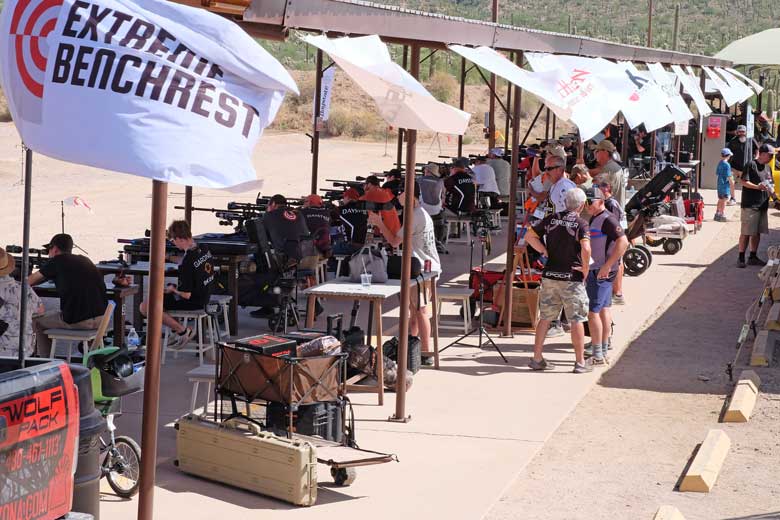
Some competitors shooting Daystate – and BRK (Brocock) for that matter – were part of the official “Daystate Wolf Pack”. That’s a group photograph of the “Wolf Pack” above, together with the company owner (center rear) and designer (far left).

But many other Daystate shooters were genuine enthusiasts who have made the brand their choice. That’s a testament to the quality, accuracy and consistency of the company’s products!
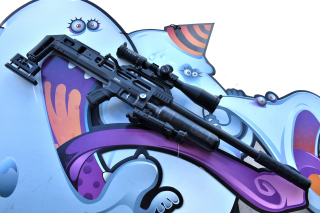
Now, on with the results…


100 Yard Extreme Benchrest Pro Class Finals

Daystate Dominates Overall At EBR 2023

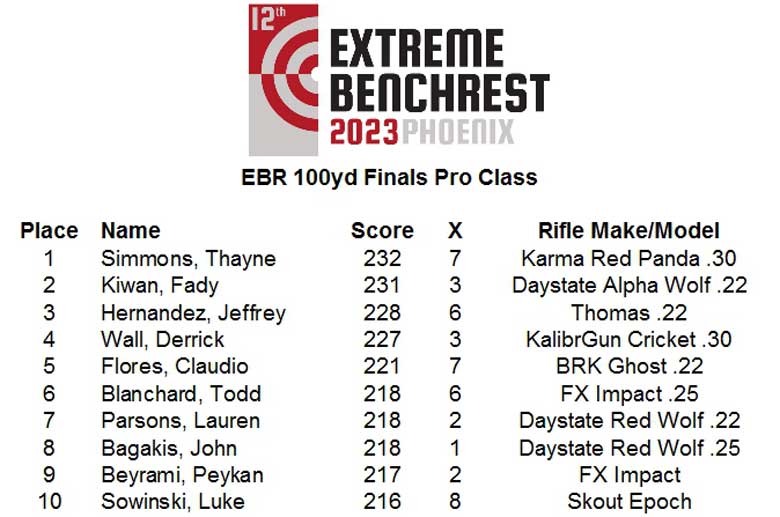
Thayne Simmons won the headline Pro Class 100-Yard Extreme Benchrest 2023 competition. Shooting a Karma Red Panda air rifle, he scored an impressive 232 7X. Above we see Thayne with his prize, which included a $7,000 check, plus an expense-paid trip to Daystate in England to collect the Daystate Air Rifle of his choice.

Daystate Dominates Overall At EBR 2023

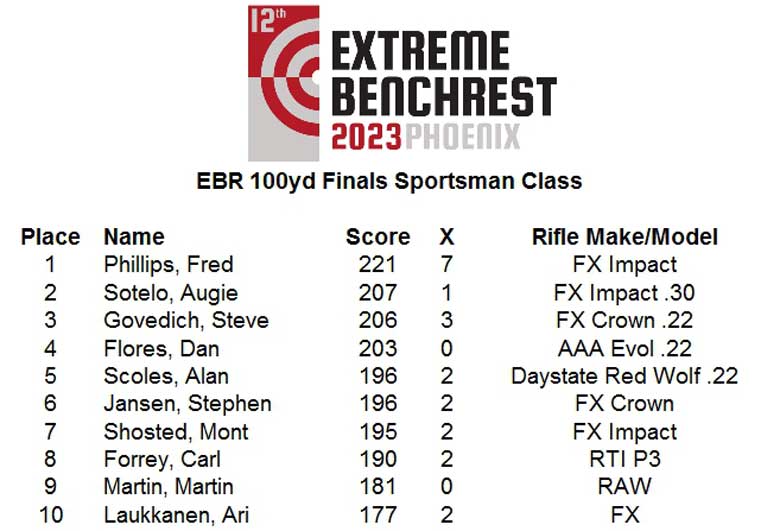
100 Yards Extreme Benchrest Sportsman Class Finals

100 Yards Extreme Benchrest Sportsman Class Finals

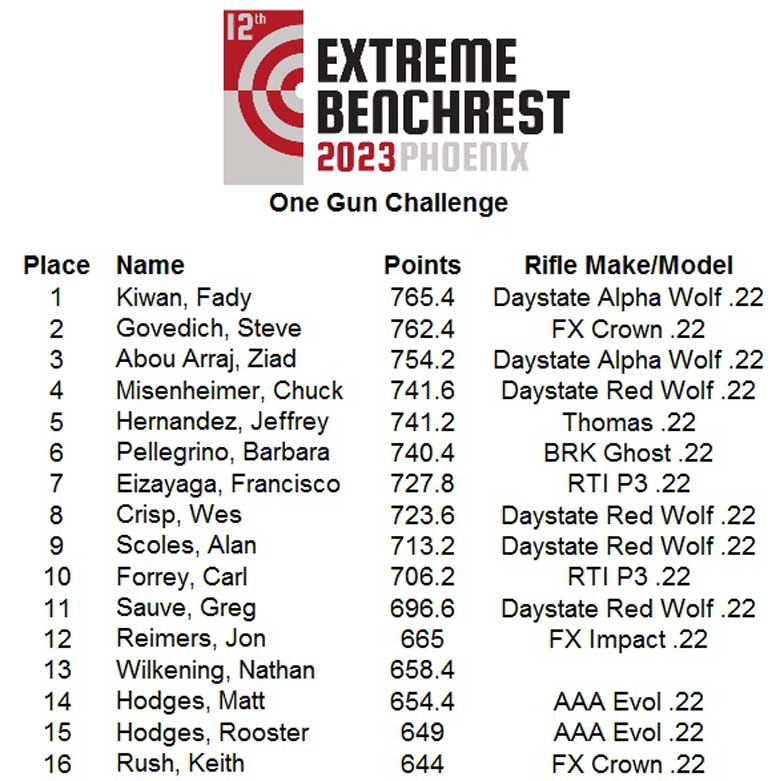
One Gun Challenge

The One Gun Challenge rewards the competitors who use the exact same air rifle for competition in (almost) all courses of fire in the EBR event. Almost? Well, yes, not including Big Bore, of course!
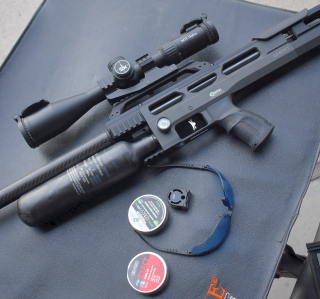
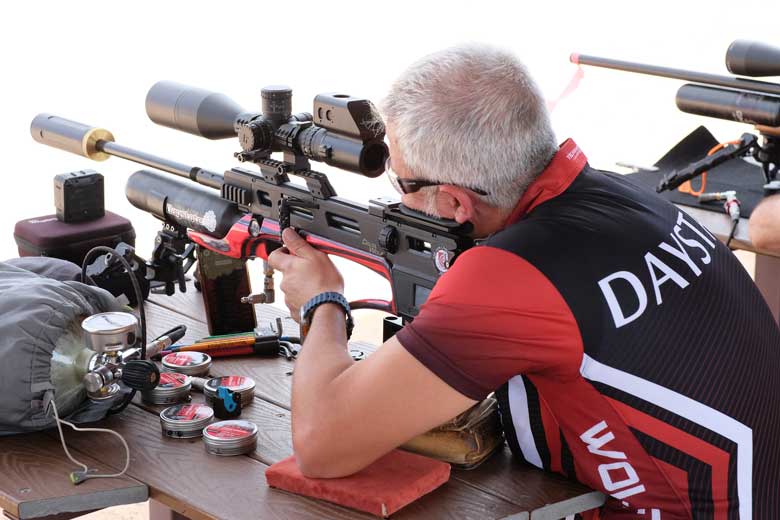
Fady Kiwan from Lebanon won this most challenging title shooting a Daystate Alpha Wolf in .22 caliber. That’s Fady shooting. below.

Daystate Dominates Overall At EBR 2023

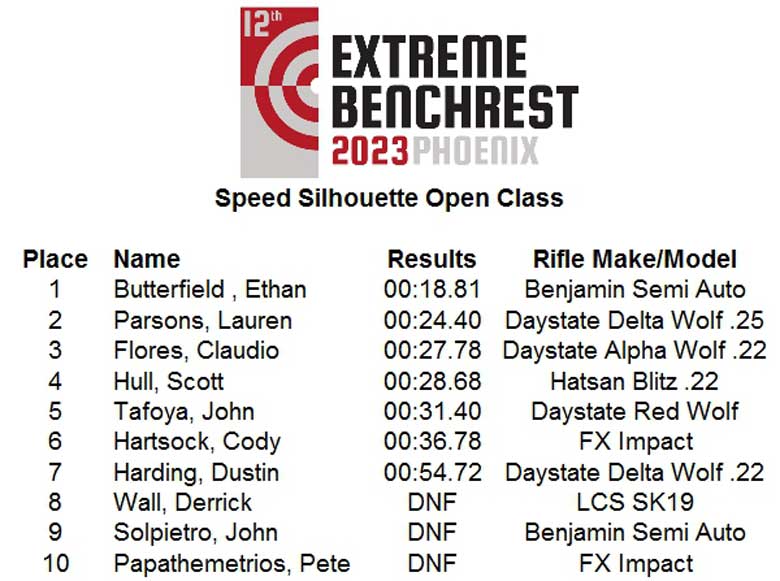
Speed Silhouette Open Class

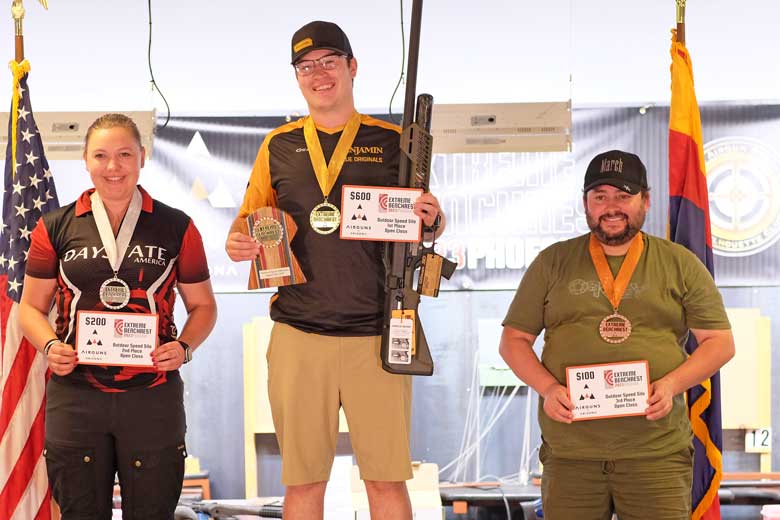
This class is “anything goes”! Magazines are loaded and installed before firing commences. Semi-autos are included, too. Here the class was won by Ethan Butterfield, shooting a Semi Automatic Marauder with a record time of 18.81 seconds. That’s the first time ever that this class has been won by a semi-auto!

But Lauren Parsons was close behind shooting a .25 caliber Daystate Delta Wolf, while the 2018 100 Yard Extreme Benchrest winner Claudio Flores was third with an Alpha Wolf in .22 caliber.


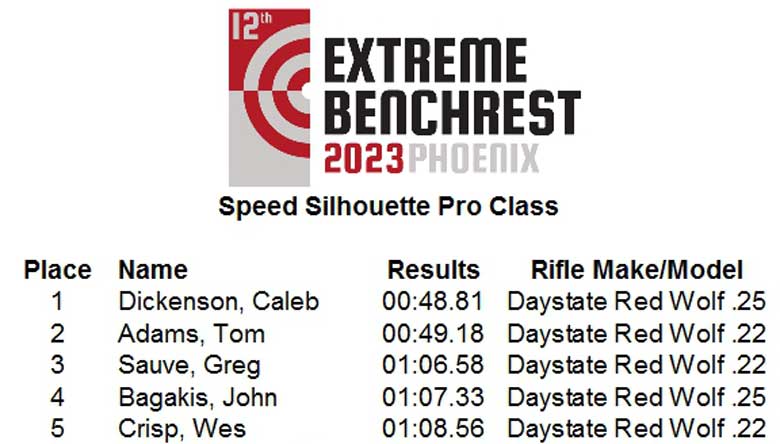
Speed Silhouette Pro Class

This class really was dominated by the Daystate Red Wolf!!!

Meanwhile, Don and Larry in the AoA mobile support van were in “Maytag Repair Man” mode 🙂

Daystate Dominates Overall At EBR 2023

Speed Silhouette Sportsmans Class


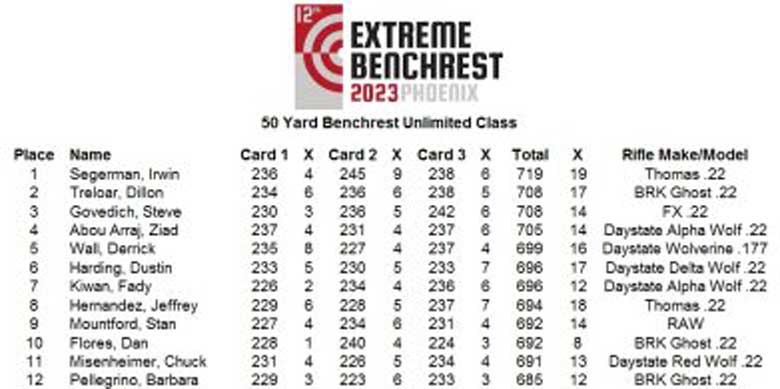
50 Yard Benchrest Unlimited


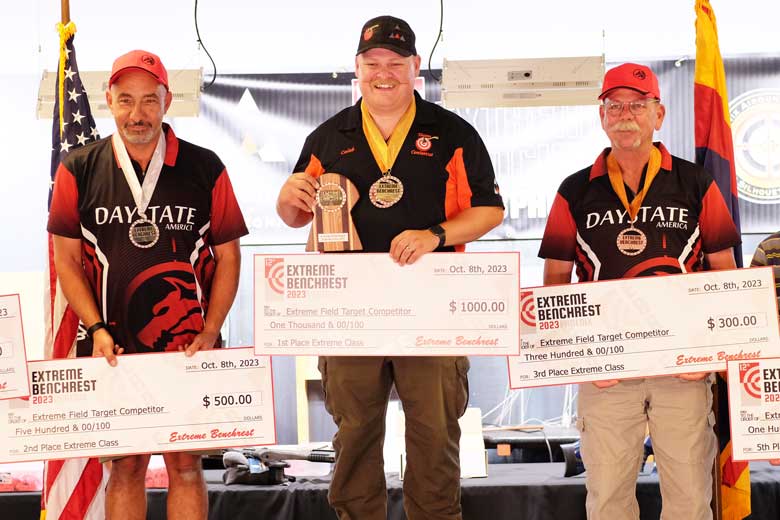
Extreme Field Target Extreme Class

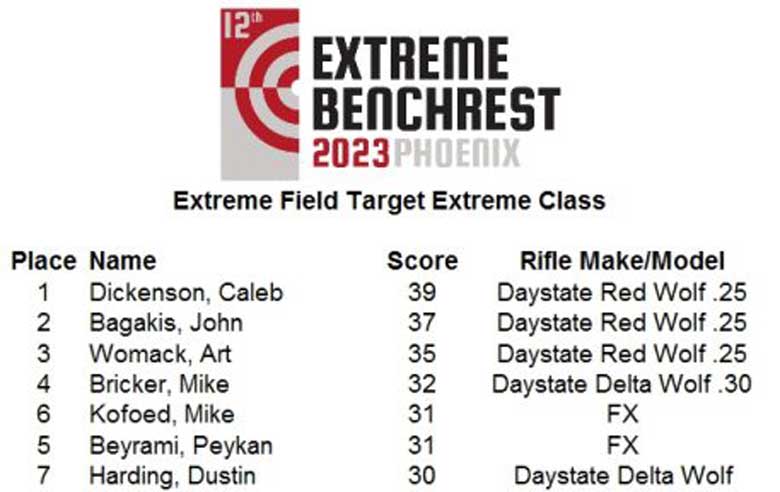
Again, another outstanding result from Daystate shooters!

Daystate Dominates Overall At EBR 2023
Extreme Field Target Extreme Class

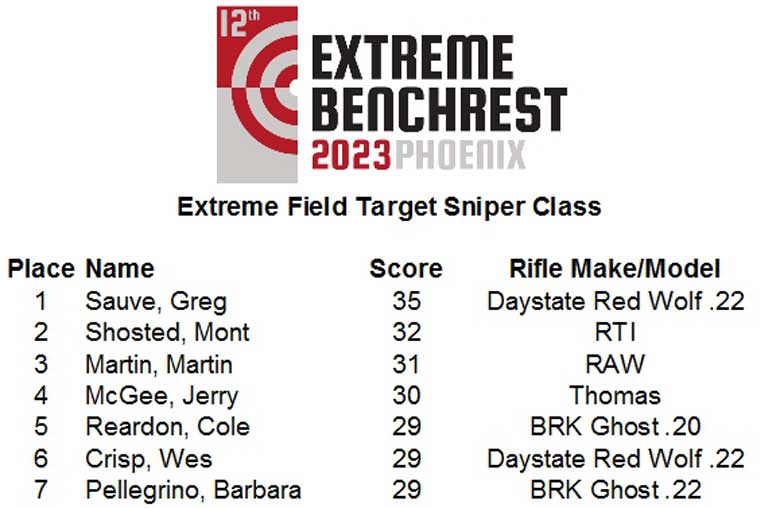
Extreme Field Target Sniper Class


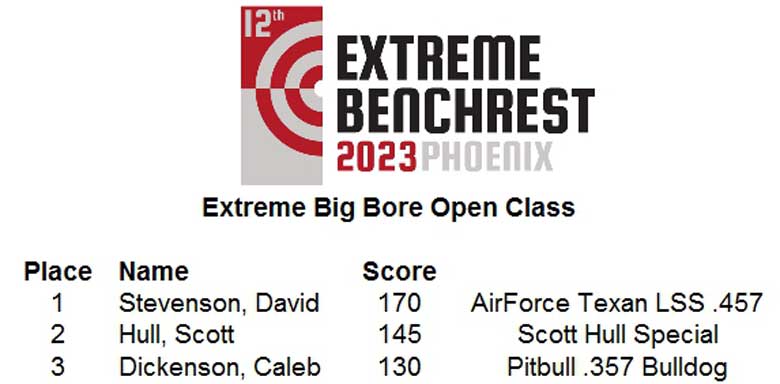
Extreme Big Bore Open Class


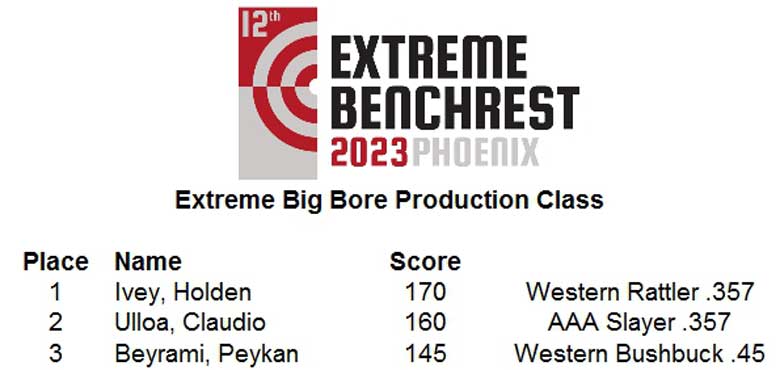
Extreme Big Bore Production Class


Congratulations to all the shooters who took part! It’s very interesting to see how the scores have improved with time. The shooters – and their equipment – are clearly getting better and better!

For something a little different in this blog I’ll begin by asking: If you shoot a PCP airgun, do you ever give much thought to that quick disconnect (QD) coupling, or fitting, you are trusting your well-being to every time you attach/detach that 4500psi High Pressure Air (HPA) hose? The answer, most likely, is probably not. And that is a good thing because modern airgunners must be doubly vigilant when pursuing our hobby. We are not only firing potentially lethal projectiles, but dealing with HPA as well – both inherently dangerous if all safety rules aren’t followed. So, if we don’t have to dwell too much on the QD fittings we are using, then we can concentrate on safely using our PCPs. Therefore, not having to give a second thought to the strength and lockup of that little coupling is one less thing to take away from the enjoyment of our hobby.

An extended QD needed by some PCPs
attached to a plug to quickly add to a line

               A little background into these indispensable items takes us back to 1915 when a man named Fred Hansen developed his first QD coupling. He produced them in Michigan under the Hansen Manufacturing Company and they soon became the industry standard. The name continues on as a division of Danfoss Corporation. Since they were originally invented by a man named Hansen, why do we generally refer to them as Foster fittings? That’s because there is a Foster Manufacturing Company out of Missouri making these couplings that are commonly used by the airgunning community. In business for over 30 years, they are now known as ZSI-Foster and part of Ideal Tridon Group. There are at least 15 other U.S. manufacturers that make these couplers and many more overseas companies producing them as well.

               They are a fast, accurate and secure way to repeatedly connect/disconnect just about any fluid line, but what makes them so effective?  There are three basic types of QDs, a Single Shut-off, Double Shut-off and Straight Through, with the Straight Through being the type used for airgunning. It is relatively easy to manufacture as it doesn’t contain any internal valving like the other two types. That means that with a ST type, some sort of manual shut-off and purge valves must be in the line to safely disconnect from the supply. The ST types can be made for less cost and handle pressures in the range of 1000 to 5000psi in the stainless-steel versions. There is also less pressure drop due to the lack of internal flow obstructions. Within the ST type connectors there are two styles, a Push Style and Sleeve Style. The Sleeve Style being more dominant because it is less costly to produce, is slightly more compact in size and its safe, strong operation. The QDs in airgunning application are considered miniature due to the 1/8-inch diameter of the plug.

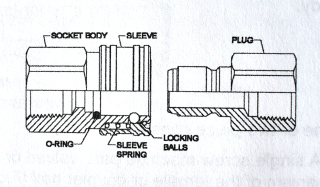
Diagram of a Straight Through QD coupling

Obviously, they are comprised of two parts, the male plug (or nipple or tip) and the female socket (or coupler or body) which contains the locking mechanism. The objective is to provide a positive method of retaining the plug in the socket while minimizing the effects of pressure in the system. And, while there are at least ten locking methods or devices used in the fluid handling industry, the Ball lock is the most common and the one used in a Foster fitting. The Ball lock is relatively easy to manufacture and reliable as well as having good swiveling characteristics along with load distribution capability. The Ball lock is made up of a series of hardened Carbon, Chromium or Stainless steel balls arranged radially in a ball cage inside the socket body. A spring-loaded sleeve covers the balls to keep them contained and recesses on the inside allow the balls to move out of the way when the sleeve is retracted and the plug inserted. Releasing the sleeve forces the balls to lock into the plug groove to complete the connection. For HPA use the female socket should contain six locking balls for the most secure lockup, as do the Foster and Hansen connectors. They are also made in brass but keep in mind that brass cannot handle the higher pressures that the steel QDs can.

A view of the locking balls held in place by the sleeve

               Like anything in your kit, visual inspection for excessive wear, metal galling or corrosion needs to take place regularly to stay safe. The same is true with your hose connectors. Keep safety in mind and that way you can enjoy this sport for a long time to come.

               Sort of like Hiram Maxim and his invention of the silencer, pieces of engineering genius over 100 years old makes airgunning a more enjoyable endeavor today.

The Ghost HP is definitely worth a second look (as in Part II) because it is a piece of elite airgun engineering that should appeal to a myriad of enthusiasts within our hobby. To the folks that like high-powered, heavy-hitting air rifles for hunting medium-sized quarry, it certainly fills the bill with an output of around 70fpe in the .25 caliber. Plus, it is also offered in a .30 caliber configuration (always a bit of a dichotomy in my mind as the Ghost is produced in England where our counterparts are limited to a measly 12fpe to avoid having to jump through government hoops, so the majority of these beasts are shipped to other countries.) For the folks that have become enamored with all the new airgun slugs hitting the market, read on as I share some excellent accuracy results with the Ghost HP. Those that are interested in long-range/extreme benchrest shooting should definitely give serious consideration to this platform. And, while I’m not a Field Target guy, with its tunability, I’m betting FT folks would find it fits their needs very nicely as well.

In Part I, a negative I pointed out was the loud report even though the barrel is shrouded. Of course, the muzzle is threaded so aftermarket suppressors can be installed. However, that adds additional muzzle weight and barrel length which kind of defeats the purpose of a bullpup configuration. Also, while the long, skeletonized cocking knob is a nice feature, I found it too long as it interfered with getting to the crossbolt safety. Also, while the toe of the buttstock did provide a two-slot picatinny rail for attachments such as the Adjustable Bag Rider or a monopod, I would like to see that expanded with additional slots. Plus, attaching a device to the toe of the stock precludes adjusting the sliding buttpad. And, as also mentioned in Part I, in order to use the nifty feature of “twinning” a pair of magazines it requires the purchase of a “lift” for the cheekrest to clear the magazine opening on each side of the gun. Perhaps I sound nit-picky because all of these perceived issues taken together would not constitute a deal breaker as there are just too many positives with this airgun. Additionally, many folks out there are into modding and will take the basic gun and make it their own thereby alleviating or circumventing these things I noted.

Now on to the positives. I had experienced Brocock offerings in the past and knew they could really deliver. The Ghost has one of the smoothest actions you’ll come across. My sample Ghost had been through other reviewer’s hands so I can’t say for sure if the trigger had been adjusted, however, at an average trigger pull of 2 pounds, 11.3 ounces, it worked just fine for me and I left it alone. Since I was mostly shooting from a bench, the 0dB Magnum suppressor I added worked like a charm and made the Ghost even more pleasant to shoot. The MTC King Cobra optic was an excellent pairing with the Ghost if you are in the market for a new scope. Adjustable Bag Rider now makes a lower profile/lighter version that I attached to the toe of the buttstock for long-range work.

While I chose not to play with the HUMA regulator adjustment as it was set at 1900psi and logically, the power wheel can dial down the power level to 60% so I didn’t see the need. I started out with pellets, shooting at 25 yards. The Ghost HP appeared to like the variety of domed pellets I fed it, providing excellent accuracy. The best of the lot, resulting in a single, ragged hole, was the JSB Exact King Heavy 33.95 grains. They averaged 917fps at power wheel setting 15 with an extreme spread of 8.9 and standard deviation of 3.8 yielding an approximate 63fpe knockdown power. Predator Pellets also made a very good showing with their Polymag polymer pointed tips at 26 grains averaging 1004fps and developing 58fpe with a standard deviation of 12fps. For those needing or wanting to shoot lead-frees, Predator’s GTOs at 16.54 grains yielded excellent accuracy as well, zipping along at a brisk 1137fps and having an extreme spread of only 7.9fps. At that velocity they naturally increase the bark of the Ghost HP, even with the silencer onboard. Keep in mind the power wheel setting of 15, so there was room to experiment with even faster speeds and find the point of diminishing returns.

Great little grouping of five shots

               Three different slugs were used with the Predator Knock-Outs at 34 grains coming out on top, with another single, ragged hole. They averaged 903fps with an extreme spread of 16, yielding 62fpe. Next came H&N Slug HPs at 36 grains, averaging 875fps with an ES of 15.5 and FPE of 61. The last slug in this series was from Apollo pellets – their Slug HP at 33 grains. The accuracy was good, easily enough for hunting applications and they averaged 916fps with an ES of only 5.4 and SD of 2.2, so they gave great shot-to-shot consistency. It yielded an average FPE of 62. Alas, so many pellets and slugs out there and so little time…

I was able to spend a short amount of time at the 100-yard range before bad weather shut me down and was close to zeroing in the Knock-Outs. It gave me confidence this combo would be an excellent competition rig, which I plan to test further.

I get to experiment with a lot of airguns and I have to say that shooting the Ghost is a truly pleasurable experience.  The range and ease of adjustability coupled with the smooth cocking effort and flip-open magazine loading, and of course, the accuracy out to at least 100 yards; it’s no wonder this Ghost series has built such positive energy in a short period of time.

Ready for some Ghost-ly fun

If you ain’t afraid of no ghosts (apologies to the movie “Ghostbusters”) then don’t let the thought of missing out on owning a Ghost “haunt” your dreams.  Get over to AofA and let them help you trap your own Ghost.

An interesting moniker for an air rifle – Ghost – however, that is what Brocock, now rebranding as simply BRK, chose to name this hard-hitting and accurate piece of kit (as the Brits would say).

Do you believe in Ghosts?

A bit of a departure from previous Brocock offerings, it is a bullpup configuration that was inspired by sister company Daystate’s Alpha Wolf. Three models are offered, a High Power (HP) version sports a 23-inch Lothar-Walther barrel and comes in at an overall length of 33.6 inches, a Carbine with 17-inch barrel and OAL of 26 inches, and the Plus, also with a 17-inch barrel but OAL of 29 inches. The Carbine is fitted with a 300cc under barrel air bottle and weighs in at 6.8 pounds and the Plus comes with a 480cc bottle and weight of seven pounds. Either model is available in .177 or .22.  Because we yanks tend to like a bit more power (just joking; we like a lot more power) and generally aren’t restricted on this side of the pond, the HP model is offered in .177, .22, .25 and, a first for Brocock, .30 caliber. Its bottle is also a 480cc and the weight a hefty 7.5 pounds.

The fill for the air bottle is 250 bar.  A Huma regulator is built in and can be adjusted up to 200 bar. The regulator pressure can be raised on-the-fly, but lowering the pressure requires removal of the bottle and dry-firing until the regulator/plenum is empty. The bottles contain their own valves so will retain th fill.

BRK loaded the Ghost with additional goodies including:

  • A picatinny scope rail with 20 MOA downward tilt as well as the ability to move the entire rail anywhere along the top of the receiver’s 11mm dovetail grooves for perfect scope eye relief
  • Additional short pic rails on either side forward of the receiver and short sections on the bottom and toe of the buttstock.
  • The buttplate is vertically adjustable for ease of fitting to the shoulder pocket
  • A fully adjustable two-stage match trigger
  • Easily swappable barrels and probes
  • A power adjustment wheel giving 20 micro adjustments to the hammer spring
  • A cocking handle that can be quickly switched to the other side as can the cheekpiece, making the Ghost truly ambidextrous
  • A carbon fiber shroud ending in a threaded muzzle

The magazines are a breeze to load with the face of the mag being a door held shut by powerful magnets. The .25 mag holds 10 rounds and is deep enough to handle longer pellets and slugs. There is no empty mag stop so it is easy to mis-count and fire an empty mag, and care must be taken to avoid double-feeds. The cheekpiece that comes with the rifle is curved and will dictate which side the mags load from based on whether it is set for a leftie or righty. “Twinning” is the Brit term for placing a second mag in the mag well opposite the first mag. They have powerful magnets in their bases to keep both secure. After emptying one, the “twinned” mag is pushed into place to continue firing. This requires not only a second magazine but also a different cheekpiece at additional cost.

I did find it a bit on the heavy side for a minimalist-styled bullpup and the MTC King Cobra optic added another 26 ounces to the package. Speaking of the Cobra, it’s a First Focal Plane scope and excellent match-up for the Ghost with its ability to magnify from 6-to-24 power and its 30mm tube with a 50mm objective bell for additional light gathering capability. Its clarity is as good as scopes in much higher price ranges. The magnetic flip-up lens covers are convenient and the ocular bell cover contains a rectangular magnification window so the shooter can see the elevation turret setting by just lifting the head slightly. The reticle is a multi-stadia “Christmas tree” type called the SCB2 (Small Caliber Ballistic 2nd Gen.) Marked in ½ mils it is extremely easy to use and the reticle center has six different intensities of red illumination. Additional niceties are locking turrets providing one click = one centimeter at 100 meters and which are resettable to zero once sighted in. My only negative comment is the parallax adjustment was extremely tight so my old, arthritic fingers had some difficulty adjusting it. Probably just this particular scope, however, I believe a large focus wheel is available from AofA which would eliminate that concern. The parallax adjusts from 15 yards to infinity making it an excellent choice for airgunners.

Got air?

One minor negative — the Ghost is on the loud side. However, BRK equipped it with a threaded muzzle so it’s easy to add one of AofA’s silencer offerings. I attached the 0dB Magnum purchased from them last year. Actually a .30 caliber moderator, the Magnum did the trick nicely on this .25 Ghost and makes it “backyard friendly” at the expense of adding 7.4 ounces and 7.6 inches to the end of the barrel. Smaller, lighter and less expensive models found on the AofA website should work equally well.

Pricing on the Ghost runs $2200 for any of the available models and they are warranted for three years. An extended female QD connector is supplied with the rifle, along with Owner’s Manual and extra O-rings, and it comes in a black hardside carrying case. Also included are the target and chrono results of five shots. The King Cobra at $630 has a lifetime warranty against defects. The 0dB Magnum runs $269 and for those doing long-range work with the Ghost HP, which it is well suited for, the short picatinny rail on the toe of the stock is perfect for attaching a Long Shot Precision Adjustable Bag Rider. The Universal Rail Mount ABR is available for $270.

A genuinely nice package indeed and a joy to shoot. More on my results in Part II next month.

Ready for some serious long-range work…
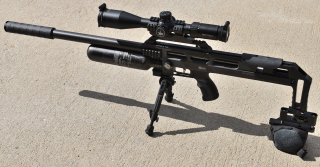
The Daystate Delta Wolf with ABR and LSP Small Bag

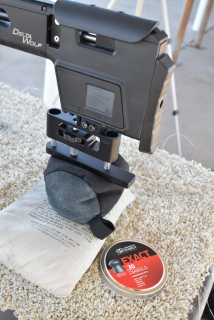
A recent addition to the extensive stable of goodies for the serious airgunner available from AofA is the Adjustable Bag Rider. Airgunners, like powder-burner shooters, have always tested the extreme boundaries of what their guns will reach out to. This pursuit led to the relatively recent long-range/extreme benchrest competitions now taking place around the country. A gentleman named Dave Pobutkiewicz, was already making his ABR to fit long-range firearms through his company, Long Range Precision, and finding success in that arena. He holds five patents or patents pending on his inventions which are completely made in the U.S.A. of 6061 aluminum; anodized black and weighing 12-14 ounces. Designed to eliminate the inconsistencies in vertical shot strings due to squeezing shooting bag rests, the ABR provides minute adjustments by turning its glass-smooth thumbwheel. On his own firearms, Dave has achieved one bullet diameter vertical adjustments at 300 yards with the ABR. Somewhere along the way his attention was directed to the potential for use with air rifles so Dave adapted his designs to work with several current air rifle stocks having picatinny rails located at the heel of the stock. Three models with a picatinny rail mount on top are currently being produced; one of which will fit current production air rifles listed on the ABR website and AofA currently carries two models.

               The sample ABR reviewed here is the Universal Rail Mount with Short ELR Adjustability (Short dowels). It was easily and quickly mounted to a .30 caliber Daystate Delta Wolf air rifle and the mounting screws were torqued to the recommended 18 inch-pounds. Along with the ABR, Long Shot Precision also sells the shooting bags for use with it. A choice of a “lite” fill weighs approximately 13 ounces, or sand weighing approximately 32 ounces is an option. In actual use it worked just as Dave has indicated. Minute elevation changes were possible once the rifle was situated on the provided LSP Small Bag and was stable. The adjustments were effortless thanks to the expert machining of the unit. Dave is particularly proud of the fact that none of his units have been returned by customers and that many customers own more than one ABR.

               This particular model of the ABR sells for $270 and the Small Shooting Bag sells for $50. If you are into long-range/benchrest, or considering it, and have rifles with buttstocks that accommodate attaching an ABR, you should get in touch with AofA regarding these units.

Long Shot Precision’s Adjustable Bag Rider