Posts Tagged ‘spring piston’

Shooting The Diana 54 AirKing Pro

The Diana 54 AirKing Pro is the latest version of a long-running classic. It’s a great buy for the airgunner wanting an unusual spring/piston air rifle.

At a price of $740, the AirKing Pro in its beautiful red laminate stock is near the top end of the pack for a spring/piston air rifle. Also it’s far from a new design, the Model 54 has been around for many years.

Yet this remains an outstanding air rifle. It’s powerful, the test gun delivered great accuracy with a wide variety of pellets. And it looks beautiful!
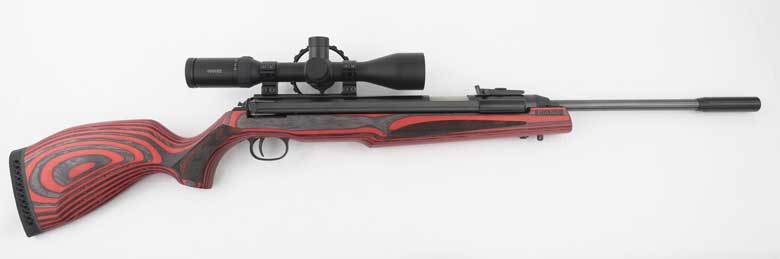

If you can bear to do without the red/black laminated stock and will settle for plain beech, the price falls to $660.

The Diana 54 AirKing Pro I tested proved to be both powerful and accurate in .177 caliber. You can compare the results I obtained to those for the .22 caliber gun tested some time back by Gordon Smith.

Muzzle Velocity peaked at no less than 1269.01 FPS with the lightest Predator GTO alloy pellets. They were accurate, too.

Maximum velocity with lead pellets was achieved with the 7.0 Grain RWS Hobby pellets. But accurate, they were not!

Underscoring the AirKing’s power, most of the pellets I tested pellets equaled or exceeded 1,000 FPS: the only exception being the heavy – 10.65 Grain – Baracuda Match pellets.

Such Muzzle Velocity numbers produce a high Muzzle Energy that’s around 19 Ft/Lbs for the majority of typical mid-weight lead pellets. The highest Muzzle Energy was delivered using H&N Field Target Trophy pellets. In this case, no less than 19.54  Ft/Lbs was achieved.

That’s well above the manufacturer’s claim and very strong performance for any spring/piston air rifle in .177 caliber. It was also very close to the maximum power of the .22 caliber model. That is a surprise!

Equally impressive is the ability of the Diana 54 AirKing Pro to provide great accuracy with a wide variety of pellets. This is not a “pellet picky” air rifle. Overall, the best accuracy was achieved using 8.44 Grain JSB Exacts, although others were very close.

Sub half Inch groups for 10 shots at 25 Yards are easily possible!

Shooting The Diana 54 AirKing Pro

The T-06 trigger delivered a very light pull weight. It was also extremely consistent, varying almost imperceptibly from 1 Lb 2.3 Oz to 1 Lb 3.9 Oz. The average was 1 Lb 2.9 Oz, as measured using a Lyman digital trigger pull gauge. That’s perfect for all practical purposes.

As is the case with most spring/piston air rifles, the Diana 54 AirKing Pro is not fitted with a shroud or moderator. With mid-weight (~ 8 Grain) or heavier lead pellets, noise level was judged to be as expected. That’s fairly loud: marginally backyard-friendly if your neighbors are not too close.

Needless to say, the light alloy pellets caused the gun to sound like a .22 rimfire! Their very high Muzzle Velocities exceeded the Speed of Sound (approximately 1100 FPS) and therefore caused a loud sonic boom. You will not want to try this in your backyard with others around and no ear protection!

This is not a complaint about the AirKing Pro as such. However it’s typical of high-powered .177 caliber air rifles when used with light pellets – even if they are fitted with silencers.
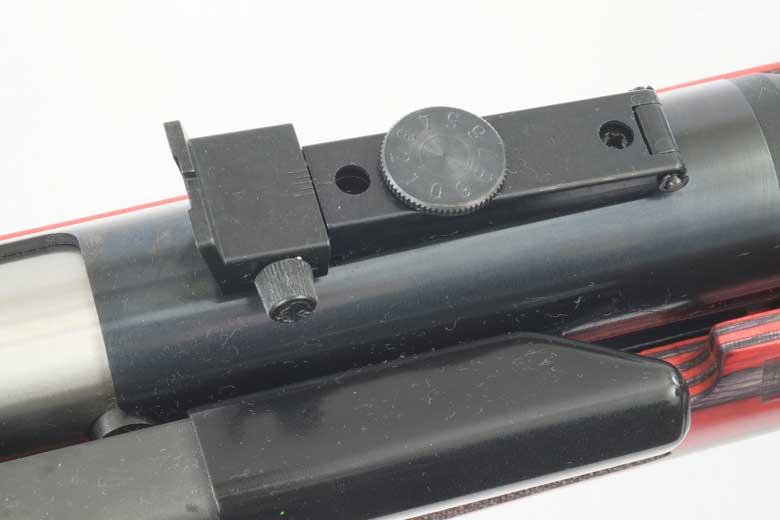
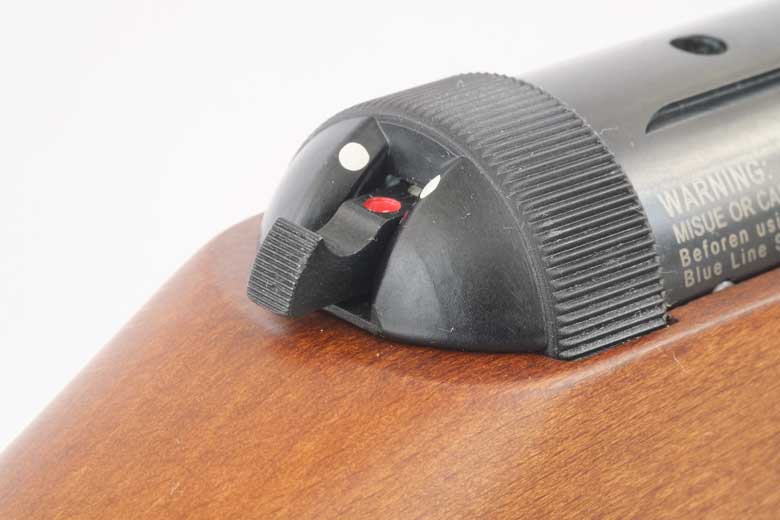
If you want to go “old school”, the Diana 54 AirKing Pro is supplied with a set of traditional open sights. The rear sight has click-adjustable elevation and windage correction capability. The front sight provides additional elevation adjustment by including a dovetail-mounted front post that slides along an inclined ramp.

Are there fiber optic inserts on these sights? Definitely not! Traditionalists will be happy about this, too.
Shooting The Diana 54 AirKing Pro

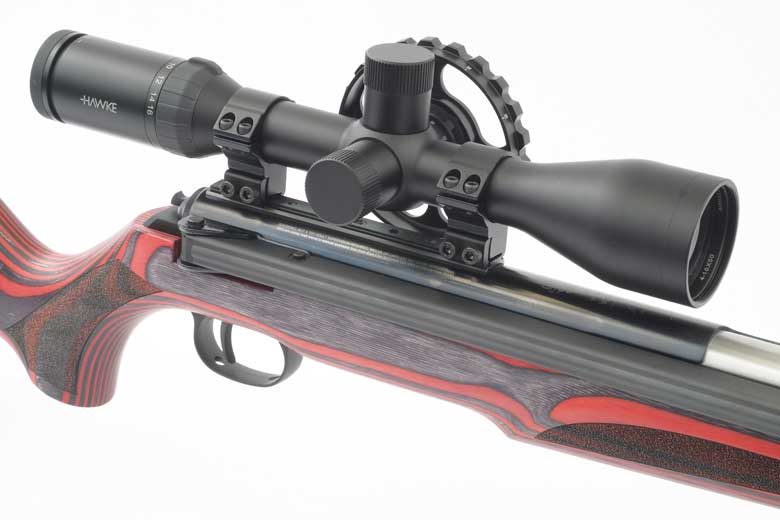
For this review, I installed a Hawke Airmax 30 WSF 4-16 x 50 riflescope. This was mounted onto the AirKing Pro using a solid pair of Hawke Match Ring Mounts.
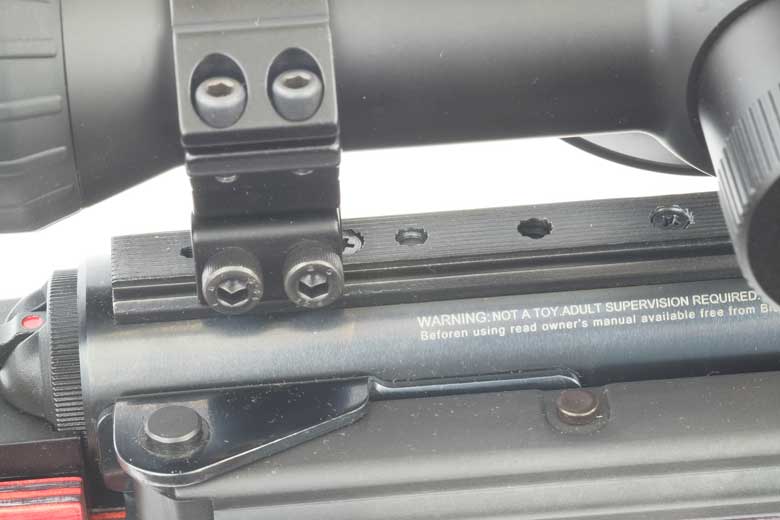
In spite of the Diana 54’s reputation for fierce action recoil, the scope stayed in position correctly for the whole review period (and more). The Hawke scope also showed no ill effects from the AirKing’s recoil.

Overall, this was a very successful pairing of scope and rifle. At 13 3/4-Inches long, this scope was about the maximum length that will fit on the gun without interfering with access to the pellet-loading port.

Yes the Diana 54 AirKing Pro is heavy. With the Hawke scope mounted, the gun you see here weighs-in at no less than 12 Lbs 7 Oz. So this is an air rifle that requires a strong – and probably also large – shooter.

However the weight balances well for off-hand shooting. In some ways the weight even makes the gun easier to shoot as the weight seemed to dampen natural operator wobbles – at least for me.

But now a word of caution…

The fixed barrel, sidelever action of the Diana 54 AirKing Pro requires the shooter’s fingers to be inside the open, sliding breech to load pellets. This is just as it has always been with every sidelever springer!

Yes, the Model 54 is fitted with a mechanical anti-beartrap mechanism plus automatic cocking lever safety and that automatic trigger safety. However every knowledgeable airgunner ALWAYS loads these guns with his/her arm between the open cocking lever and the body of the gun. This is to provide additional protection should – by some unpredictable mischance – the action suddenly slam forward during loading.

To be fair, I have never heard of this happening with a Model 54. But if it did, the result would definitely be immensely painful and likely result in the loss of fingers!

Shooting The Diana 54 AirKing Pro

So the Diana 54 AirKing Pro owner MUST learn to load this gun with care and with his/her arm in this “buffer position”. At first it can feel unnatural, but you’ll soon get used to it and do so. If you have any doubts, AoA’s experienced staff can help you out.

So if you’re in the market for a quality spring/piston air rifle – the Diana 54 AirKing Pro is great value for money – whichever caliber and stock you choose!

And did I mention that it’s beautiful???

It’s Still A Classic! The Weihrauch HW30S

The Weihrauch HW30S is a spring/piston air rifle air rifle that’s been available for many years. In fact, it’s no mistake to describe it as a classic break barrel airgun.

Yet it still sells strongly because this German-manufactured airgun offers outstanding quality. It combines this with great handling and is easy to shoot well. All at a very attractive price!

The HW30S is compact and is supplied with industry-leading open sights. It’s great for the whole family to use for plinking and informal target shooting.

Sure, it’s not a powerhouse hunting gun. But the limited power allows so many other positive attributes that most people will be happy to accept that and just enjoy the fun of shooting it…

It’s Still A Classic! The Weihrauch HW30S

Remarkably, the HW30S currently being sold by Airguns of Arizona for just $313.98. That’s outstanding value for money, particularly when combined with an amazing – for a gun of this price – limited lifetime warranty!

This price is really not so much more than that of many widely-available spring/piston or gas ram air rifles, yet the quality and shootability are “night and day” different.

So why is that?

Well, like all other airguns from the family-owned Weihrauch company, the HW30S doesn’t strive to attract customers with all the latest features and marketing buzzwords. There’s no “Zillion FPS” muzzle velocity claims, nor many of the other “bells and whistles” that are found on so many other breakbarrels.

Instead you have a simple, great-shooting gun that can provide tons of enjoyment for the whole family. You don’t have to be a body-builder to cock it, the weight is light and the recoil minimal.

The only downside is the relatively low Muzzle Velocity. Although that is precisely the reason for most of the other benefits…

With the Weihrauch HW30S we have a genuine case of “less is more”!

Most mid-range, domed pellets produced 615 – 640 FPS from the .177 caliber gun I shot. Typical Muzzle Energy is in the 7 – 8 Ft/Lbs range.

This is fine for plinking and informal target shooting out to about 40 Yards. But it’s not enough for ethical hunting use unless you’re an expert shot, the range very short and the quarry very small.

The best accuracy in my test was achieved by 8.64 Grain H&N Field Target Trophy pellets. However the HW30S was consistently accurate with a wide variety of pellets. It’s not at all “pellet picky” and that’s unusual.

Weihrauch triggers are always good. The HW30S I tested was no exception and was very pleasant. The trigger blade itself is metal, nicely-curved and ridged for good finger contact.

Touching the trigger brings a very light first stage into play. Then there’s a clear distinction with the second stage. Sear release is predictable and controllable. The average pull weight was just above 2.5 Lbs.

Cocking is smooth and quiet. There’s none of the roughness that sometimes afflicts springers. In fact the cocking action itself is actually very pleasant. There’s no whip or flexing in the action and the ball bearing lock-up is very positive and solid.

Cocking effort of the HW30S I tested peaked at about 24 Lbs. This would definitely be considered light or manageable by the vast majority of shooters. That makes the HW30 ideal for extended shooting sessions.

The relatively low muzzle velocity means that the HW30 is backyard-friendly, even with light alloy pellets. This makes it ideal for many airgunners whose range is in their back yard, garage or basement.

There’s no moderator, shroud or any silencing system fitted to this air rifle. But that’s because there’s no need for such equipment!

Weihrauch is one of the few airgun manufacturers which remain truly committed to open sights.

The rear sight has the expected click adjustment capabilities for windage and elevation. But look closer and you’ll see that this rear sight actually has a choice of four different sighting notches!

By pulling out and rotating the rear sight notch plate, you’ll find a choice of wide and narrow square notches, a V notch and a U-shaped notch. These are the perfect compliment to the interchangeable front sight elements – no less than six of them! – which are also provided with the HW30S.

That’s no less than 24 different combinations of iron sight configurations provided with the gun!

For my HW30 test review, I mounted a Hawke AirMax 4-12 x 40 scope using an one-piece mount. Such a scope would be a typical choice for many HW30 purchasers. It’s fairly light but has good optical quality and an Adjustable Objective (AO) for focusing down to 10 Yards.

Note that – if you order the scope and mount at the same time as the gun – AoA will carefully install and sight it in at no additional charge. That’s an outstanding free service !

At 12.9-Inches overall length, this is definitely the longest scope that it’s possible to mount on the HW30. Any longer and it would not be possible to break the barrel!

Even with the Hawke Airmax 4-12 x 40 scope mounted, the total weight of the HW30 was just 7 Lbs 3 Oz. That made it extremely easy to carry and hold.

The Center of Gravity was just where you want it: directly ahead of the trigger and in the natural position for the shooter’s forehand. So balance and handling were natural, neutral and easy to achieve. This was aided by the pleasantly-shaped ambidextrous buttstock.

With the low-mounted scope, I was able to achieve an excellent cheek weld against the stock, while the rubber buttpad gave a secure, grippy surface against the shoulder.

To summarize, the HW30 is a little air rifle that exudes quality.  Metal finish is exemplary, bluing is deep and even. The Italian Minelli stock is gracefully-shaped and has panels of sharply-executed checkering in the Beech wood.

Performance is outstanding so long as you can accept the limited power level available.

It also benefits from that outstanding limited lifetime warranty that’s fulfilled in the USA by Airguns of Arizona. That’s a huge benefit that shows that the quality impression is not just skin deep!

There’s A Surprise At AoA. The new Diana 34 EMS!

Although it’s not on the website yet, AoA has the new, versatile Diana 34 EMS in stock and available now!

So what is the Diana 34 EMS? It’s a new breakbarrel springer. The initials EMS in the name stand for Easy Modular System. The initials EMS in the name stand for Easy Modular System. The Diana 34 EMS series provides a measure of designed-in customization capability that’s unique for a breakbarrel air rifle.

The first products in the EMS system are four combinations of the basic air rifle. There’s wood and synthetic stocks available, both with a choice of .177 and .22 caliber barrels.

There’s A Surprise At AoA. The new Diana 34 EMS!

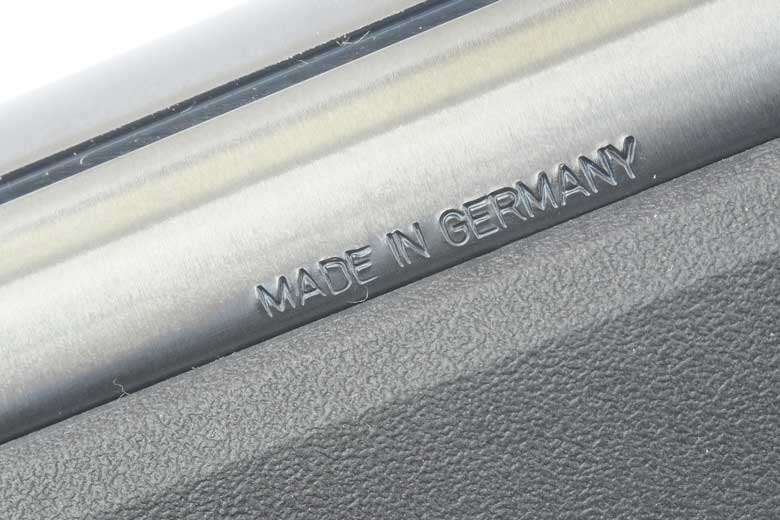
Diana afficionados will appreciate the fact that these 34 EMS series guns are a part of the company’s Performance Line. This means that they carry the prized wording “Made In Germany” on the compression tube.

There’s A Surprise At AoA. The new Diana 34 EMS!

There’s also the expected, classic two-stage T06 trigger assembly. This is adjustable for first stage travel, sear engagement and pull weight through setscrew adjustments.

The Easy Modular System allows for changeable sights and the ability to swap calibers. The base guns feature spring/piston powerplants, but Diana will be offering N_TEC gas ram conversion kits for those owners who prefer that.

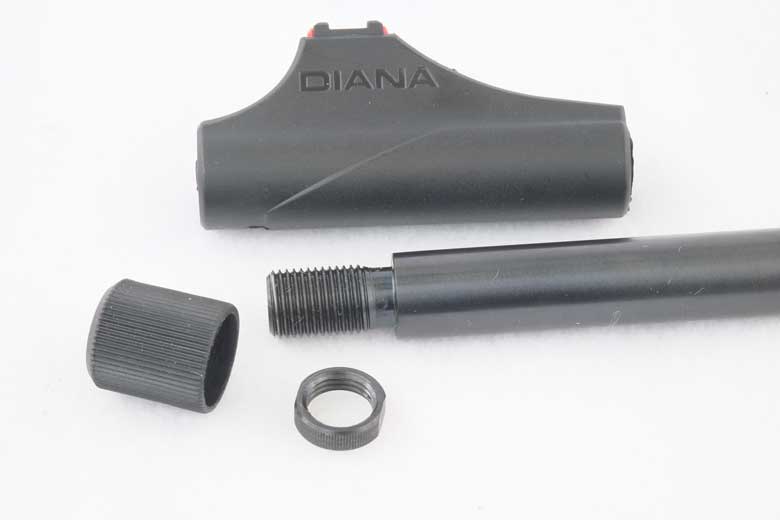
The front sight can be removed and changed, or a moderator added as required.

So the Diana 34 EMS series is a combination of tried and tested, classic design, coupled with some significant improvements. They’re mixed with a new level of customisability for a breakbarrel air rifle.

New to the Diana 34 EMS is an innovative shim system for counteracting barrel droop. Not only that, but it can be easily accessed and adjusted by the owner. Under the hood there’s also an improved cocking system, too.

There’s A Surprise At AoA. The new Diana 34 EMS!
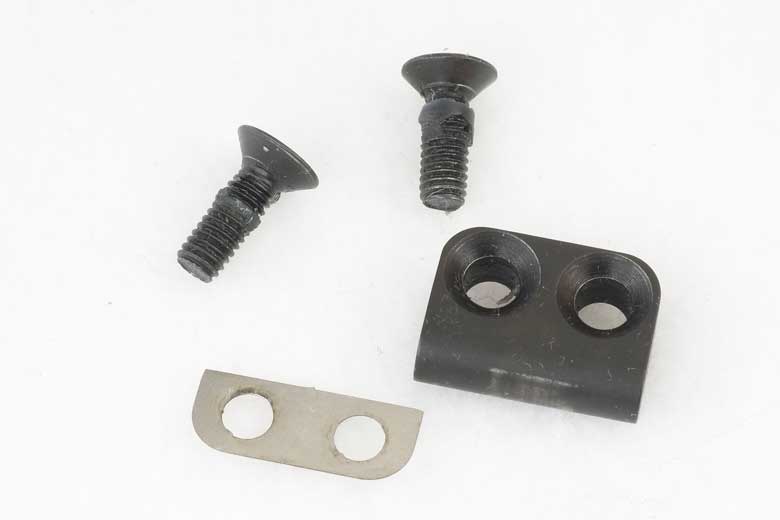
Remove these two screws to gain access to the barrel droop correction feature.

For many years, “barrel droop” has been a problem for breakbarrel air rifle shooters. Now Diana 34 barrel droop issues are a thing of the past with the new Model 34 EMS.

It’s the phenomenon whereby the barrel does not lock-up completely parallel and true with the compression tube. This can be “built in” to the gun from new, or it can happen with time, wear and use. And – to be clear – it can happen with break barrel air rifles, whether spring/piston- or gas ram-powered, from ANY manufacturer.

There’s A Surprise At AoA. The new Diana 34 EMS!
The bright finish part is the shim spacer. Just add more to eliminate barrel droop.

Typically the barrel is mis-aligned downwards. The result is that the gun shoots low. Hence the term barrel droop.

Because a riflescope is mounted on the gun’s compression tube, the issue is particularly pronounced when a scope is used.

So now there’s a simple and easy way to eliminate barrel droop. But it’s only available in the new Diana Model 34 EMS.

Diana plans to make barrel droop tuning kits available for the Model 34 EMS. These will include spacer shims, an instruction manual and tools. Look for it to become available in the fairly near future.

There’s A Surprise At AoA. The new Diana 34 EMS!

When I tested a Diana 34 EMS in .177 caliber, muzzle velocity peaked at 1,160 FPS with Predator GTO 5.5 Grain alloy pellets. The maximum velocity with lead was the 971 FPS that was achieved with 7.0 Grain RWS Hobby wadcutters.

As is normal with springers, the lightest, fastest pellets tended to give the highest Muzzle Energy results too. This, of course, is exactly the reverse of the power levels achieved by PCPs.

Overall, the results of this Diana 34 EMS test review show that the gun generates a healthy 15 plus Ft/Lbs of Muzzle Energy with the mid-weight domed lead pellets that will be its staple fodder for most owners.

The average trigger pull weight was just 1 Lb 2 Oz for the gun I tested. Yes, that’s right – just 18 Ounces straight out of the box!

There’s A Surprise At AoA. The new Diana 34 EMS!

In spite of the relatively light weight of 8 Lb 15 Oz, including mounted UTG 3-9 x 40 scope, the recoil was very manageable.

Accuracy was good too, with best performance being obtained with 7.9 Grain and heavier pellets. At 25 Yards, 10.65 Grain H&N Baracuda Match pellets produced a 10-shot group that fitted inside the size of a Dime. That’s great accuracy…

The break in period for the 34 EMS I tested was very short. As with any spring/piston air rifle, there was a little “dieseling” when the gun was first fired. However, this lasted for just 5 or 6 shots.

The muzzle velocity then rapidly settled-down to consistent figures. This is indicative of high quality assembly – not too much oil or grease in the compression tube!

The standard Diana automatic safety is easy to use.

Overall, the Diana 34 EMS is a successful new “take” on the classic, spring/piston air rifle. The easy cocking and soft recoil are benefits that will be appreciated by many shooters. The up-gradable design gives the owner a range of options unavailable with any other current breakbarrel model.

The price? look for it to be well under $400 with wood stock, less still for the synthetic model.

Your friends at AoA will be able to tell you more if you give them a call…

Weihrauch HW95

The Weihrauch HW95 spring-piston airgun.

Most of us live in a fast pace rat race society.  With today’s advanced technology we stay connected to family, friends and the workplace associates seemingly 24/7.  I find myself looking back at the days of my youth with pleasure more and more.

At the age of 54, I grew up when phones still had cords, fuel was .25 cents per gallon and the drive-in movie was a great place to take your sweetheart or find one.  I remember saving the spent shot shells from my dad’s 16-gauge after the opening day of dove season because I thought they were so cool.  As a society we seem to need immediate satisfaction with today’s connectivity. We can order the latest widget and expect it at our door tomorrow, use it over the weekend, and discard it after our disappointment over its lack of quality and/or performance. We tend to want our things fast and cheap, and not value the qualities that last.

My last blog post was in honor of Mr. Stefan Weihrauch, owner/partner of the HW airgun factory in Germany. The owner brothers Hans and Stefan have built a company that embraces quality over quantity with high value for the money. I recommend their products highly. In particular, the Weihrauch HW95. This rifle is of the highest quality and performance standard with pricing that was negotiated by Stefan before his passing to provide German engineering at a value that rivals much cheaper made airguns. Take advantage of this special promotion while it lasts and bring back some childhood memories. It will put a smile on your face!

Thank you for reading,

Robert Buchanan

President, Airguns of Arizona

If someone were to back at the more than 300 blogs I have written for www.airgunsofarizona and ask “What were the most important ones?” My answer might surprise you.

I have been extremely fortunate in my tenure here. I’ve had the opportunity to test literally hundreds of really neat air rifles and air pistols, to interview champions about their shooting skills and practice routines, to talk with airgun manufacturers, and to do some admittedly zany experiments. It has been, for the most part, a lot of fun.

Sure, not every day has been a trip to Santa’s lap; there have been days when I couldn’t hit the broadside of a barn, when airguns have misbehaved, or when scope mounts were in active rebellion, but those times have been rare. And I have been blessed to work with the good folks at www.airgunsofarizona.com, although at a distance of a couple of thousand miles. It is a common misunderstanding among the people who respond to the blog. They think I am in close proximity to Airguns of Arizona; I am not. Airguns of Arizona is just where it is supposed to be – in Arizona. I am in upstate New York.

But if you press me about which blogs have I written that were truly important, I would have to say there is no contest: the important blogs were the ones about safety. When first started writing about airguns well over a decade ago, I mistakenly thought that it had been years since anyone had been killed by misadventure with an airgun. Unfortunately, I was wrong. Deaths from airguns do occur.

In my view, there shouldn’t be any deaths or injuries from airguns because they are completely preventable. Here’s how: never, ever point an airgun or an air pistol at anything you don’t want to see perforated, broken, injured, destroyed, or killed.

That’s the Big Secret of airgun safety (in fact, all gun safety): always, always, ALWAYS keep your air rifle or air pistol pointed in a safe direction. If it is pointed in a safe direction, even if somehow, magically, the airgun goes off by itself without human intervention, it can only shoot where it is pointed. It can’t hurt a person or animal or destroy property if it is not pointed at them. And don’t point the airgun someplace where it could ricochet and cause damage that way.

All the other rules of gun safety – treat every gun as if it were loaded, and so forth – follow from rule one: never, ever point an airgun or an air pistol at anything you don’t want to see perforated, broken, injured, destroyed, or killed.

Another good rule to follow is to make sure that everyone on the firing line has eye protection.

Kids generally need adult supervision to make sure that they follow rule one. Check that — let me put it a bit stronger: if you are not 100% totally certain that the kids in question will follow rule one all of the time, they need adult supervision.

Now, what does adult supervision entail? Watching from the kitchen window to make sure the kids don’t shoot each other? No. Telling the kids as they go out the door to “be safe?” No.

Adult supervision means being close enough to redirect the muzzle of the airgun if that becomes necessary. Some kids are great at following the rules while others have extremely poor impulse control. Further, kids these days have grown up in general playing video games where they can get away with extremely dangerous behavior, hit reset afterwards, and everything is fine. Unfortunately, in the real world, things can go from fine to disastrous in a few thoughtless moments.

So do the right thing: read about airgun safety in detail here: http://198.154.244.69/blog/2013/12/airguns-101-the-basics-safety.html and supervise the kids!

Til next time, aim true and shoot straight.

–          Jock Elliott


G12 FWB Sport 004There is one thing on the FWB Sport that is a bit unusual: on the dovetails on top of the receiver, there are no holes for anti-recoil pins on a scope mount. Instead there are four horizontal grooves like the ones that are on the dovetails on my FWB 150/300 match rifle. You might be able to fit an anti-recoil pin into one of those grooves, but if the scope moves at all, it might mess up the finish on the rifle.

I decided to use a one-piece mount that has four Allen bolts to mount a Vortex scope, and I had not problems with movement of the scope or mount.

G12 FWB Sport 002

The FWB Sport locks up very snugly, so you have to slap the barrel near the front sight with the palm of your hand to get the action to break open. After that you can grab the barrel and crank it down and back to cock the action and open the breech for loading. I estimate the cocking effort is in the mid-30-pound range, and you’ll hear a little bit of spring noise during the process.

Next, slide a .177 pellet into the aft end of the barrel and return it to is original position. Take aim at your target, push the safety forward to the FIRE position (there is a little red indicator for that), and squeeze the trigger. The first stage requires 1 pound 4 ounces of effort, and a 2 pounds even, the shot goes down range. The trigger is very, very crisp.

G12 FWB Sport 006

The action exhibits a little bit of vibration and a little bit of rattle when the shot goes off, but this is heard, not felt, at the shooter’s position. There is no bucking on twisting, and that makes it easy to shoot this air rifle well.

The FWB sport launches 7.9 grain Crosman Premier Pellets at around 900 feet per second. The accuracy is simply excellent. At 13 yards, I put four pellets into a round hole about the size of a .22 caliber pellet and I yanked a fifth shot. At 32 yards, the FWB Sport put five pellets into a group that measured just 5/8 inch from edge to edge or .448 inch center-to-center. This is an air rifle that I would happily campaign in Hunter Class Spring Piston Field Target competition. Based on the way this air rifle shoots and feels, it inspires confidence when you get to the firing line, and that is critically important.

In the end, I think FWB has succeeded in creating a legacy air rifle. It looks and shoots great and should last for years.

Til next time, aim true and shoot straight.

–          Jock Elliott

G12 FWB Sport 001

It’s been more than a decade, and I hope that I am recalling this correctly, but I seem to recall reading in print that it was a Feinwerkbau (FWB) 124 or 127 that first opened the eyes of Tom Gaylord to the extraordinary world of adult precision air rifles.

I have never seen, handled or shot an FWB 124 (.177 cal.) or 127 (.22), but it is my understanding that a lot of America airgunners first got the idea that an air rifle could be really something special from their experiences with the FWB 124/127.

It has been a number of years since FWB has manufactured a spring-piston air rifle (they have been concentrating on their match rifles), but now they have come back in style. The new FWB Sport stretches 44.8 inches from end to end and weighs 8.2 pounds. It is also one of the most expensive spring-piston air rifles I have ever shot. I spoke to the good folks at www.airgunsofarizona.com , and they, in turn, have spoken to the folks at FWB. The intent of FWB in creating the FWB Sport was not to hit a particular price point or to capture a chunk of the breakbarrel springer market, but to create an “heirloom” air rifle.

G12 FWB Sport 003

As such, I think they have succeeded, but first let’s take a walk around the FWB Sport. At the extreme aft end is a brown rubber butt pad, which is attached to the ambidextrous hardwood stock by a black spacer. Forward of that, the butt stock has a modest rise to the comb and a swell for a cheek rest on either side.

G12 FWB Sport 008

Moving forward, the pistol grip is modestly slanted and has fish scale checkering, which I have never seen before but find attractive, on either side. Forward of that, a black trigger guard surrounds an adjustable silver metal trigger. The design of the trigger guard is unusual, composed of three angled sections. When I first looked at it, I thought it might be a piece of folded metal. I must confess that I don’t actually know what it is composed of. It feels warm to the touch, so I suspect it might be plastic, but if it is plastic, it is exceeding sturdy plastic. If it is metal, it must be some alloy, and it is smoothly finished both inside and out.

Moving forward again, there is fish scale checkering on either side of the forestock, and there is a narrow slow for the cocking linkage on the underside of the forestock. The designers at FWB must have a lot of confidence that the cocking linkage will maintain its precise alignment throughout the cocking stroke, because this is narrowest slot I can remember seeing on the underside of a springer.

The far end of the forestock tapers slightly as it reaches the breech block. Forward of that is the .177 caliber barrel and at the muzzle is a hooded blade sight. Moving back along the barrel, you’ll find a precision, micro-adjustable rear notch sight, which is fitted into a slot machined into the breech block. I’ve never seen an arrangement like this before, but it seems fairly certain that it will not wobble from side to side and cause any sight alignment problems. The rear sight has four notches that the shooter can select for optimal sight picture.

At the aft end of the receiver is a push type automatic safety that is a serrated metal roller. On either side of the receiver Feinwerkbau is embossed in silver lettering. In all, the fit and finish of the FWB Sport are fully befitting an “heirloom” air rifle.

Next time, we’ll take a look at shooting the FWB Sport.

Til then, aim true and shoot straight.

–          Jock Elliott


"Varmint cong" at work at El Rancho Elliott. They are undeniably cute, but they can be very destructive.

“Varmint cong” at work at El Rancho Elliott. They are undeniably cute, but they can be very destructive.

Sometimes the subject for a blog comes from the strangest places. My wife and I were on an outing with her sister and our brother-in-law Kyle. Kyle is my best buddy.

My mechanic had informed methat one of our ancient cars had several problems that, when the inevitable failure came, would be too expensive to fix. So we were talking about cars. Kyle was relating how pleased he was with his Honda van, how reliable it was, and how over the years he had spent relatively little for repairs and maintenance. . . except for “The Great Chipmunk Invasion.”

Kyle and his wife’s house are in an older development that was built perhaps 30 years ago in a vast oak forest. Everywhere you look, there are oak trees and vast quantities of acorns are available every year. So why, exactly, chipmunks would choose to crawl into the innards of Kyle’s Honda van and chew on the plastic that insulates the wires, no one knows. What Kyle and his repair shop know, for a certainty, is that the chipmunks did $800 worth of damage in a very short period of time. In addition, chipmunks or squirrels (Kyle can’t be sure which) also ate several important plastic parts on a lawnmower stored in Kyle’s shed. He related all this to me while were chatting about cars. He also said he had begun a war on chipmunks. He calls them “varmint cong.”

What came next, however, surprised the heck out of me. “You know that pistol you gave me?” Kyle said. I nodded. He was referring to an RWS/Diana 5G springer pistol. It launches 7.9 grain pellets at around 530 fps.

He continued, “Well, the other day I killed five chipmunks with it.”

The RWS 5G pistol when it was temporarily rigged with a red dot.

The RWS 5G pistol when it was temporarily rigged with a red dot.

“Holy smokes,” I said. “How far away were you?” In the back of my mind, I was thinking that he must have been pretty close. The eastern chipmunk is not a large animal. It’s about 5-6 inches long and weighs about 3 ounces. Further, since the RWS 5G is a springer pistol, it has typical springer recoil, which makes it challenging to shoot with high accuracy. Beyond that, the 5G is a difficult pistol to mount a scope on, so Kyle was probably shooting with iron sights.

“I was shooting from the deck,” Kyle said. His deck juts off the second story of his house and offers a commanding view of the back yard. “I got three of them by the shed and two by the woodpile.”

I thought about it for a moment. It has to be a good 30-40 feet from the deck to the shed or the woodpile.

“That’s some good shooting,” I said. “How did you do it?”

“I was shooting two-handed,” Kyle replied. “Sometimes, I rested my hands on the deck railing. The fiber optic sights really helped in lining up the shots.”

Kyle related that he dropped four of the chipmunks instantly. Another was hit but crawled under the shed.

So, if you are wondering if spring-piston air pistols can be used for pest control, under the right circumstances, yes they can!

Til next time, aim true and shoot straight.

–          Jock Elliott

You don’t see it talked about much in the airgun forums, but many spring-piston air rifles and air pistols – springers – actually burn some of the lubricants in their compression cylinders during the shot cycle. Don’t worry; it’s a normal thing.

Here’s how G.V. Cardew and G.M. Cardew describe it in their book The Airgun from Trigger to Target: “The combustion phase is the phase in which most high powered sporting spring rifles operate. As the piston comes forward on firing, the temperature of the air in front of it rises with the pressure; this very high temperature causes oil, or any other combustible substance to burn, thereby increasing the pressure further, producing enough energy to drive the pellet up the barrel at a very high velocity.”

Further, they proved that the combustion takes place through an ingenious test that they called “The Nitrogen Experiment.” Starting with a .22 caliber Weihrauch HW35, they stripped it, degreased and rebuilt it with the correct amount of lubrication everywhere. They then fired it through a chronograph until it settled down at 636 fps with a 14.4 grain pellet (12.9 fp of energy at the muzzle).

They then placed the HW35 and a supply of pellets in a long plastic bag and sucked all the air out of it with a vacuum pump, leaving it sitting under vacuum for half an hour to remove all oxygen from within the seals and mechanism. The bag was sealed around the barrel and a rubber bung pressed into the muzzle to prevent oxygen from re-entering the gun. After that, nitrogen, an inert gas that does not support combustion, was blown into the bag to make it a manageable size for shooting the gun. The bung was removed and replaced for each shot, and a number of shots were fired. With the HW35 unable to enter the combustion phase of the shot cycle, the gun managed only 426 fps or 5.8 foot-pounds. The Cardews had proved conclusively that combustion is necessary for the proper operation of a sporting springer.

So, a little bit of lubrication is necessary so that combustion can take place. But what happens when your brand new airgun has a little too much lubrication? Check out the chart below.

WhatIsThis

This is the graph of velocities of an airgun that has too much lubrication and has entered into what the Cardews call the “detonation phase,” or what airgunners generally refer to as “dieseling.” Instead of making normal shot-cycle sounds, the shot goes off with a bang, producing the wild variations in velocity that you see above. Often smoke comes out the barrel and there is a characteristic smell. In severe cases, dieseling can actually bow out the walls of the compression chamber and drive the piston backwards with such force that it kinks the mainspring.

Fortunately, it is usually the case that a handful of shots with extra-heavy pellets will drive the excess lubricant out of the powerplant and settle the airgun back into normal operation. Below is the velocity graph of the same airgun after it was shot enough to settle down.

WeihrauchHW4522

The bottom line: high powered sporting air rifles and air pistols require some combustion of their lubrication to operate properly. But there is such a thing as too much. If you find your air rifle or air pistol dieseling, 5-10 shots with the heaviest pellets you have of the appropriate caliber may help to correct the situation.

Til next time, aim true and shoot straight.

–          Jock Elliott


G12 misc and modular moderator 022

A few years ago I conducted an interview on long-distance shooting with a gentleman who is well known in the airgunning community. He offered the opinion that no one would want a silencer on an airgun unless they wanted to do poaching.

I’ve had a few years to think about that statement, and my conclusion is that it is hogwash. Sure, I imagine that there might be some airgunners out there who are poachers and who would want silenced air rifles for that purpose, but among all the airgunners that I have spoken with or met not once has the subject of poaching even been whispered.

On the other hand, I have talked with and met many airgunners who particularly enjoy the special freedom that airguns offer – that is, the ability to shoot legally in many locations where the discharging of firearms is strictly forbidden. Many of them desire air pistols and air rifles with a reduced report to help maintain good relationships with their neighbors.

For myself, accuracy is the thing that attracts me to airguns, and in addition to accuracy I simply enjoy shooting an air rifle that makes as little noise as possible. In general, most spring-piston are much quieter than, say, a .22 long rifle, and most pre-charged pneumatics and multi-stroke pneumatics, if they are not fitted with some sort of sound-attenuation device, tend to be considerably noisier than springers.

Some time ago, I read that Dr. Robert Beeman, former owner of Beeman airguns, had done an experiment in which he had a colleague position himself so that he couldn’t see Beeman shooting. Beeman then fired a springer with and without a sound attenuating device, asking the hidden listener which as louder. The listener apparently found no discernable difference. From this, if I remember correctly, Beeman concluded that sound attenuation devices really didn’t have an impact on springers.

Recently, however, I had the opportunity to shoot a Walther LGV .177 caliber, high-power version, that had been fitted with the FX Modular Moderator. It’s easy to do a with-and-without comparison because all you have to do is remove the screw-on sections that attach to the base piece that is permanently bonded to the barrel.

G12 misc and modular moderator 023

Now, from the factory, the LGV is the smoothest shooting spring-piston powerplant on which I have had the pleasure to squeeze the trigger. If you want the easiest cock, quietest version, go for the .22 caliber 12-foot-pound version. It is simply amazing. But if you want the flattest shooting model, go for the .177 high power. It launches 7.9 grain Crosman Premier Lights (CPLs) at around 930 fps and produces a report at the muzzle that is very similar to the Weihrauch HW80 – a bit of a snap as the pellet exits. Fitted with the FX Modular Moderator, the noise at the muzzle of the LGV .177 high power seems to just disappear. The shooter hears and feels the action of the powerplant as the shot discharges, and that’s it. I like it. It makes an already excellent air rifle even better, and, as an added bonus, the modular moderator extends the length of the barrel assembly beyond the muzzle. I found myself grabbing the modular moderator as a cocking assist handle that, because of the additional length and leverage, reduces the cocking effort.

Til next time, aim true and shoot straight.

–          Jock Elliott