The new Western Airguns Rattler is a .357 caliber, semi-automatic PCP air rifle that’s in-stock and available right now at Airguns of Arizona. It provides the capability for rapid follow-up shots for hunting larger game and pest control purposes.
The Rattler is also suitable for long range benchrest shooting. Plus, it’s fun!
In an indication of how semi-automatic actions are moving towards the mainstream for PCP airguns, Western Airguns says that the Rattler is capable of long range target shooting. Indeed, they claim sub-MOA groups are possible at 100 Yards, courtesy of the hammer forged Nitrate-coated TJ barrel.
That sounds like definite Extreme Benchrest-winning capability except for one thing. The main EBR competition is for a maximum of .30 caliber. But I’ll bet you’ll see the Rattler shooting in the Big Bore competition this year!
The Western Airguns Rattler has a fixed, 15- round magazine manufactured from Titanium. The depth of the mag is 21mm, which Western Bigbore says is capable of holding some of the longest slugs in the market today.
The manufacturer claims upwards of 15 consistent shots per fill of High Pressure Air using the included, interchangeable 580 cc carbon fiber cylinder. The fill pressure is 3,625 PSI (250 Bar). Two pressure gauges display regulator and HPA tank pressures.
Airguns of Arizona will supply the Rattler set-up to fire 81.02 Grain JSB pellets at a muzzle velocity of 900 FPS. That’s around 150 Ft/Lbs of energy.
Using 170 Grain slugs, AoA reports 800 FPS and 250 Ft/Lbs, simply by adjustments to the power adjuster wheel.
Raising the regulator pressure can bring the maximum Muzzle Energy with slugs to over 270 Ft/Lbs, they say!
The Ratter 357 utilizes a hammerless firing system that’s claimed to deliver strong shot-to-shot consistency also.
For it’s expected use at long ranges, the scope rail incorporates a 20 MOA Picatinny angle. In addition there are dual side rails, and a Picatinny bottom rail for attaching the bipod or accessory of your choice.
The Rattler has a solid aluminum shroud silencing system. It’s also equipped with dual safeties, an AR style interchangeable grip, synthetic cheek piece, and comfortable butt pad.
Plus – as we can see below – it’s easy to remove the HPA tank and barrel from the Rattler 357 if required for cleaning and maintenance.
The Western Airguns Rattler is in stock at AoA. Of course you can order online, or by phone. But stocks are not limitless so you’ll probable want to do so soon. Like very soon!
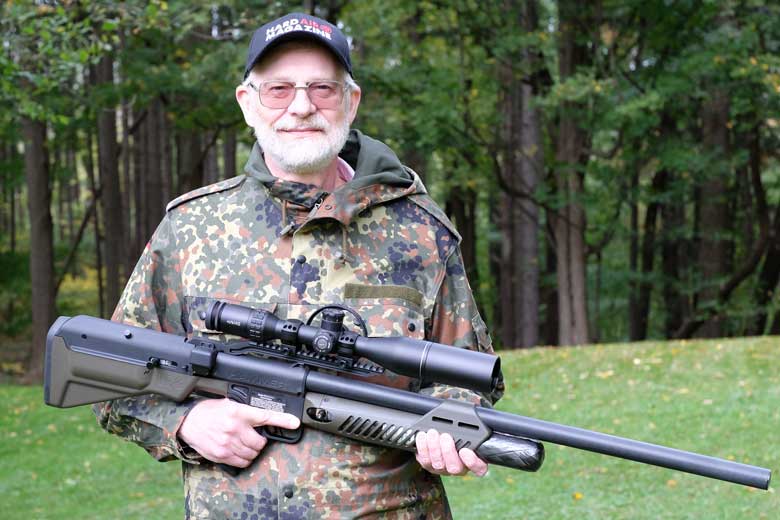
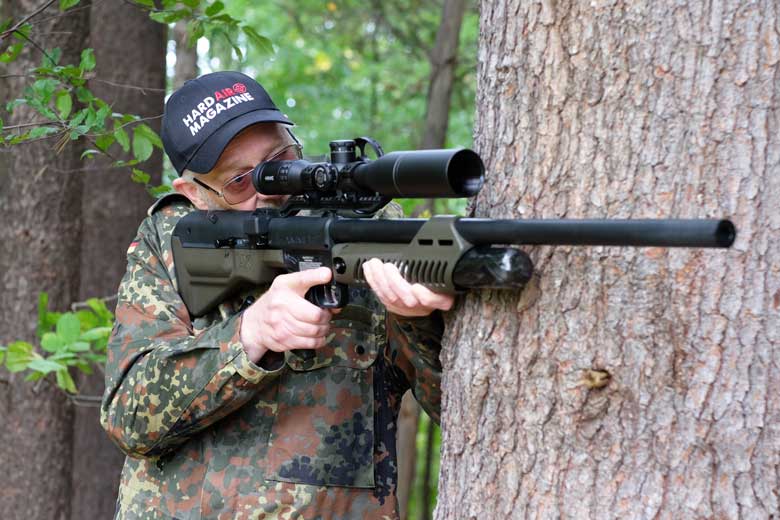
The Umarex Hammer .50 Cal was a long time coming. But now it’s here and working!
At AoA’s price of $849.99, the Umarex Hammer .50 Cal can’t be beaten in terms of power for price. If you’re in the market for an air rifle to hunt big game at the lowest price, the Hammer is the obvious choice.
The Hammer provides a combination of uniquely-outstanding performance and somewhat unusual quirks. I found that it’s VERY ammo-sensitive. Michail Kalashnikov would definitely not have approved of this design!
But keep reading, there are some real benefits too…
First The High Points
Accuracy was very good indeed!
Given the design of the Hammer and its intended use solely as a hunting tool, I specified only two-shot groups when testing the gun. Why use two shots? Well the Hammer has a 2-shot magazine, so I wanted to see how it performed in a “rapid follow-up shot” situation.
At 50 Yards, using Umarex 320 Grain SLA bullets, accuracy was 5/8-Inch CTC for two shots. That’s definitely better than required for successful big game harvesting.
At 25 yards, Both shots went through the same hole!
For testing, I did not have access to the 550 Grain bullets that give the Hammer its’ claimed 700 Ft/Lbs muzzle energy. However, I saw a maximum Muzzle Velocity of 889 FPS with 320 Grain slugs. This represents a muzzle energy of 561.7 Ft/Lbs. This is a powerful air rifle!
The trigger of the Hammer I tested by had a rather long, and rather creepy pull. However the Umarex Hammer .50 Cal is not intended to be a target rifle. It’s a hunting gun and the trigger is perfectly usable for this task.
Trigger pull weight was also acceptably consistent. The average was 2 Lbs 13 Oz.
Next, The Unique Benefit
The Hammer .50 Cal is unique as the only regulated big bore airgun. Umarex claims that three full-power shots are available from one 4,500 PSI fill of High Pressure Air.
But as the Umarex Hammer .50 Cal I tested used 600 PSI per shot and the regulator is set to 3,000 PSI, it’s clear that – even when fully filled – the gun will give just two full-power shots per fill. The third will have – at most – 2,700 PSI to work with. As this is below the regulator set pressure, it will – therefore – generate a lower velocity.
So, the Hammer I tested gave just two really consistent full power shots per fill. However, two consistent shots is better than any other – unregulated – big bore out there, so this is a big benefit for the Hammer.
Another benefit for the Hammer is that those two FULL POWER shots are also available even when filled from a tank that only has 4,200 PSI inside.
In testing for this review, I was able to achieve no less than 14 full power shots from a 550 Cu. Inch tank with a starting fill pressure of 4,500 PSI. I filled the gun multiple times before the tank pressure fell to 4,200 PSI.
So, if you want to shoot a significant number of full-power shots in a day with a big bore airgun without having a portable compressor, booster pump or additional HPA tanks available, the Hammer is unique. There’s no other big bore that can match this performance!
But There Are Some Downsides…
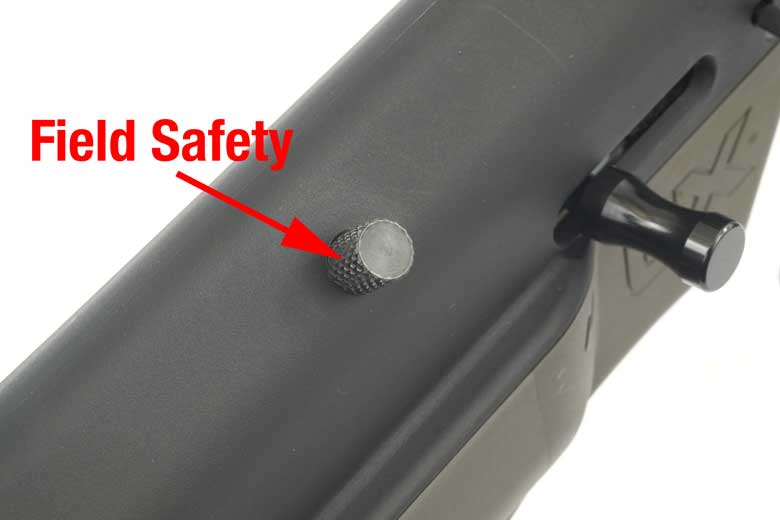
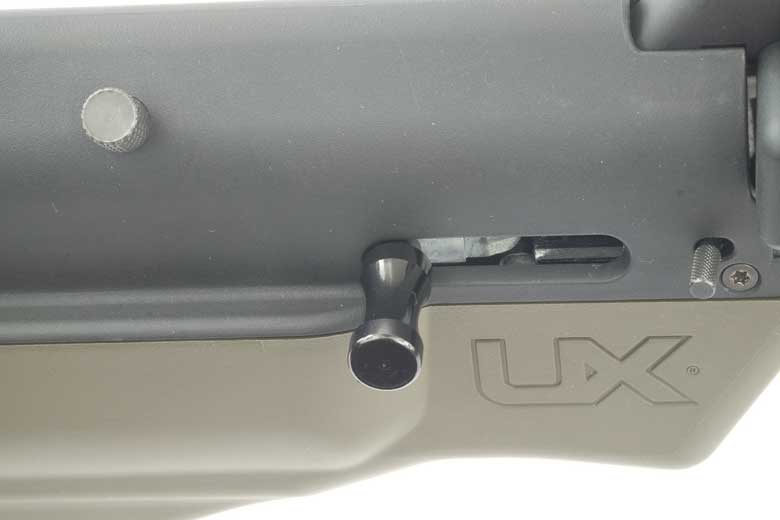
With no less than three safeties, this is a complicated airgun to use. So it’s mandatory to read the Owner’s Manual before operating. But once you understand the workings, it’s not so difficult to shoot and handles surprisingly well.
The position of the Field Safety is fine for use by right-handers. However, it’s a pain for left-handed shooters as it’s located exactly where the cheek rests.
During testing, I experienced a couple of misfires when shooting the Hammer. However this was traced to operator error. I was being too gentle with the bolt handle!
Yes, it does say in the Hammer’s Owner’s Manual that the bolt handle must be pushed “ALL THE WAY FORWARD”. It fact, the bolt handle needs to be pushed all the way forward with a fair amount of force to ensure that it’s correctly engaged. Once I understood that, the gun worked correctly.
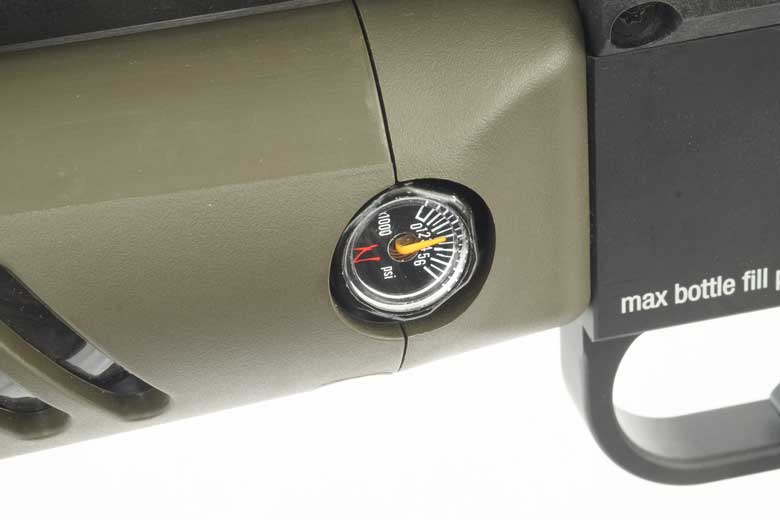
Also the Hammer uses a Ninja Paintball regulator and pressure gauge. In my opinion, this gauge is extremely difficult to read accurately. The graduated angle on the gauge plate is too small, the maximum indication (6,000 PSI) is too high and there’s no red warning section to advise that the HPA bottle is being overfilled.
In addition, the Hammer Owner’s Manual indicates (with a rare degree of honesty) that the gauge has an accuracy of +/- 10%. That’s a full 450 PSI either way at the full 4,500 PSI fill pressure!
So I agree wholeheartedly with the Owner’s Manual. When filling the Hammer, do not rely on this built-in gauge but consult the more accurate and larger gauge on the HPA tank or compressor being used to fill the gun.
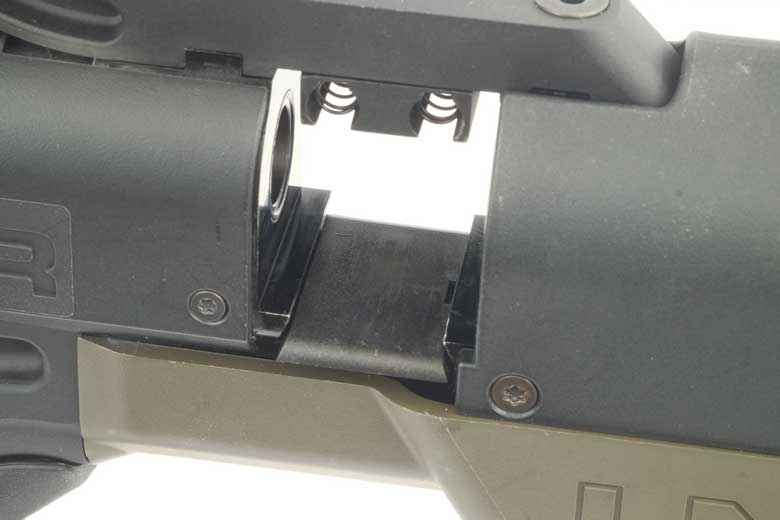
One additional issue with the Umarex Hammer .50 Cal is also covered well in the Owner’s Manual. This is the considerable blast of air that emerges from around the magazine well when the gun is fired!
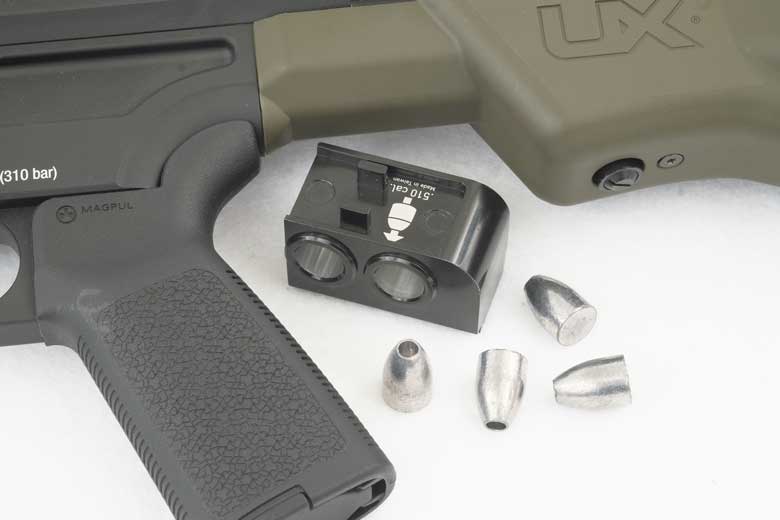
Because it has no conventional bolt, the Hammer fires slugs directly from the magazine. They “jump” across to the barrel at the moment of firing. The magazine is a close fit in the magazine well, but there are no seals, so air escapes from all around the magazine when the gun is fired.
In fact, a surprisingly large amount of 3,000 PSI air is expelled in this way when the gun is fired. You definitely do not want your hand or face in the way – or even to be next to the gun!
This means that fit of the slug (or bullet) in the magazine is extremely critical. Too loose and the slug can fall out of the magazine. Too tight and it will not load fully into the magazine.
Importantly, the difference between “too tight” and “too loose” is very small. This would have upset our Mikhail!
The diameters of the chambers in the magazines for the Hammer I tested measured 0.507 Inches. So, .510 caliber Umarex SLA ammo is – in theory – 3 Thou oversize. This allows the slug to be pushed into the magazine without too much force, yet there’s enough swaging effect of the ammo for the slug to be an appropriately-tight fit into the magazine.
In fact, the base of the SLA slugs measured a consistent .509 Inches diameter. They inserted perfectly into the magazine – all except one which measured .511 Inches. That did not.
The additional 2 Thou made all the difference. There’s a very fine balance here between ammo that works and that which doesn’t!
The Rogue pushes into your shoulder and wants to lift the muzzle when the shot is triggered. I recommend shooting off a bipod.
To get the Benjamin Rogue ready for shooting, you first have to install batteries to power the electronics that control this air rifle. Lay the Rogue on its left side and remove the right side cover screws with a .0625 allen wrench. Install two AA batteries (the folks at Crosman recommend lithium batteries for long life) and replace the cover. Remove the cover on the foster fitting at the end of the air reservoir and charge the Rogue to 3,000 psi with a SCUBA tank or high pressure pump. The display on the left side of the receiver will tell you how much pressure is in the air tube.
The Rogue magazine holds six .357 caliber bullets.
Load the Rogue clip with six .357 bullets and slide it into the breech from the left-hand side until it clicks. Slide the bolt forward and down. This will push a bullet from the magazine into the barrel. Now, note this: the Rogue is designed with an extra position on the bolt. It has to be moved back about a quarter of an inch into the READY TO FIRE position before the electronic action can fire. To allow hunters to be able to walk around with the Rogue charged and loaded, there is a bolt activation lever just below the bolt that, when in the DISABLED position, prevents the bolt from inadvertently moving back into the READY TO FIRE position. The bolt activation lever enables and disables the bolt, and the push-button safety near the trigger enables and disables the trigger.
So, to fire the Rogue, flip the bolt activation lever to ACTIVE, pull the bolt back to READY TO FIRE, push the safety off, take the slack out of the first stage of the trigger, and squeeze the second stage.
A 145 grain Nosler Benjamin eXTREME Bullet next to a 7.9 grain Crosman Premier Pellet.
What happens next is really quite astonishing – the Rogue kicks. Ed Schultz says it has roughly the recoil of a 28-gauge automatic shotgun. (I’ve never shot a 28-gauge shotgun, but I’ll take his word for it.) The recoil is not punishing by any means, it doesn’t slam into your shoulder, but the Rogue definitely pushes back against you, and the muzzle tries to lift. When I first shot the Rogue at Crosman, I was using cushions for a rest, and it didn’t work very well. In fact, given the weight of the Rogue, and its propensity to recoil and lift, I consider that a bipod, which can be readily attached to the Picatinny rail under the forearm, is an essential accessory for this air rifle. A bipod makes the Rogue much easier to shoot well.
The report of the Rogue is about as loud as a subsonic .22 rimfire, but – thanks to the shrouded barrel – not nearly as loud as it might be. (The loudest precharged air rifle I ever shot was a Sumatra .22, which I thought sounded like a 12-gauge shotgun. I hated it.) The Rogue, considering the power it generates, is very modest in the sound it makes, but still it is not the air rifle for shooting in a suburban backyard . . . unless, of course, you have an urgent need to kill a coyote (even then, BE SURE to check with local authorities to make sure that shooting an airgun is legal where you are.).
I put six 145-grain Nosler bullets through the chronograph. Here are the velocities in order (fps): 783.2, 754.6, 750.9, 749.0, 741.3, and 739.1. (After six shots — a magazine-load — the air pressure drops to about 2,000 psi and the reservoir needs to be refilled.) That works out to 752.18 fps average and – drumroll please – 182.2 foot-pounds of energy at the muzzle. That is one pot-load of power, roughly 50% more than a .22 rimfire. That’s about 10 times the power of most air rifles sold in the United States, power enough for hunting coyotes and hogs. That’s also enough power that you want to be extremely careful in choosing your backstop for target shooting with the Rogue.
Five shots at 50 yards with the Rogue.
Shooting the Rogue off its bipod at 50 yards, I put five Nosler bullets into a group that measured 1.4 inches from edge to edge. A number of bullets are available for the Rogue, including a 95 gr. hollow point, a 170 gr. flat nose, a 159 gr. round nose, and a 127 gr. flat nose.
The power with which it hits is impressive. I’m told that when Crosman brought out the Rogue at the Northeast Regional Field Target Championship in 2011, they put a target on a cinderblock at 50 yards, and the Rogue punched a hole in the cinderblock.
Bottom line: I think a lot of hunters and pest control professionals will find the Rogue an interesting and useful tool.
The Benjamin Rogue is a big, powerful .357 caliber precharged pneumatic air rifle.
When I’m not writing this blog for www.airgunsofarizona.com, I occasionally have other writing assignments in the airgun field. For the past several years, for example, I have written the “airguns update” for the SHOT Show Daily newspaper that is handed out each day at the SHOT Show.
Now, there is too much going on at the SHOT Show to print each day’s edition of the newspaper fresh from scratch. That would be the road to madness. As a result, a considerable chunk of the SHOT Show Daily is pre-printed well ahead of the show. The article that I write about what’s new in the field of airguns is part of that preprinted material.
So here’s what happens: sometime in August (usually) my editor at the SHOT Show Daily will contact me and given me a deadline for my airgun article. The deadline is typically sometime in October. So I begin contacting all the airgun manufacturers and distributors who will be exhibiting at the SHOT Show and I tell them that I need the pertinent information about whatever new products they will be exhibiting at the SHOT Show by a date that is usually a week before the day I have to turn in my story to my editor.
As a result, I usually know about a lot – but not all – of the cool new airgun stuff that will be unveiled at the SHOT Show. I have to keep all of this information is strictest confidence until it is officially released at the show. I have also learned over the years that many of the new products that are announced at SHOT Show will not be commercially available until later – sometimes much later – in the year.
So I was talking with one of the nice marketing people at Crosman about some products that were announced at the SHOT Show 2012 when she asked, “Have you ever seen a Benjamin Rogue?” I had to admit that I had not and didn’t think anything more about it until three weeks later one arrived at my door.
Until the Rogue showed up, the largest bore airgun I had ever shot was a .25 caliber. Quarterbore, as it is sometimes called, is a nice fat caliber that serves very well for hunting small game, varminting, and pest control, but the pellets might weigh, say, 19 to 25 grains. The Rogue, though, is a .357 caliber precharged pneumatic air rifles that launches “bullets” that might weigh as much as 170 grains. You don’t have to be Einstein to figure out that if the Rogue could launch these pellets faster than I could throw them, it would be fairly easy to generate energy at the muzzle that would be in excess of a .22 rimfire cartridge. That’s a lot of power for an airgun. I didn’t think that the pellet trap I ordinarily use would be capable of stopping pellets from the Rogue.
Further, I figured any airgun capable of generating that kind of power was likely to be pretty loud. So immediately I had a problem: I needed to find a place where I could shoot the Rogue safely and where it wouldn’t disturb neighbors. I mentioned this to the folks at Crosman, and one of them suggested I bring the Rogue with me when I covered the Northeast Regional Field Target Championship. I did, and the first time that I got to shoot the Rogue was in the company of Ed Schultz, who is the head honcho for engineering at Crosman.
This display and these three buttons serve as the control center for the Rogue.
The Benjamin Rogue is a big, hairy-chested, powerful precharged pneumatic air rifle. It weighs 9.5 pounds before you mount a scope or bipod, stretches four feet long, and is a six-shot repeater. At the extreme aft end of the Rogue is an AR15 style buttstock that can be expanded or collapsed after squeezing a release lever. Forward of that is the receiver, which has a liquid crystal display on one side and three buttons for making various control selections. The Rogue is electronically controlled, including a digital pressure display and an electronic valve that precisely meters the amount of air that is used for each shot. The shooter can choose from two power settings and various bullet weights to custom-tailor the performance of the Rogue to their preference.
Crosman has recently simplified the software that controls the Rogue. “We realized the no one wants to shoot a big bore airgun on low power,” Schultz says, “so we eliminated that option.”
Below the left side of the receiver is an AR-style pistol grip and forward of that is the trigger and trigger guard, above which is a push-button safety. Ahead of the trigger guard, you’ll find the forestock, part of which is covered with a tan polymer guard that is textured for gripping. Beyond that, the rest of the forestock is black and has a Picatinny rail for attaching accessories.
Moving forward again, the air tube, finished in tan, has a screw-off cap at the end. Undo it, and there is a male foster fitting for filling the air reservoir. Above the air tube is the barrel, which is shrouded and has baffles to quiet the report. Moving rearward along the barrel, the receiver has a 3/8 inch dovetail for mounting a scope. In the middle of the receiver is the breech which has a slot large enough for accepting a 6-shot rotary magazine.
On the right side of the panel, you’ll find a removable panel, the bolt, and a small bolt activation lever. That’s it.
Next time, we’ll take a look at what’s it is like to shoot the Rogue.