Posts Tagged ‘CO2’

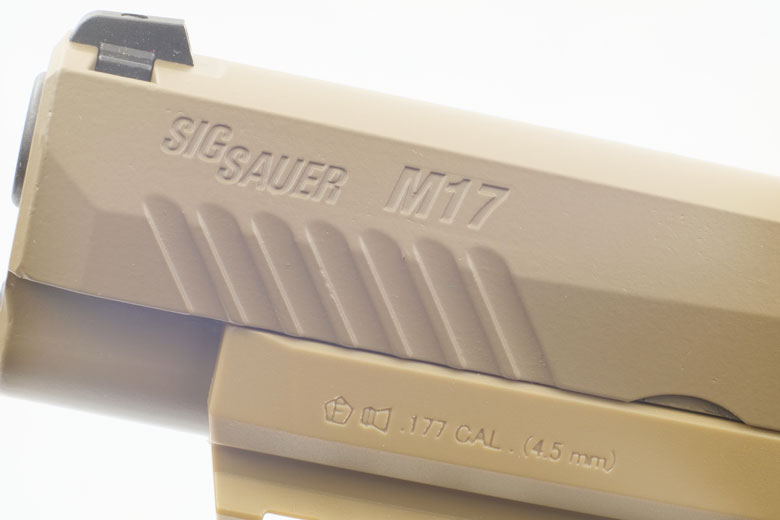
SIG SAUER P320 M17 Air Pistol

Airguns of Arizona is usually regarded as an outstanding supplier of “serious” – make that expensive and often PCP – airguns. But the company actually sells airguns of all types – including “fun pistols”

It’s such a fun pistol that we’re looking-at today. The SIG SAUER P320 M17, in fact.

SIG is unusual in that many of their CO2-powered centerfire replica air pistols are pellet-shooters. True, they do have some BB-firing models, but their specialty is pellet pistols.

SIG SAUER P320 M17 Air Pistol

SIG’s air pistols are almost all CO2-powered versions of the company’s centerfire models. That’s the case also with the P320 M17.

You see, the SIG Air P320 M17 air pistol is a remarkably realistic version of the US Army P320 M17 service pistol. Length, width, height and weight are all identical – or almost – to the centerfire original.

SIG sets high standards throughout the organization and its products. It’s clear that this is the most realistic pellet pistol that they have introduced to date. It’s thus ideally-suited for the training role that the company sees  as a key value proposition for its airgun products.

The P320 M17 air pistol features a fully-functional ambidextrous manual safety – a first for a SIG Air pistol and an exact match to the firearm.

There’s also a functioning takedown lever. Unlike previous SIG pellet pistols, the M17 can be field-stripped, which will please many people.

SIG SAUER P320 M17 Air Pistol

The drop-free magazine release is not ambidextrous. But this is a relatively small difference from the centerfire M17.

The overall appearance of the sights is very realistic. However, it’s true that that sights do not offer the night vision capability of the military firearm. Nor are they adjustable. This means that we need to be creative if your sample doesn’t shoot exactly to the point of aim.

One alternative would be to mount a small laser on the Picatinny rail and make aim corrections using that. This is a Leapers UTG LS200 Red Sub-Compact laser. As you can see, it fits onto the P320 M17 air pistol very conveniently.

Another is the the SIG M17 Pellet Pistol Reflex Sight.

This is a huge asset to the M17. It provides elevation and windage adjustment capability, combined with multi-brightness control of the projected red dot. It’s delightfully small and light and makes accurate shooting the M17 so much more enjoyable!

SIG SAUER P320 M17 Air Pistol

SIG claims that the P320 M17 air pistol is a perfect tool for M17 firearm owners to practice with and stresses the similarity to the firearm. I agree.

The manufacturer also claims a Muzzle Velocity of “up to 430 FPS” – depending on temperature and other environmental considerations. Unfortunately, the maximum FPS achieved by the P320 M17 air pistol I tested was just 310 FPS, with 5.56 Grain alloy pellets.

Now it’s true that this was recorded in a cool – 62 degree F – test range in up-state New York. It’s also true that the Muzzle Velocity for CO2-powered airguns varies by about 2 FPS per degree F temperature change.

However, even if the range temperature had been 92 degrees F in sunny Arizona, the test gun would have only achieved a maximum of 370 FPS. That’s the 310 FPS at 62 degrees + (30 degrees difference x 2 FPS) = 370 FPS.

Actually, a maximum of 370 FPS would still be a pretty good muzzle velocity for a CO2-powered air pistol. But it’s still 60 FPS short of the claim.

Is that a big deal? For most people who plan to use the P320 M17 air pistol for practice and punching holes in paper, the answer is “no”.

The P320 M17 air pistol I tested showed very good accuracy. The gun was certainly “minute of soda can” accurate at 6 Yards.

However, there was a clear tendency for the pellets to strike slightly to the right of the bull. This was not an issue at 6 Yards, however the group dropped down and to the right on the 10 yard target.

Accuracy was quite consistent with all the pellets I tried. The RWS Hobbys performed marginally best however, so these were shot at the longer, 10 yards range.

Although to pellets struck low and right at 10 yards, they were still within the “minute of soda can” – just not exactly in the right place! Overall, this was a very creditable performance and with one of the add-on sights you could easily be “spot on”.
The SIG P320 M17 air pistol offers a very realistic-feeling blowback, particularly with a new, full, CO2 cartridge. Felt recoil is surprisingly strong, another big improvement over previous SIG non-blowback pellet pistols.

One complaint is that the slide does not hold back after the last pellet has been fired. This is not unknown among CO2-powered replica firearms, however.

The trigger is double-action only and has a rather long pull. The pull weight of the test gun was rather heavy at an average of 9 Lbs 8 Oz.

Both pull weight and length are clearly related to the pellet feed mechanism. It is the trigger pull which advances the next pellet into battery for firing, rather than the slide recoil. So technically, the M17 is actually a revolver!

However, the pull itself felt consistent and predictable.
SIG SAUER P320 M17 Air Pistol

My SIG P320 M17 air pistol gave just over 60 shots before the Muzzle Velocity fell below 200 FPS. This is around average for a CO2-powered air pistol with strong blowback.

However, I kept firing and eventually achieved 80 shots before the gas was completely exhausted. That’s a very good count for a blowback air pistol, although the FPS for the final magazine’s contents was very low.

The CO2-loading system employed in the M17 is – in my opinion – the best there is at the present time.

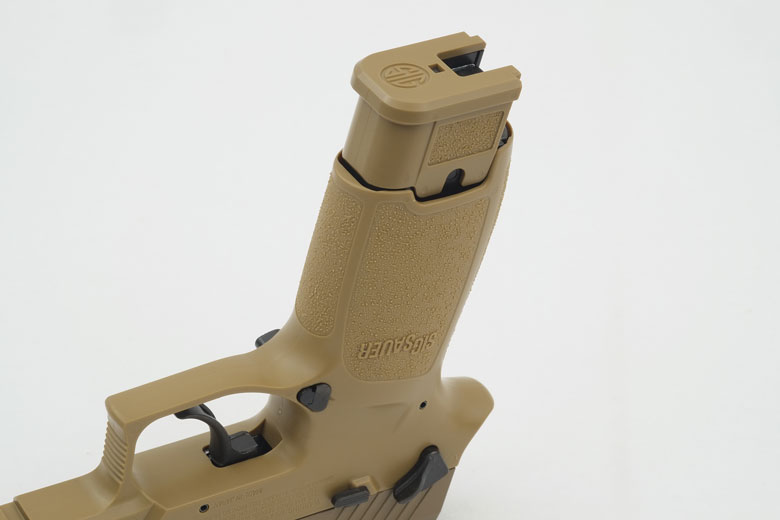
SIG’s cam lever system is simple, easy and quick. There’s no screws to turn and no unsightly levers hanging down below the magazine. There’s no need for an Allen (hex) wrench either and no issues if that wrench were to become lost.

SIG SAUER P320 M17 Air Pistol

Incorporating the cam lever system into the magazine itself is also a significant operational improvement compared to having it located in the frame, as with some previous SIG models.

As with any replica air pistol – both BB- and pellet-firing, loading the ammo is actually the longest task of preparing the P320 M17 air pistol for shooting. But the new, 20-pellet magazine is really quite convenient to load. It also has no need for the owner to hold down a spring-loaded follower, as can become tedious with some BB pistols.

So if you’re looking for some fun plinking, or some serious training action for a centerfire P320, the SIG P320 M17 air pistol could be just what you’re looking-for.

And at $119.95, it’s not exactly going to break the bank!

Surprise! The QB78 Is Now Available At Airguns Of Arizona

Generally, it would be fair to say that Airguns of Arizona is better known for selling airguns in the $1,000+ price range, rather than those at around $100. But now there’s an exception…

You see, AoA now has in stock three versions of the CO2-powered Beeman QB78 air rifle.

These Beeman QB78 air rifles are the latest version of a model with a long history. The basic design goes waaaay back to that of the iconic Crosman 160 of 1955!

Surprise! The QB78 Is Now Available At Airguns Of Arizona

So, yes, this is basically a 60+ year old air rifle – with improvements! They’re still a great gun because – like the Mauser 98 bolt action firearm – it has a winning blend of features and a long, proven history of happy owners.

Of course, as a CO2-powered gun, it’s not a powerhouse. Don’t expect 1,000 FPS, or anywhere like it. But for plinking and target shooting, Beeman QB78 air rifles have many fans. At prices as low as of $94.95, they are great value!

AoA main man Robert Buchanan was turned on to the QB78 back in the Summer when investigating the DT Fletcher collection of historic airguns. This brought him back into contact with the classic Crosman 160 and – from there – to the QB78.

In fact, Robert considers that the finish and general manufacturing quality of current-production QB78s is far superior to that of the vintage 160s built many years ago in Fairport NY.

There’s three QB78 models in stock at AoA. All are bolt action and CO2-powered. Two have synthetic stocks and one – the QB II model – is actually a magazine-fed 10-shot repeater. Wow! That’s the ultimate development of Crosman designer Rudy Mertz’s original 1955 air rifle.

Any QB78 model can be a great choice for “back to basics” plinking or fun shooting. They’re also great for newcomers to the sport who want to start at the lowest-possible price

CO2 airguns have a generally bad reputation for shot-to-shot consistency. But it has to be said that the shot curve of Beeman QB78 air rifles can be less extreme than that of many unregulated PCP air rifles!

Yes, it’s true that FPS will drop rapidly if any CO2-powered airgun is fired rapidly. However, many shooters take their time when shooting, particularly with a single-shot, bolt action like that of the Beeman QB78 or QB78S air rifle.

Surprise! The QB78 Is Now Available At Airguns Of Arizona

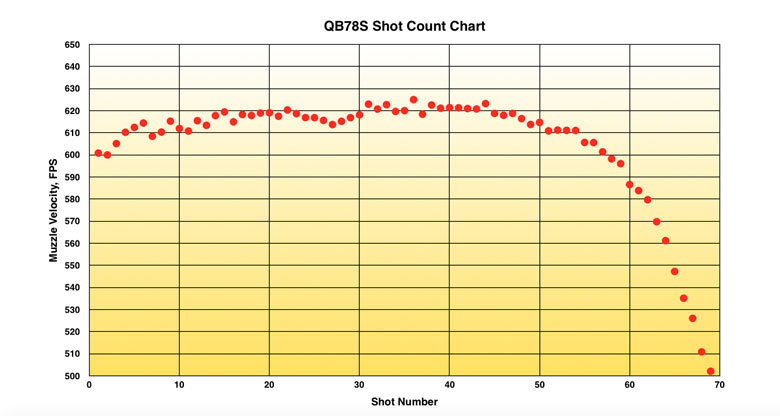
For example, I fired a QB78S air rifle (synthetic stock, non magazine-fed model) with a shot-to-shot gap of 30 seconds for this test.

As we can see from the following chart, the result was 58 “consistent” shots. That is, 58 shots at between 600 and 625 FPS from a normal fill of 2 x 12 gram CO2 cartridges at around 65 degrees F. That’s a Standard Deviation (the statistical calculation of shot-to-shot variability) of 6.17 FPS.

Surprise! The QB78 Is Now Available At Airguns Of Arizona

This is an excellent number and is a shot curve that is not far behind some regulated PCP air rifles I have tested!

But let’s talk more about muzzle velocity…

Beeman is extremely conservative in its muzzle velocity claims for QB78 air rifles. This is a VERY unusual trait in the world of low-priced air rifles where “Zillion FPS” claims are common, whatever the actual performance capabilities of the gun in question.

Below. Two 12 Gram CO2 cartridges are loaded back-to-back in the QB78. Just like the Crosman 160!

Beeman specs are a maximum of 650 FPS in .177 caliber and 500 fps in .22 cal. But – unlike every other manufacturer in the low end of the market, these figures are given for lead pellets at an average 68 degrees F temperature.

This is important because, as with other CO2-powered airguns, the muzzle velocity of Beeman QB78 air rifles increases with ambient temperature. In fact by about 2 FPS per degree F.

This means that a typical .177 caliber QB78S air rifle will meet the 650 FPS claim with 7 Grain lead pellets at somewhere around 70 degrees F.

At higher temperatures, the FPS will continue to rise, reaching a maximum at about 90 degrees F. So, at 90 degrees, our QB78S will achieve 760 FPS with light alloy pellets and 695 FPS with 7 Grain lead RWS Hobby pellets. All in .177 caliber, of course and with no change except ambient temperature.

Trigger pull weight is also remarkably consistent for an air rifle of this price. The average pull weight for the Beeman QB78S air rifle I tested was 2 Lbs 11 Oz and it varied by only 2 Ounces around the average at most. That betters the performance of many more expensive air rifles I have tested!

And that trigger is easily adjustable for pull weight, sear engagement and overtravel. Just pop off the stock to find adjustment screws on the trigger housing. That’s a manual safety we see just in front of the trigger guard…

Beeman QB78 air rifles are easy to shoot. They’re light and point naturally. The trigger is good for the price and consistent, as we have described above.

Unlike all the powerful spring/piston break barrel air rifles at around this price, the Beeman QB78 has no recoil and requires no special hold to shoot accurately. That’s a huge advantage for it in the “around $100, entry level airgun” market, so long as the owner is not intending to use it for hunting.

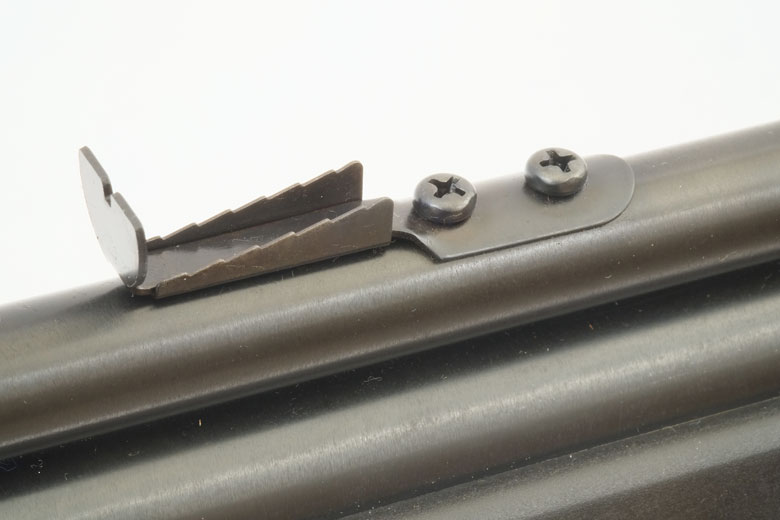
Beeman QB78 air rifles come with iron sights as standard. However these are very much 1950’s style! The rear sight has elevation provided by moving back the ramp. This allows the sight leaf to “catch” in a higher notch and raise the point of impact.

And if you think that’s primitive, just wait for the windage adjustment! This is achieved by loosening the two setscrews holding the sight leaf in place, moving the sight leaf across “by eye” and re-tightening the screws. The “high tech” QB II repeater has fiber optic sights to go with the modern rotary magazine!

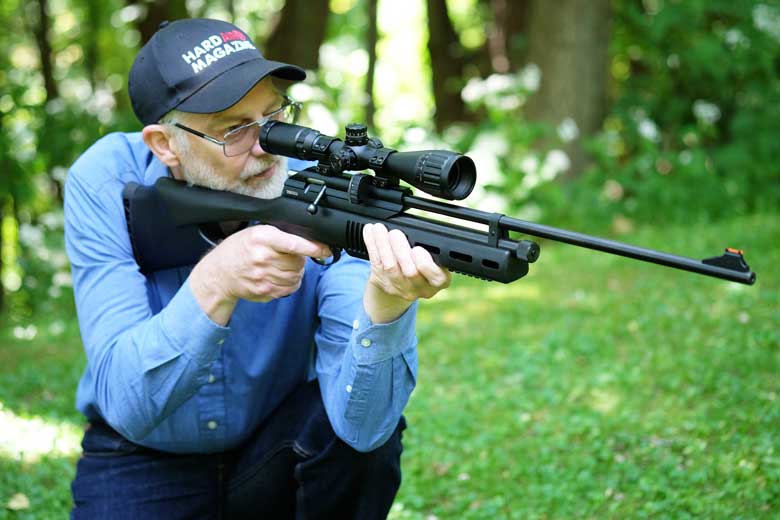
Fortunately, the breech of Beeman QB78 air rifles has dovetail rails for scope rings. If you want to benefit from the accuracy potential of this gun, you really need to mount a scope…

Some potential purchasers of the single-load QB78s are concerned about accessibility for loading pellets when a scope is fitted. However, there’s actually plenty of space, as you can see below.

With the single-load guns, I find it best to lay a pellet on the flat side of the breech and just roll the pellet across until it drops into the loading tray. At any event, there’s more space for pellet-loading than is found in Crosman bolt action breeches, like that fitted to the Benjamin Discovery and Maximus, for example.

The magazine-fed version makes loading even easier, of course. But it’s probably rather too easy and modern for “hard core” single-load QB78 fans!

Finally, the single-load Beeman QB78 air rifle is the Ruger 10/22 of the airgun world! It’s a small, light, cheap gun that has a load of fans and a vast array of upgrades and accessories available out there.

It’s incredibly customizable and has been the starting point for many amateur (and professional!) airgunsmiths, due to its simple, intuitive design.

If you are one of the few serious airgunners who has never tried the classic delights of a single-load QB78, now could be just the time to do so. It’s bargain-priced time travel!

G12 S&W CO2 revolver 005

This week we are continuing our exploration of replica air pistols with one of my personal favorites, the Smith & Wesson 6″ revolver. This .177 caliber revolver is a replica of the Smith & Wesson powder-burning revolver, and it looks and feels like the real thing.

The 6-inch Smith weighs 2 pounds 12 ounces and is 11.5 inches long. It has a 6-inch rifle barrel, a 10-shot rotary magazine and is powered by a 12-grain CO2 cartridge hidden in the pistol grip. The Smith can shoot both double action (where you pull the trigger to cock the hammer and discharge the shot) and single action (where you cock the hammer first, then discharge the shot by pulling the trigger.

G12 S&W CO2 revolver 006

The entire pistol is polished, blued metal, with the exception of the rubber grips (it also comes in a nickel finish). On the left side of the frame, below the hammer and just forward of the pistol grip, is the pellet clip release lever. To ready the pistol for shooting, press the pellet clip release forward. This will release the pellet clip, allowing you to swing the 10-shot magazine out to the left. Remove the magazine from the shaft. Set it aside for the moment.

G12 S&W CO2 revolver 008

Next remove the right hand grip by prying it up at the forward edge near the trigger guard. This reveals a chamber into which you will insert a 12-gram CO2 cartridge with the small end pointed toward the hammer. Pull the cartridge lock lever at the bottom of the pistol grip down as far as it will go. Loosen the gold-colored cylinder screw by turning it clockwise. Insert a new CO2 cartridge into the chamber. Tighten the cylinder screw by rotating it gently counterclockwise until snug. Return the cartridge lock lever to its original position by pushing it upward – this may require considerable effort. This should pierce the CO2 cartridge. To confirm this, point the pistol in a safe direction, and squeeze the trigger. You should be rewarded with a “pop.”

If you don’t hear a pop, swing the cylinder lock downward, tighten the cylinder screw a bit more, and try again. Once you are certain that the pistol is discharging CO2, it’s time to load the rotary magazine. With the ratchet teeth facing you, insert pellets headfirst into the ten pellet bays, taking care that the pellet skirt is level with or slightly below the edge of the pellet bay.

Slide the magazine back onto its shaft with the ratchet teeth facing toward the hammer, and swing the magazine back into position. You are good to go, and you can shoot the S&W either double action or single.

G12 S&W CO2 revolver 007

And this is the point in the testing process where I was mightily surprised. This is my favorite replica pistol, and I enjoy shooting it a fair amount. My personal pistol is tricked out with a red dot sight but otherwise it is unmodified. Further, I never found it particular bothersome to shoot double action, although I prefer to shoot it single action because the trigger is lighter.

So imagine my surprise when I tested the Smith with my electronic trigger gauge and found that double-action shooting required an astonishing 9 pounds 4 ounces of effort on the trigger. Shooting in single-action mode, the trigger weight is considerably less but still required 6 pounds 4 ounces of effort. Before I made the measurement, I would have guessed that double-action mode required about 6 pounds of effort and single action, maybe 2.5 pounds. I tested both my pistol and the sample that www.airgunsofarizona.com sent me and got similar results with both.

So why doesn’t the S&W feel heavier to shoot? My theory is that the ergonomics of the grip and the trigger work together especially well (at least for my hands), particularly when shooting with a two-handed weaver grip.

The factory says that the Smith will deliver up to 426 fps, and I believe it. At 10 feet, I found that it would punch through a soup can most of the time, and, if you loaded the magazine with ultralight non-lead pellets, it would blow through one side of the can all the time and very often punch an exit hole through the other side. Of course, like other 12-gram CO2 powered air pistols, if you shoot very fast, the velocity and the penetration force will drop. Nevertheless, I think that the Smith packs enough wallop that it could be used for control of small pests (for example, a rat trapped in a garage) at short range.

In the end, I like the S&W 6-inch revolver a whole lot and can recommend it for pistol shooting fun.

Til next time, aim true and shoot straight.

–          Jock Elliott

G12 Colt 1911, Beretta 92 007

The Beretta 92FS is another CO2-powered replica air pistol. It looks and feel like the Beretta pistol used by so many military forces and law enforcement agencies. The air pistol (there is some disagreement about what it should be called. The www.airgunsofarizona.com website has it as the Beretta 92 FS, the printed manual that comes with it calls it the Beretta 92FS, and the label on the side of its case says Beretta M 92 FS) weighs 2 pounds 12.2 ounces, and its length is 8.27 inches.

Everything on this pistol appears to be made of metal except for the checkered plastic grips. There are several models, including a blued finish with black grips, blued with walnut grips, nickel with black grips, nickel with walnut grips, and an all-black XX-Treme model with false silencer and dot sight. I tested the nickel finish version with black grips.

G12 Colt 1911, Beretta 92 009

What all of them have in common is that, while they look like their semi-automatic firearms counterparts, they are, in fact, double-action revolvers. Press the slide release lever on the side of the receiver, and the front of the slide moves forward to reveal the slot for the 8-shot rotary magazine.

G12 Colt 1911, Beretta 92 012

The procedure for loading the CO2 cartridge and for loading the magazine is exactly the same as it was for the Colt 1911 replica CO2 pistol that I tested last week, so I won’t go through that again here. And like the 1911 that I tested last week, the Beretta suffers from the same malady: if you shoot it in double action mode, the trigger pull is very high – over 10 pounds – but when you shoot it in single-action mode, the trigger pull drops to 5 pounds 5 ounces (which is still higher than I would like to see). And, like the 1911, the wallop that the Beretta packs is sufficient at 10 feet to dent and bounce tin cans but not enough to punch holes in them.

And that leads, naturally enough, to a question: what exactly are guns like the Beretta 92FS and the Colt 1911 from last week good for? They are not as accurate as match pistols, and they are not powerful enough for pest control at short range. And yet they are fun to shoot.

So what is needed, in my not so humble opinion, is a really good game to play with these pistols, and I think an airgun version of IPSC – the course of fire offered by the International Practical Shooting Confederation – would be just the ticket. Here’s what the IPSC website (www.ipsc.org) says: “IPSC shooters need to blend accuracy, power, and speed into a winning combination. Multiple targets, moving targets, targets that react when hit, penalty targets, or even partially covered targets, obstacles, movement, competitive strategies, and other techniques are all a part of IPSC to keep shooters challenged and spectators engaged.”

I think it would be absolutely terrific if the folks who manufacture replica air pistols would offer a line of targets that would allow shooters of these replica pistols to set up their own “backyard IPSC” courses. Check out this video of airsoft IPSC shooters in Asia — https://www.youtube.com/watch?v=ABhkFTO4cp4 – I don’t see why a similar thing couldn’t be done with replica air pistols . . . and it looks like an enormous amount of fun to me.

If anyone knows of an effort in the US to put together something like IPSC for air pistols or air soft, please let me know.

Til next time, aim true and shoot straight.

–          Jock Elliott

G12 Colt 1911, Beretta 92 013

I’ve been seeing a lot of replica air pistols lately. By replica, I mean air pistols that look and feel like their firearms counterparts.

This week’s example is the Colt Government 1911 A1 pellet pistol from Umarex. It stretches 9 inches from end to end and weighs 2 pounds 6 ounces. Everything except the checkered grips (plastic) is made of metal in a handsome blued steel finish. Powered by a 12-gram CO2 cartridge, it features a slide release latch, a manual safety on the left side, a functioning grip safety at the back of the pistol grip, non-adjustable front and rear sights, a lanyard loop, and a working hammer.

G12 Colt 1911, Beretta 92 014

It looks like a semi-automatic, but in actuality the 1911 A1 is a double-action revolver that houses a small rotary magazine inside what looks like the 1911’s slide.

G12 Colt 1911, Beretta 92 015

To ready the 1911 for shooting, first press the slide release lever just above the trigger assembly on the left side of the pistol. This will allow the front section of the slide to move forward, opening a gap to reveal the rotary magazine. Remove the rotary magazine. Next, press the magazine release button on the left side of the receiver between the trigger guard and the pistol grip. This releases the grip panel on the right side of the pistol which you must finish removing with your fingers. Beneath the grip panel is a chamber to hold the 12-gram CO2 pistol.

G12 Colt 1911, Beretta 92 018

Pull the cartridge lock lever at the bottom of the pistol grip down as far as it will go. Loosen the gold-colored cylinder screw by turning it clockwise. Insert a new CO2 cartridge into the chamber with the small end point toward the top of the pistol. Tighten the cylinder screw by rotating it gently counterclockwise until snug. Return the cartridge lock lever to its original position by pushing it upward. This should pierce the CO2 cartridge. To confirm this, point the pistol in a safe direction, flip the safety to FIRE, push in the grip safety, and squeeze the trigger. You should be rewarded with a “pop.”

If you don’t hear a pop, swing the cylinder lock downward, tighten the cylinder screw a bit more, and try again. Once you are sure that the pistol is discharging CO2, it’s time to load the rotary magazine by inserting pellets headfirst into the eight pellet bays. The back of the magazine has a small eight-point star-shaped assembly at the center. Once the magazine is loaded, drop it into the slot between the front and rear sections of the slide with the front of the magazine facing the muzzle and close the slide by pulling the front section of the slide back until it locks.

You can chose to shoot the 1911 A1 in one of two ways. In double action mode, you pull the trigger back, back, back, driving the hammer backward until the shot fires. In single action mode, you pull the hammer back until it locks and then you pull the trigger to discharge the shot.

Theoretically, double action mode is faster because you don’t have to pause between shots to cock the hammer. I found, however, that the effort to pull the trigger in double action mode is high . . . very high . . . 8 pounds 12 ounces, in fact. That’s high enough to be no-fun-at-all, in my view.

However, if you shoot in single action mode and cock the hammer first, the effort to trigger the shot is much more reasonable: only 2 pounds, 13.5 ounces. As a result, I highly recommend shooting this pistol in single action mode.

On a 75-degree day (velocities from CO2-powered airguns can vary considerably with temperature), the 1911 1A launched its first 7.9 grain pellet at around 400 feet per second. I shot slowly, taking a few seconds to align the pistol over the chronograph sensors, and every subsequent shot was slower, until the last shot registered around 353 fps. This is typical of CO2 powered airguns unless you give them sufficient time to recover CO2 pressure between shots.

I tried a few shots at a soup can at a distance of about 10 feet and found the 1911 A1 didn’t have enough oomph to punch holes in the can. It would dent the can and bounce around, but no holes.

In the end, I found the 1911 A1 is well made and fun to shoot. What this air pistol really needs is a fun game to play with it, and we’ll get into that a little bit next week when I take a look at Beretta 92FS pellet air pistol.

Til then, aim true and shoot straight.

–          Jock Elliott

G12 Colt 1911, Beretta 92 019

Back in the very late 1800s and early 1900s, the US Army had a problem. From 1899 to 1902, US Soldiers were fighting the Philippine-American War, and this involved facing Moro tribal insurgents who are alleged to have rendered themselves insensible to pain through a combination of body binding with leather, narcotics, and religious ritual.

When the Moro charged, they just kept on coming, and the soldiers’ .38 caliber service revolvers were not adequate to deterring the Moros. According to the Internet sources I have read, the Army tried reverting to the .45 caliber single-action Colt revolver. The heavier bullet was effective, but the single-action Colt simply wasn’t fast enough. A higher rate of fire was needed.

Enter John Moses Browning, prolific firearm inventor. In addition to a lever action rifle, a pump action shotgun, a machine gun, and an automatic rifle, Browning invented the M1911 semi-automatic magazine-fed pistol, which served as the standard-issue sidearm for the US Armed Forces from 1911 to 1985. This pistol has an illustrious history and is still widely used by military, law enforcement, firearms competitors, and private citizens throughout the world.

Recently, the good folks at www.airgunsofarizona.com sent me the Colt 1911 WWII Commemorative Edition air pistol. It is a limited edition model, with just 500 made. I was immediately struck by the appearance of the box for the WWII Commemorative. At first glance, it looks like an ancient corrugated cardboard box that has been lying neglected in some warehouse for decades – stained by the dirt, dust and grease of not being disturbed for years. In short, the box looks like it might have been made during World War II and somehow “fell through the cracks” until now. Closer inspection reveals that the box actually has the shiny finish of modern printing, but nevertheless, it is a very cool effect.

G12 Colt 1911, Beretta 92 022

Open the box, and the appearance of the pistol is even more striking: as the antiques folks put it, it has been “distressed,” given an aged look that suggests the pistol you are holding is a veteran of World War II. Normally I am not much of a fan of “faux” this or faux that, but in this case I am more than willing to make an exception. Whoever at Umerex designed this commemorative pistol did a really nice job, and it absolutely looks the part. I think would be interesting to put one of these in front of a 1911 firearms enthusiast and see how long it takes them to figure out that this is a modern replica and an air pistol at that.

G12 Colt 1911, Beretta 92 020

The WWII Commemorative stretches 8.5 inches from end to end and weighs two pounds, one ounce. The frame is metal and the grips are wood. Press the magazine release button and a magazine that holds a 12-gram CO2 cartridge and 20 BBs drops out of the pistol grip. The pistol features a full blow-back slide, a slide release latch, a manual safety on the left side, a functioning grip safety at the back of the pistol grip, non-adjustable front and rear sights, a lanyard loop, and a working hammer.

G12 Colt 1911, Beretta 92 021

To ready the Commemorative for shooting, release the magazine and turn the cartridge piercing screw counter-clockwise with the allen wrench that is provided. Slide a CO2 cartridge into the magazine and slide the magazine back into the pistol grip. Now turn the cartridge piercing screw clockwise until the CO2 cartridge is pierced and stops hissing. Eject the magazine again and slide the BB follower down until it locks. Load up to 20 BBs into the magazine through the loading port, press the BB follower to unlock it and re-insert the magazine into the pistol grip.

Now, here’s the really cool part: as the last step before shooting, you have to “rack the slide” – pull the slide back so that it cocks the hammer. Take aim at your target, and a mere 2 lbs. 4.8 oz. of pressure on the trigger will send the shot downrange. As it does so, the Commemorative emits a “pop,” and the slide blows back, cocking the hammer for the next shot, just like the real deal. When the last shot is fired, the slide locks in the back position, just like the real deal.

The Commemorative launches BBs at around 300 fps. That’s not enough to punch a hole in a tin can at 10 feet, but it is enough to bounce the can around pretty well. I can imagine setting up a backyard practical shooting course and having a whale of a lot of fun with this interesting commemorative pistol.

Til next time, aim true and shoot straight.

–          Jock Elliott

The Fusion with the included scope mounted.

The Fusion with the included scope mounted.

Recently the nice people at UmarexUSA sent me a sample of the new Fusion. It’s a single-shot, bolt-action, CO2-powered, .177 caliber air rifle that will probably sell in the neighborhood of around $200.

As I have said before, airguns that sell for $200 and below can be a decidedly mixed bag. Many, while having appealing features, also have some flaw that diminishes the joy of shooting them. The Fusion, in my experience, does a number of things pretty decently and doesn’t appear to have any terrible flaws in my view. As a result, I like the Fusion a whole lot and really enjoyed shooting it.

The Fusion stretches just shy of 40 inches from end to end and weighs 6 lbs. 1 oz. with the included scope mounted and a couple of 12-gram CO2 cartridges inserted. The entire color scheme of the rifle, with the exception of the silver lettering on either side of the receiver, can be summed up in one word: black.

The butt stock and pad.

The butt stock and pad.

At the extreme aft end is a soft rubber butt pad that is attached to a matte finish black polymer stock. The stock is symmetrical from side to side, which is good news for left-handed shooters, but the bolt protrudes from the right side and there is no provision for switching it to the opposite side. The butt stock on either side has grooves for a kind of faux cheek piece, but it is not moveable or adjustable. The pistol grip comes down at a shallow angle typical of sporting-type rifle and it has a couple of finger indentations on the forward edge.

The safety, visible just above the trigger, looks for all the world like an electrical switch.

The safety, visible just above the trigger, looks for all the world like an electrical switch.

Forward of that is a black plastic trigger guard which encloses a folded metal trigger. Forward of that is the forestock, at the end of which is a black relief valve assembly for the air tube into which the CO2 cartridges are loaded. Above that is the black metal barrel. At the muzzle end of the barrel is a polymer assembly that the package calls the “SilencAir” airgun silencing system. Moving back along the barrel, you’ll find a polymer barrel band, followed by the metal receiver which includes the breech, the bolt, and the bolt handle. On the right-hand side of the receiver, just above the trigger guard, is the slide-type safety, which looks for all the world like an electrical switch.

The Fusion also comes with a 4x scope and rings that must be mounted onto the Fusion by the buyer. While this is a relatively inexpensive, non-AO scope, it is adequate to the task. I found that I could see through it clearly and shoot decent groups with it.

The relief valve assembly, just below the barrel at the end of the forestock, must be removed to insert two 12-gram CO2 cartridges.

The relief valve assembly, just below the barrel at the end of the forestock, must be removed to insert two 12-gram CO2 cartridges.

To ready the Fusion for shooting, you must remove the relief valve assembly and insert two CO2 cartridges. The first one goes in small end first; the second goes in big end first. Umarex recommends putting a drop of RWS Chamber Lube on the small end of each CO2 cartridge and on the o-ring of the relief valve assembly. In section 3 of the Fusion Operation Manual, there are detailed instructions for charging the Fusion and adjusting the relief valve assembly. Anyone who owns the Fusion will do well to read them and heed them.

After loading the CO2 cartridges, pull the bolt back to cock the action and open the breech for loading. This also activates the automatic safety. Load a .177 pellet into the breech, return the bolt to its original position, and move the safety to the FIRE position by sliding the switch toward you. Squeeze the trigger. The first stage comes out at 9.1 oz. After a long pull, the shot goes down range at 4 lbs. 1.3 oz.

The package claims that the Fusion will make 700 fps with lead pellets and 750 fps with alloy pellets. I chronographed the Fusion on a day that was only 58 degrees F. outside, and the gun had been stored in a 55 F. basement. The Fusion launched 7.9 grain Crosman Premier pellets at 612 fps for 6.5 foot-pounds of energy. What’s more, the Fusion was extremely consistent: the high velocity was 613 fps and the low velocity was 612 fps. Since CO2-powered airgun powerplants are sensitive to temperature, I would expect that the Fusion would provide more speed and power on, say, an 80-degree day.

The SilencAir device, at the end of the barrel, reduces the report considerably but does not render the Fusion dead quiet.

The SilencAir device, at the end of the barrel, reduces the report considerably but does not render the Fusion dead quiet.

The package also says the Fusion is “incredibly quiet.” I found this to be a bit of an overstatement. It is certainly a neighbor-friendly report – a muted pop – but it is not dead quiet. I think it is the kind of air rifle you could shoot in a suburban backyard without raising the ire of the neighbors, but it is not perfectly stealthy. It is certainly quieter than other CO2 air rifles I have shot that were not equipped with the SilencAir technology.

I found that I could easily shoot nickel-sized groups at 13 yards with the scope provided with the Fusion, and that it had sufficient power to blow through both sides of a tomato can at 20 yards.

In the end, I can happily recommend the Fusion. It has sufficient power for light pest control duty in the garden, enough accuracy to make backyard plinking fun, and ease of shooting that should please most members of the family.

Til next time, aim true and shoot straight.

–          Jock Elliott

Go to virtually any fast food restaurant, and you can witness people creating and using airguns. No, I’m not kidding. Wait a little while, and you’ll see a kid tear one end off the paper wrapper on a soda straw, blow air through the straw, and launch the paper wrapper at someone. That’s an airgun, plain and simple. All airguns use the same principle – gas (air or CO2) moving down a tube – to launch a projectile.

There are a variety of powerplants that are used in modern airguns to get the air moving and send a pellet or a BB down range. There really is no such thing as a “perfect” airgun powerplant. All of them have advantages, and all of them have disadvantages. The one that will work best for you depends on which performance characteristics are top priorities for you.

In case you think airguns are a modern development, they’re not. Folks were experimenting with pneumatic airguns in the late 1500s, and by the 1700s, gentry were using them regularly for hunting. Lewis and Clark carried an air rifle with them on their historical journey of exploration of 1804-1806.

So let’s take a look at those powerplants.

Multi-stroke pneumatic


The 1377c is a classic multi-stroke pneumatic pistol.

The 1377c is a classic multi-stroke pneumatic pistol.

Multi-stroke pneumatic (also known as MSP or pump-up) airguns require multiple strokes (usually 2-8, but sometimes more) of an on-board lever (very often, the forestock) to store compressed air in the powerplant. The more you pump, the more air is stored and at higher pressure, which means the faster the pellet will be driven down range when the shot is triggered.

Advantages: MSPs are virtually recoilless, which means that they are easy to shoot well; you don’t have to worry about how you hold or rest the gun to get the best possible accuracy out of it. In addition, pump-up airguns are completely self-contained, so all you need for a day afield is the gun and a tin of pellets. In addition, the velocity of the pellet (and consequently the power with which it hits the target) can be varied with the number of strokes. Fewer strokes generally result in a quieter shot.

Disadvantages: The main downside of a multi-stroke pneumatic is that once it has been fired, it must be pumped up all over again. While some shooters find all that pumping very tedious, other liken it to shooting a blackpowder muzzle loader. Another consideration: when pumped up to the max, a multi-stroke pneumatic can be loud.

Single-stroke pneumatic

Single-stroke pneumatic airguns also use a lever to compress air in the powerplant, but – as the name implies – require only a single stroke to fully charge the gun. This is the powerplant that was used on many Olympic 10-meter match guns and is still used on some entry-level match rifles as well as some air pistols.

Advantages: Single stroke pneumatics are fully self-contained, easy to cock, highly consistent and often incredibly accurate.

Disadvantages: There is a limit to how much air you can compress in a single stroke. As a result, the power and speed of these guns is usually low, shooting relatively light match-grade .177 pellets at 500-600 fps.

Precharged Pneumatic

The Cricket is a pre-charged pneumatic rifle in a bullpup configuration.

The Cricket is a pre-charged pneumatic rifle in a bullpup configuration.

Precharged pneumatic airguns are similar to similar to single and multi-stroke pneumatics in that the shot is driven by compressed air stored in a reservoir on the rifle or pistol. But precharged pneumatics (also known as PCP guns) are charged not from an on-board pump, but with air from a SCUBA tank or high-pressure pump. This is powerplant of choice for high-energy hunting guns, Olympic 10-meter rifles and pistols, and top-echelon field target rifles.

Advantages: Pre-charged pneumatics are virtually recoil-free, very consistent, and typically superbly accurate. They can also been extremely powerful. (This powerplant has been used to create big bore air rifles used for hunting large game.) In addition, some manufacturers have broken the “high-price barrier” with the introduction of PCP rifles that cost roughly as much as a magnum spring-piston rifle.

Disadvantages: Until recently, precharged airguns have been generally expensive. In addition, they are not self-contained – you need a SCUBA tank or high-pressure hand pump available to recharge the gun – as a result, they are sometimes viewed somewhat complicated to operate.

Spring-Piston/Gas Ram

The Weihrauch HW80 is a fine example of a breakbarrel spring-piston air rifle.

The Weihrauch HW80 is a fine example of a breakbarrel spring-piston air rifle.

Spring-piston airguns – also called “springers” – use a lever (normally the barrel or a lever under or to the side of the barrel) to cock a spring and piston (or a gas cylinder “gas spring” in the case of a gas-ram powerplant). When the trigger is pulled, the spring (or ram) is released, pushing the piston forward (and the gun backward) and compressing a powerful blast of air behind the pellet. As the piston nears the end of its stroke, it slams into the wall of air at the end of the compression cylinder and recoils in the opposite direction. All this happens before the pellet leaves the barrel. (In effect, the springer creates a short blast of compressed air on demand.) The recoil effect is the same for a gas ram.

Advantages: Springers are a favorite of many airgunners because they are self-contained, often relatively quiet and can be very accurate.

Disadvantages: The Dark Side of springers is that, because their unique whiplash recoil, these guns often require considerable practice to shoot them at their highest accuracy. In addition, the unique recoil of springers demands airgun-rated scopes that can withstand the forward-and-back recoil.

CO2

The Walther Lever Action is a CO2 powered repeater rifle.

The Walther Lever Action is a CO2 powered repeater rifle.

CO2 airguns are powered by 12-gram cartridges, 88-gram AirSource cartridges, paintball tanks, or CO2 transferred from a bulk tank into the gun’s on-board reservoir. These cartridges and tanks actually contain CO2 liquid some of which vaporizes in the tank at very low temperatures, producing a high-pressure gas which is then used to propel pellets or BBs down the barrel. The gas pressure produced when the liquid vaporizes depends on the ambient temperature: the lower the temperature, the lower the gas pressure, and therefore the lower the velocity of the pellets.

Advantages: CO2 airguns are recoilless, and (in high quality models) extremely accurate. They are also very convenient; it’s easy to carry a handful of 12-gram cartridges in a jacket pocket. The convenience of the cartridges has also made CO2 a popular propellant for air pistols. Noise levels vary from model to model. Cocking effort is usually very low, making these guns a favorite for family shooting.

Disadvantages: CO2 airguns require periodic refilling and performance will vary with temperature. Velocity will drop considerably in wintry conditions, and CO2 airguns will shoot faster than normal in very warm conditions. In addition, CO2 airguns should not be stored in temperatures above 120 degrees F.

What’s the Best Choice?

So which airgun powerplant is right for you? If you want a gun that is self-contained, choose a spring gun, multi-stroke pneumatic, or single-stroke pneumatic. If you want a neighbor-friendly report, a spring powerplant is most likely to deliver it, and there are quiet pre-charged, multi-stroke, and CO2 models. If you demand the highest accuracy, a single-stroke pneumatic match rifle or a precharged gun is the way to go. Usually the shortest range airguns will be the single-stroke pneumatics, while some of the precharged rifles are suitable for varminting at rimfire distances.

There is no single powerplant type that will satisfy every requirement. This accounts for why so many airgun enthusiasts acquire several airguns and enjoy the unique advantages of each one.

Til next time, aim true and shoot straight.

–          Jock Elliott

At top, the HB17; the EB22 in the middle, and the HB22 at bottom. Classic pistols that have been discontinued.

At top, the HB17; the EB22 in the middle, and the HB22 at bottom. Classic pistols that have been discontinued.

Well, it’s official: three Benjamin air pistols – the EB22, the HB22, and the HB17 – have been “obsoleted” according to a Crosman Corporation spokesperson and will be dropped from the line.

The EB22 is a .22 caliber, single-shot, bolt-action, CO2 powered pistol. Overall length is just nine inches, and the weight is 28 ounces. All the metal is black with the exception of the silver metal trigger and silver bolt at the back of the receiver. Under the receiver is the metal pistol grip frame, which is fitted with a couple of dark-colored hardwood grips. Ahead of the grips is a safety button. Push it full left to allow the EB22 to fire. Just forward of that is the silver metal trigger inside the black metal trigger guard.

Above the trigger guard is the tube that holds the 12-gram CO2 Powerlet that powers the EB22. At the end of the tube is a black knurled metal knob, the filler cap. Above that are the muzzle of the 6.38-inch brass barrel and the front sight. Moving back along the barrel, you’ll find the breech and the loading port. Behind them are the rear sight and the bolt.

To ready the EB22 for shooting, remove the filler cap and insert a CO2 Powerlet small-end-first into the tube under the barrel. To ease removal of spent Powerlets, it’s helpful if you smear a dab of Pellgunoil on the end and around the neck of the Powerlet. Replace the filler cap and make sure it is completely screwed into place. Cock the action by rotating the bolt knob ¼ turn counterclockwise and pull it full back until you hear two clicks and it stays back. Put the EB22 off “safe” and pull the trigger. This usually punctures the CO2 Powerlet, and you should hear a “pop.” If not, reactivate the safety, tighten the filler cap, and repeat the procedure.

Next, cock the action again, insert a pellet into the breech, close the bolt and rotate it clockwise until it locks. Now you’re good to go. Take aim at your target, click off the safety, and squeeze the trigger. At around 2.5 pounds pull, the shot goes down range at velocities up to 430 fps, depending upon the pellet weight. That’s enough power to punch through one side of a soup can at 10 yards. You can expect 25 to 35 shots per cartridge before the velocity really starts to die.

I like that the EB22 is solidly made of brass, metal, and hardwood, is its handy and compact, has enough power to defend the bird feeder or garden at short range, and is just plain fun to shoot..

The Benjamin HB17 and HB22 are multi-stroke pneumatic pistols that are outward identical. Both weigh two-and-a-half pounds, stretch 12.25 inches overall, are single-shot bolt action, and are made of metal (including a brass barrel) and American hardwood. The only difference between the two is that one is .177 caliber (the HB17), and the other is .22. With 8 pumps in them, the HB17 will launch pellets a little over 500 fps, and the HB22 will propel them a bit more than 400 fps. The HB17 will punch through both sides of a soup can at 10 yards, and the HB22 will punch through one side. Like the EB22, they are solidly built.

If you are fortunate enough to acquire either of these MSP pistols, there are a couple of tricks that make life easier. First, lubricate the gun before you shoot it the first time. The manual recommends Crosman Pellgunoil, but you could use some light machine oil or non-detergent 20 or 30 weight motor oil. Put a drop of oil at each spot recommended in the owner’s manual. This will ease the pumping effort a bit and extend longevity, since the guns are shipped nearly bone-dry in their factory packaging. Be sure to give your pistol a little lubrication before each shooting session.

Second, when pumping the HB17 or HB22, make sure that you don’t grip the forend so that the heel of your pumping hand is over the trigger guard. If you do, you’ll whack the heel of your hand on the trigger guard with every stroke, and this becomes annoying very quickly. Instead, grab the forend so that the heel of your hand rests on it just forward of the trigger guard. Wrap your other hand around the barrel and the trigger guard so the heel of your hand is resting on the breech. Open the forend all the way, then return it to its original position by driving your two hands together. When the pumping stroke nears completion, wrap the fingers of your forend hand around the barrel to help finish the stroke.

It saddens me to see these classic air pistols go out of production. I suspect that many airgunners will treasure the ones that they own. I know I will.

Til next time,

Aim true and shoot straight.

Jock Elliott

The E.B.O.S. is a BB rifle like no other.

The E.B.O.S. is a BB rifle like no other.

Once a year, after the SHOT Show, airgun manufacturers will frequently send me their latest catalog as part of their press kit announcing what’s new and interesting. These catalogs prove invaluable because, as the year wears on and I am looking for something to write about, I’ll pull out a catalog or two to see what might be a fun subject for a blog.

So that was the scene a few weeks ago as I paged though the catalog from UmarexUSA. When I got to page 35, I noticed something called the E.B.O.S. It is a BB gun that boasts 540 fps and “8 shot burst!” Could be interesting, I thought, so I called the nice people at www.umarexusa.com and asked them to send me an E.B.O.S.

One arrived a few days later in a deceptively small box. When I first pulled it out, it looked like a two-handed air pistol, but I soon realized that there is a buttstock that attaches to the main receiver. E.B.O.S. is an acronym that stands for Electronic Burst Of Steel. The EBOS is 24.75 inches long and weighs 3 pounds. It shoots .177 steel BBs and is powered by an electronic action and an 88 gr. CO2 cartridge (not included).


Under the pistol grip is a hatch for loading six AA batteries.

Under the pistol grip is a hatch for loading six AA batteries.

The entire EBOS appears to be made of matte black engineering polymer. Under the pistol grip there is a slide-off hatch into which you insert 6 AA batteries (not included) that provide power for the electronic trigger and firing mechanisms. Forward of the pistol grip, the engineering polymer forms a guard around a black polymer trigger. Forward of that is an additional grip that can be moved fore and aft along a rail under the receiver.

The safety (right) and selector switch for number of shots.

The safety (right) and selector switch for number of shots.

Above the rail on the left side of the receiver are two selector switches. One allows the shooter to SAFE the action so that it won’t fire, and the other allows the shooter to select 1, 4, or 8 shots to go down range when you pull the trigger. Above the two switches on the left side is a 24-shot BB magazine and a bb follower that pushes the BBs into the breech as they are needed.

The BB magazine with BB follower and (above to the left) the BB reservoir.

The BB magazine with BB follower and (above to the left) the BB reservoir.

At the extreme front end of the EBOS is the plastic muzzle which has threads that could possibly be used for mounting a barrel extension or faux silencer. On top of the receiver at the front end is a large capacity reservoir that can hold 360 BBs and the back edge of which incorporate the front sight.

Below the reservoir on the right side of the EBOS is another switch that can be used for selecting 300, 400, or 500 shots per minute. Moving back along the top of the receiver, you’ll find a Weaver/Picatinny type rail that can be used for mounting a red dot or scope. At the aft end of the rail is the notch-type rear sight which can be adjusted for windage.

The buttstock removed, showing the 88 gr CO2 cartridge underneath.

The buttstock removed, showing the 88 gr CO2 cartridge underneath.

To ready the EBOS for shooting, open the hatch under the pistol grip and insert 6 AA batteries in correct orientation. Next, screw an 88 gr CO2 cartridge into the back of the receiver. Slide the buttstock over the CO2 cartridge until it latches. Finally, having made sure the EBOS is on SAFE, slide the hatch back on the BB reservoir and pour in a generous supply. Pull the BB follower toward the muzzle and lock it in place. Shake the EBOS until 24 BBs load into the BB magazine and gently release the BB follower. The EBOS is now good to go.

Take aim at your target, slide the safety off, and squeeze the trigger. In single shot mode, I found the EBOS would launch steel BBs at around 525 fps. If you begin to shoot quickly, the velocity drops to around 449 fps average (on a 70 degree day). If you change the selector switch, you will indeed get 4 or 8 shots bursts.

I discovered the purpose of the EBOS while collecting my pellet trap from the garage. One of the empty soup cans that I keep for penetration tests made a smart remark to me, and I decided then and there to teach it a lesson. I tossed it into the driveway, flipped the selector to single shot and cut loose. The first couple of shots blew cleanly through the sides of the can.

Then I put the selector on 4-shot burst: pow-pow-pow-pow! The can fell over and began rolling around in an effort to escape. I flipped into 8-shot mode: pow-pow-pow-pow-pow-pow-pow-pow. I walked over to inspect the shredded can. “I’m sorry,” it said. “You should know better,” I said as I consigned it to the trash.

The EBOS is simply excellent for bouncing cans around, and I imagine it would be great fun with whiffle golf balls or a bag full of dollar store dinosaurs. If you decide to indulge yourself, make sure everyone on the firing line is wearing eye protection because BBs will ricochet, and, as always, be sure that you are firing in a safe direction where no people, pets, or property will be damaged.

Til next time, aim true and shoot straight.

–          Jock Elliott