Posts Tagged ‘pellets’

With more and more airgunners shooting at ever longer ranges, pellet consistency becomes increasingly important. But what should we expect as consumers from the pellets we shoot?

Dedicated Field Target and Benchrest competitors have long sorted their pellets. So there’s some experience that sorting by weight – and by head size, too – maximizes downrange accuracy.

Measuring pellet head diameters is easy. Just use a Pelletgage – it’s available from AOA.
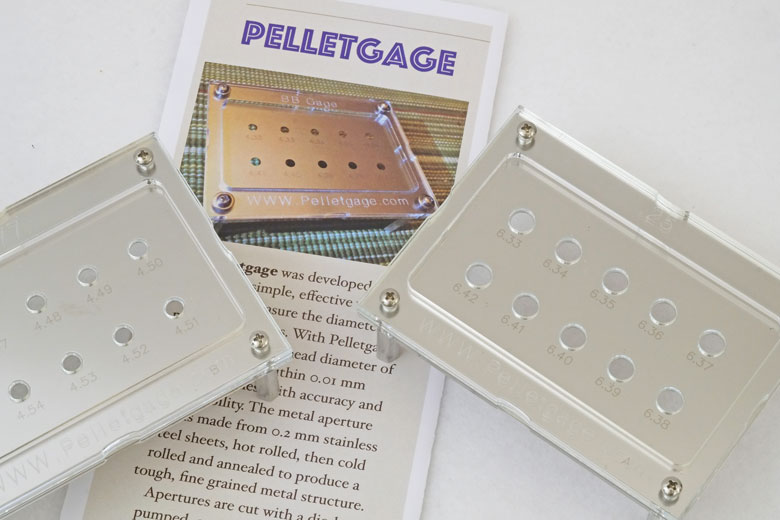
First, let’s give the pellet manufacturers some congratulations!

Given that they’re mass-manufacturing and selling pellets for just a few cents each, the quality is really amazing. It’s clear to any enthusiast that the overall quality and consistency of our pellets has improved greatly over the years.

The head diameter of a pellet determines how deeply it engages with the barrel’s rifling. Variations in this degree of engagement can alter the Muzzle Velocity and result in downrange accuracy issues.
Today, Let's Talk Pellet Consistency!

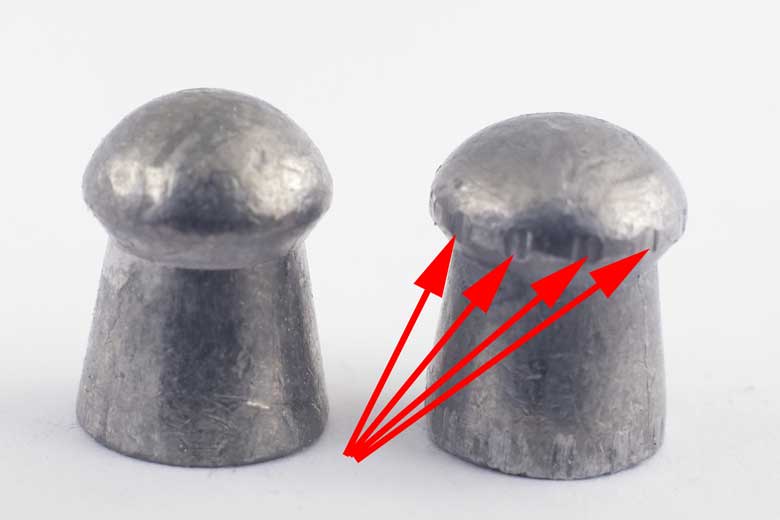
The photograph below shows two pellets of the same type. That on the left is un-fired. The one on the right has been fired. Grooves caused by the pellet’s head engaging the rifling are highlighted by the arrows. (The skirt also shows some grooves, as you can see).

As a result of a TON of measurement, we find that – on average – pellets work-out to have head sizes slightly larger in diameter than the nominal barrel diameter.

In fact, pellet head diameters average 0.51% larger than the caliber. This makes sense as – if the head diameter were to be smaller than the bore, the head would not engage with the barrel’s rifling and accuracy would be terrible!

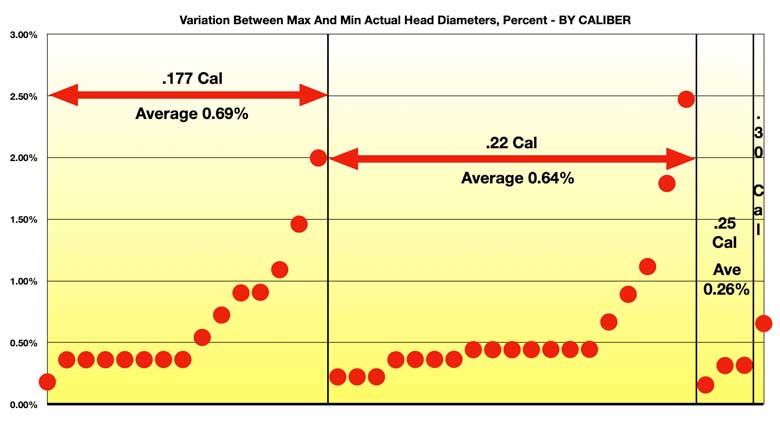
The average difference in diameter between the smallest and largest pellets in a tin can be as high as 2.5%. But typically it’s more likely to be around 0.5%, as we can see here from this chart.

Today, Let's Talk Pellet Consistency!

Generally, larger calibers tend to have head diameters that are proportionally greater, as we’ll see below.

Furthermore, heavier pellets in any specific caliber will tend to have head diameters that are larger. Lighter pellets in a specific caliber tend to have head diameters that are closer to the nominal bore size.

Take look at this chart…

Today, Let's Talk Pellet Consistency!

As this chart shows, the percentage by which pellet head diameters measure above the nominal bore diameter increases with caliber. So – for example – .22 caliber pellets have greater head engagement in the rifling than do .177 caliber pellets.

It would be reasonable to expect that rifling depth is likely to be greater in larger bore diameters, so that makes sense.

But as we can see from the next chart, the variation in head diameter between the smallest and largest pellets in a tin tends to be greater in .177 cal than it is in .22 caliber.

Today, Let's Talk Pellet Consistency!

That tells us that  – on average – there’s likely to be somewhat more benefit to sorting pellets if you use .177 caliber than if you shoot .22 cal. However, in each caliber a good number of pellets tested showed a difference of 0.02 mm – that’s about 8/10 of a Thou – between the largest and smallest in a tin. It’s the outliers that make the difference!

If we take the same data and express it as a percentage, the average difference between largest and smallest is less in .22 caliber than it is for .177. This is basically because a similar level of consistency is being applied to a different diameter. (The larger the bore diameter, the smaller the percentage).
Today, Let's Talk Pellet Consistency!

All-in-all, this analysis demonstrates remarkable consistency in airgun pellet head diameters. However, it also demonstrates that – for best results downrange – sorting pellets for consistent head diameters is extremely valuable.

Consistent downrange accuracy requires consistent pellets. Somehow I very much doubt that any top competitors in Extreme Benchrest fail to sort their pellets!

For information, the pellet test data analysis here is based on measuring a total of 3,800 pellets. As you can see, there’s more data for .177 and .22 cal than for the larger calibers. But the general trend is pretty clear.

If you’re interested in accurate shooting and don’t have your own PelletGages yet, it’s time to buy some! They’re available in five common airgun calibers. There’s .177 and .22 calibers, of course, together with.20 cal, .25 and .30 caliber. AoA has them in stock…

New Airgun Ammo Choices at AoA

At a time when airgun ammo is – if not exactly limited – less plentiful than usual, your friends at Airguns of Arizona have been introducing new brands of pellets and slugs. And they’re in stock!

First The Pellets

New Airgun Ammo Choices at AoA

Norma is a familiar name among powder-burning shooters, but now they have introduced a range of airgun pellets. And AoA is among the first to have them in stock! They’re not on the website right now, but they’re definitely on the shelves – I’ve seen them myself.

You can order when you phone-in…

To start with, Norma pellets are available in .177 and .22 calibers only. There’s four different styles in each caliber, making a total of eight SKUs.

New Airgun Ammo Choices at AoA

Norma S-Target Match pellets are flat-head, wadcutter pellets. These are intended for short-range target shooting in airguns with muzzle energies below 12 Ft/Lbs where the ability to create a nice, sharp hole in paper is a primary consideration.

Superpoint Strike pellets have a sharply-pointed head design. They’re primarily intended for hunting use. Being relatively light weight, the manufacturer says that they’re most suitable for use in air rifles with muzzle energies below 18 Ft/Lbs. That represents muzzle velocities of about 1,000 FPS in .177 caliber and 750 FPS in .22 cal.

In addition, there are two domed-head designs. Norma Golden Trophy FT and Golden Target FT Heavy pellets. Given this design, these are general-purpose pellets that are suitable for use on reactive targets and for hunting.

New Airgun Ammo Choices at AoA

The difference between these two domed pellets is primarily weight and length. The length difference is shown in our comparison photograph above. Norma says that the lighter version is most suitable for airguns with less than 18 Ft/Lbs muzzle energy. (Around 990 FPS in .177 cal and 730 FPS in .22 cal).

The Golden FT Heavies are slated for use with air rifles having muzzle energies greater than about 18 Ft/Lbs.

New Airgun Ammo Choices at AoA

Norma pellets have competitive Ballistic Coefficients too. For example, the .22 caliber 17.6 Grain Golden Trophy FT Heavies have a BC of 0.023. The Golden Trophy “non heavies” clock-in with a BC of 0.019 in .22 caliber.

All Norma .177 caliber pellets are packed in tins of 300 and have an MSRP of $9.99. In .22 caliber, it’s 200 per tin with an MSRP of $9.99.

Now For Slugs

New Airgun Ammo Choices at AoA

ZAN Projectiles is a manufacturer of premium airgun slugs that’s based in Ljubljana, the capital city of Slovenia. Slugs are their passion and business – and now they’re in stock and available in the USA from Airguns of Arizona.

These swaged lead slugs include a deep hollow point and dish base. The use of soft lead leads to significant expansion in the target – even at long range or with low muzzle velocity. This means that they could be a great choice for hunting!

ZAN Projectiles slugs are available in .22 and .25 calibers. The diameters are sized to .218 Inches (5.53 mm) for the 22s and .250 Inch (6.35 mm) for the 25s. Currently, Airguns of Arizona has five weights available in .22 cal and seven in .25 cal.

Our photograph below shows (from left to right) .22 cal, 23 Grain; .22 cal., 25.5 Grain; .22 cal., 28 Grain and .25 cal., 33 Grain slugs.

New Airgun Ammo Choices at AoA

Slugs of all calibers and weights are packed individually in trays of 100. There are two trays to a pack, making for 200 slugs per box.

The packaging is both well thought-out and stylish! Each tray is surrounded by a card sleeve with a colorful target printed on each side. To aid with measuring group sizes, there’s a ruler printed on either end – one Metric, the other Imperial units.

New Airgun Ammo Choices at AoA

So you actually get 200 slugs plus four targets and four rulers per pack!

The photograph below shows a .22 caliber, 28 Grain slug.

New Airgun Ammo Choices at AoA

Ballistic Coefficients for .22 caliber ZAN slugs range between 0.075 for the 23 Grainers to 0.107 for the heaviest 33 Grain projectiles. Of course, the heavier the slug, the higher the BC.

In .25 caliber, the BCs range up to 0.108 for the 41 Grain slugs.

Prices are in the $21.00 to $22.00 range for boxes of 200 slugs.

As everyone knows, it’s tough for any company to keep products in stock right now – in any industry. As you would expect, AoA is going the extra mile to ensure that they have ammo in stock for your favorite airgun!

Daystate Juggetnaut Slugs

Daystate has announced the launch of Juggernaut slugs. And the first shipment is on it’s way to Airguns of Arizona right now!

From a market that didn’t exist 2-3 years ago the range of available airgun slugs has exploded to a market full of different weights, brands and sizes.

Daystate Juggetnaut Slugs

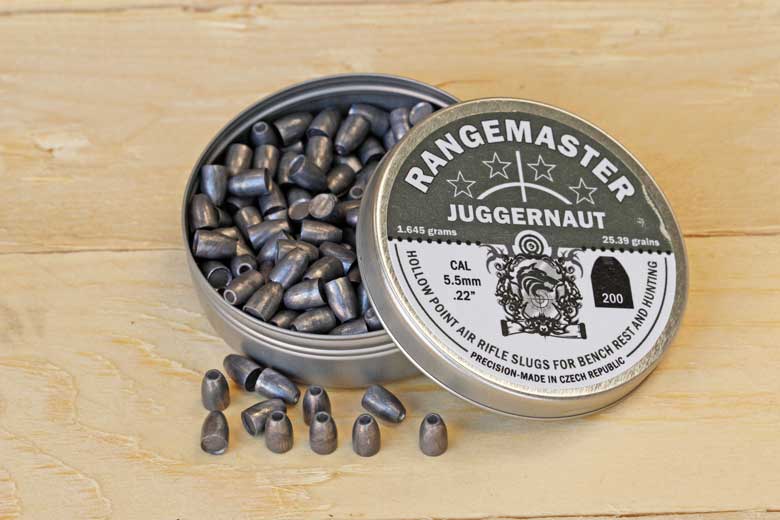
Daystate has cut through this with it’s Rangemaster brand. The company has adopted and branded this .22 caliber, 25 Grain hollow point slug as its contender of choice…

And what a choice!

Through exhaustive testing by its Accuracy Research Team (ART), Daystate continues to develop its Rangemaster-branded airgun ammunition in collaboration with the world’s finest pellet manufacturers.

After testing around 20 different types of slugs, the latest ammo to be adopted in this ongoing program is the new Rangemaster Juggernaut – a .22 calibre slug.

Daystate Juggetnaut Slugs

Extensive performance tests – on the range and in the field – over the past year have proven this 25.39-Grain, solid-body slug to produce a superior level of accuracy in both high power Daystate and Brocock air rifle models, says the company.

They say this extends also many other air rifles with power output levels in excess of 30 Ft/Lbs.

Daystate’s Accuracy Research Team was set up 3 years ago to specialize in accuracy testing of a new type of barrel. This soon expanded into pellet testing and the ‘ART’ is now tasked with testing and selecting all the pellets available on the market and adopting the best into the Rangemaster Brand of Ammunition.

Sometimes this can mean not only testing pellets from many different manufacturers but many different weights and head sizes to select the best available. Though the ART team specifically test with Daystate and Brocock rifles, the rule of excellence will most often apply to other makes of airgun as well.

So why shoot slugs?

Daystate Juggetnaut Slugs

The design of slugs is similar to that of traditionally-shaped bullets. When applied to an airgun a slug usually has a better Ballistic Coefficient than a pellet.

What this means in practice is that Juggernaut slugs retains a lot more energy at extreme ranges compared to traditional airgun pellets.

But The ART team didn’t have an easy time of it! Trials revealed that it’s not always so easy to get better results with slugs than pellets. So a lot of development work was needed to ensure that short range accuracy would at least match that of a quality pellet.

The Daystate Juggernaut slug is the team’s answer producing phenomenal accuracy right out to 100 Yards and beyond.

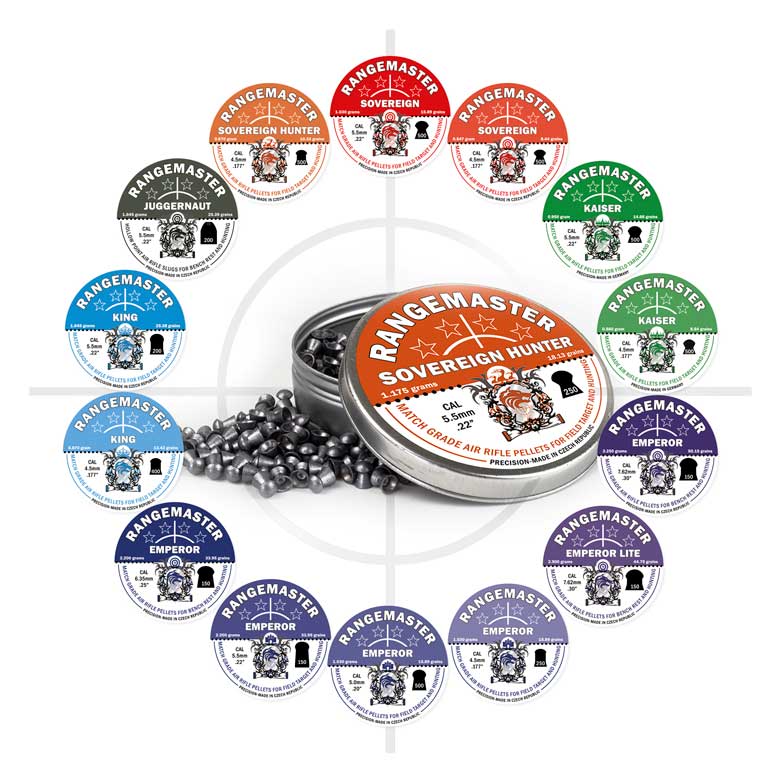
The Juggernaut .22 now joins a range of 18 other pellets in the Rangemaster brand with each type is given it’s own sub brand relating to the power it is recommended for.

Daystate Juggetnaut Slugs

If you have a high powered .22 caliber Daystate rifle like the Red Wolf, or a Brocock Commander or Sniper, it’s definitely be worth trying a tin (or three) of these new Juggernauts if you shoot at long range.

Supplied in new, easily identifiable colour-coded tins, Daystate says Rangemaster is the airgun ammo line that’s got every shooting scenario covered.

The company also says that more additions to the Rangemaster brand will be coming soon. Keep checking this blog and the AoA ammo page for the new additions…

Maybe it’s just me, but I’ve always been a little confused about the names on JSB pellet labels. So I checked around with some friends and they weren’t too sure either…

But it was also clear to me that obviously JSB has a system behind the words on its pellet labels. It’s just that I had not been able to comprehend it!

So, some time back, I spoke to Pavel Kolabec – JSB’s main man – and asked for his help to translate the meaning of the words on JSB pellet labels.

As you might imagine, it’s actually quite simple when you know! Pavel did explain also that these names have grown up over the many years JSB has been manufacturing pellets. This means that some of them have a more complex, historical, logic behind the name that I’ve omitted here for simplicity.

So here is your easy-to-follow guide to understanding JSB pellet labels.

Below, the JSB Exact Diabolo 8.44 Grain pellet. Exact means .177 caliber.

Calibers

Firstly, it’s important to know that some of the words on JSB pellet labels actually describe the caliber of the pellets. These words are used in many cases instead of the numeric caliber itself.

However, some calibers are actually identified by numbers. For example .20, .35 etc.

A Guide To JSB Pellet Names

Weights

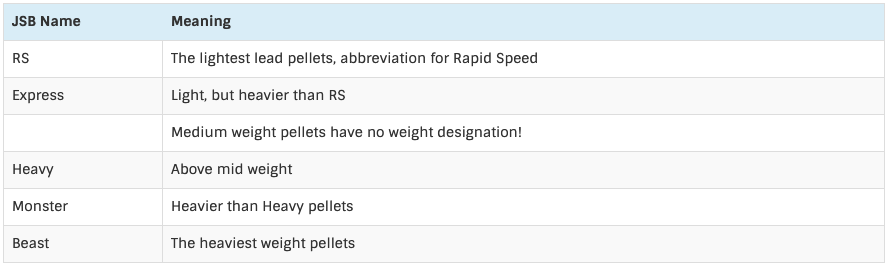
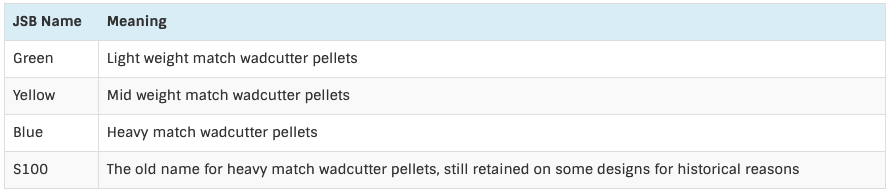
Some of the words are used to describe the general weight of the pellet. The precise weight is also indicated on the label in Grains and grams, of course. And note that there’s no name on JSB pellet labels for middle weight. It’s a middle weight pellet if there is no other weight name on the label.

A Guide To JSB Pellet Names

Below. The JSB Jumbo Monster is a .22 caliber, super-heavy pellet. In fact, it weighs 25.39 Grains.

A Guide To JSB Pellet Names

Pellet Types

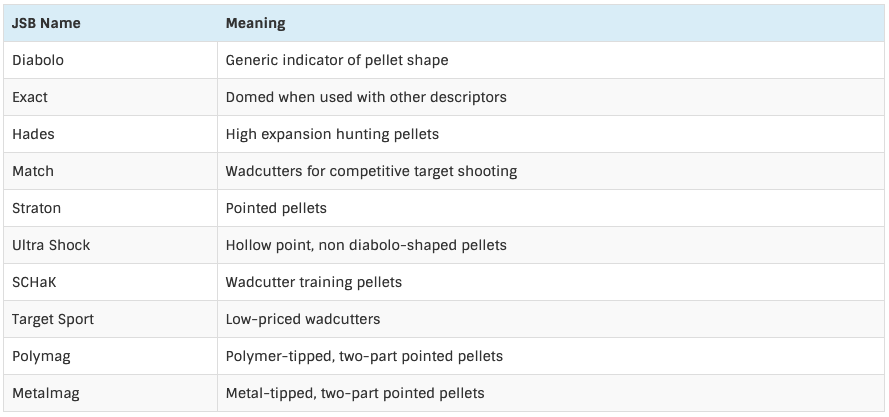
Some of the words indicate the pellet type. These can cover the pellet shape, or its intended use. Like these…

A Guide To JSB Pellet Names

Note that EXACT is also used as an overall brand name on many JSB pellet labels.

More Pellet Types

There are also other descriptive words used for more pellet types. Really, I just broke these out to avoid making the previous table too long and complex to read!

Below. JSB King Heavy pellets are for .25 caliber and weigh 33.95 Grains.

A Guide To JSB Pellet Names

Special Match Pellet Types

Given JSB’s historical background in developing and manufacturing wadcutter pellets for precision match competition, it’s not surprising that there’s also a group of names specifically dedicated to this type of airgun sport.

So that’s it. Really it’s easy and obvious to understand JSB pellet labels when you know how! I hope that this guide will help you in future.

Of course, you can find a wide variety of JSB pellets in stock at Airguns of Arizona.

JSB Hades Pellets - The Hunter’s Choice

JSB Hades pellets are a new range of products from the famous Czech manufacturer. Designed specifically for hunting, they have been rolled-out in caliber sequence.

Hades pellets were first announced in .22 and .25 calibers at the 2019 SHOT Show. Smaller – .177 caliber – versions were announced at the 2020 SHOT Show and should be available here in the USA by Summer.

This means that the Hades hunting pellet line-up will be as follows:
– Hades .177 cal. 10.34 Grains weight.
Hades .22 caliber 15.89 Grains.
Hades .25 cal 26.54 Grains weight.

JSB Hades Pellets - The Hunter’s Choice

Like the .22 and .25 caliber pellets, the .177 cal JSB Hades pellets are dedicated, high impact hunting ammo. The larger caliber versions have already achieved a great reputation with airgun hunters. I’m sure that this will also be the case for the smaller caliber pellets!

Does the Hades design work? Just take a look at the before and after photograph below. That expansion on impact clearly results in a devastating wound channel – exactly what is required for ethical, “one shot kill” airgun hunting.

JSB Hades Pellets - The Hunter’s Choice

The Hades design has a heavy head with a long skirt and slight waist. The head is divided into three sections, the intention being that it promotes mushrooming in the target.

JSB Hades Pellets - The Hunter’s Choice

However, each caliber is slightly different in profile, as we can see from these photographs. That’s .25 caliber Hades pellets above and .177 cal pellets below.

JSB Hades Pellets - The Hunter’s Choice

I tried shooting 15.89 Grain Hades pellets with the .22 caliber Brocock Sniper XR Magnum air rifle as part of its recent review. Accuracy proved to be outstanding at 30 Yards with the Brocock’s power adjuster set in the second position.

Why not full open? Well the Sniper Magnum was actually too powerful for the Hades pellets when shooting at the full power setting. Muzzle Velocity exceeded 1,000 FPS in .22 in full power.

Setting 2 on the power adjuster gave an average muzzle velocity of 927 FPS. That’s 30.32 Ft/Lbs of muzzle energy – a very good value!

I have also undertaken some informal shooting tests with the pre-production sample JSB Hades .177 cal pellets. They have worked well in a variety of air rifles, ranging from a Benjamin Marauder, through a Umarex Gauntlet to a Umarex Fusion 2.

If you’re an airgun hunter – and let’s face it, there’s not many airgunners who are not – JSB Hades pellets are a must to try in your air rifles. An accuracy test will obviously be in order to prove their suitability in your air rifle: you’re likely to be impressed both with the accuracy and impact characteristics as I have been!

Finally, you know where to find these great hunting pellets. It’s at Airguns of Arizona, of course!

You Need To Check Your Pellets With A PelletGage!

The PelletGage is a simple-to-use device that is able to to determine the head size of pellets in 0.01 mm (ten micron) increments. Actually, it’s an extremely precise “go – no go” gauge

It is currently available in five common airgun calibers. There’s .177 and .22 calibers, of course, together with.20 cal, .25 and .30 caliber

Most air rifle shooters are interested in accuracy. They know know that their guns “like” – that is, shoot most accurately with – a particular pellet or pellets. In many cases, this may be due to the head size of that particular pellet.  Pellet dimensions actually vary significantly between different designs and the head diameter is a particularly critical measurement.

That may not be too surprising, but it’s more surprising to discover that head size can vary significantly between the “same” pellets from one tin!

Testing has shown significant size variation in tins of quality pellets, and differences of mean diameter between tins of the same size and weight. This may be a key to finding that next tin of pellets that shoots so well.

Here’s an example of this variation in head diameter for JSB Redesigned Monster pellets. These are a high quality pellet, of course. But even so, you’ll see that there are two “fliers” with head diameters slightly outside the 5.56 mm aim from the 50 pellets that were measured.

You Need To Check Your Pellets With A PelletGage!

If we look at a lower-quality, anonymous pellet, we can see a much wider spread of head sizes. It’s not difficult to see that these pellets are likely to be less accurate than the JSBs…

You Need To Check Your Pellets With A PelletGage!

The PelletGage allows us to know the diameter of the pellet’s head, and to make that determination quickly. It allows us to check the pellets in one tin for consistency.

Each PelletGage has ten round apertures precisely cut into a thin metal sheet. These apertures allow a range of head sizes to be measured for each caliber.

To use a PelletGage, roll or drop the head of the pellet into the smallest expected aperture.

If the pellet head is larger than the selected hole, it will not drop into the opening. Move up to the next larger size(s) – diameters are etched in the metal – and the pellet will drop partially through aperture, caught by the skirt.

This establishes the size range of the pellet head as being between the largest aperture it won’t clear, and the smallest that it will. That’s why this type of gauge is commonly called a “go no-go”.

You Need To Check Your Pellets With A PelletGage!

With a PelletGage, you can rapidly sort pellets by size, or simply to give you an accurate measure of the head diameter of that new tin of pellets you just received.

Once you know what diameter your gun “likes”, you can take steps to get that same diameter for better shooting results. You’ll be confident of consistent accuracy, whether you’re hunting with your air rifle, or shooting field target competition – so long as you and the gun do your part, that is.

Note that the PelletGage is a measuring tool. It’s not intended to “size” or change the diameter of any pellet.

Measuring the diameter of a round object isn’t easily done. Normal micrometers and calipers can measure one chord or section across the object only.

PelletGage is more accurate, repeatable, and faster than using calipers or micrometers. Also, it doesn’t demand the skill of using those devices. Lead pellets are very easily damaged and you could damage the very pellets you are measuring by incorrect use of calipers or a “mike”.

So why does the PelletGage measure head diameters in mm (millimeters)?

This is because many high quality .177 caliber pellets used for precision field target shooting are manufactured in Europe where they use metric units, such as mm. So, the head diameters of these pellets are designed to be 4.51/4.52/4.53 mm, etc. rather than .177/.178 inches etc.

You’ll often find this manufacturing aim diameter printed on a sticker on the bottom of H&N pellet tins. It’s 5.53mm in this example, below.

Check Your Pellets With A PelletGage!

Actually, each 0.01 mm step is actually 10 microns, or 0.0004 inches. That’s four tenths of a thou – about the width of a human hair. The accuracy of the holes in a PelletGage is assured by a state of the art laser cutting technique, combined with special alloy sheet steel. The tolerance is +/- 0.0025 mm of indicated inside diameter. That’s precision!

The Pelletgage is available from your friends at Airguns of Arizona. If you’re interested in shooting accurately – and who isn’t? – you need one for each caliber of pellets you shoot.

Let's Take A Visit To Crosman

Crosman has been a fixture of the Rochester, New York, area for nearly 180 years – although at first not as an airgun company. Back in 1838, when Rochester was still on the wild frontier of New York State, and 23 years before the start of the American Civil War, a certain Fred Crosman founded a seed company in the city. Amazingly, the Crosman Seed Company is still alive and well, operating successfully in the area.

However, in 1923, Bertram Fenner, then the Operations Manager of the Crosman Brothers Seed Company, reached an agreement with one William McLean to produce pellets and an air rifle based on McLean’s designs. In 1924 the Crosman Rifle Company was formed and, with several changes of name and ownership since, has become the company we know today as Crosman Corporation.

Over the course of time, Crosman has grown from a 6-person company in 1940, to the large corporation we see today. In 1992, Crosman acquired Benjamin Sheridan – another major US airgun manufacturer and cemented its position as by far the largest American manufacturer of airguns. Of course, the Benjamin name is now used as the brand for Crosman’s adult hunting and high performance models.

Below. Versions of the 392 and 397 air rifles are still made today, using traditional brass tubes.

Let's Take A Visit To Crosman

From the early days, Crosman specialised in multi-pump and CO2-powered airguns. This line of development has been pretty well unbroken to the current day, with the addition of PCP models and breakbarrel air rifles.

The Company Today

In 1971, Crosman moved to a large new, purpose-built location in the rural village of East Bloomfield. This has been the company’s headquarters and manufacturing centre ever since.

And if you think Crosman’s 250,000 Square Foot headquarters is big – it really is!

Let's Take A Visit To Crosman

You also then need to add a huge, separate Finished Goods warehouse a few miles away that itself is certainly as large as any other in the airgun industry. Well over 200 people work at Crosman. Like many companies with seasonal swings in manufacturing, the number varies with manufacturing demand.

Both Crosman, as a corporation, and its employees are very proud of the fact that the majority of its products are actually manufactured in the USA. You can read that as “not manufactured in China”.

Like any large manufacturing operation, Crosman sources products from multiple different suppliers in different countries. For example, it makes no sense for it to manufacture the screws and O rings used in its guns (no-one else does, either). But it designs most products in-house and manufactures many parts, too, including barrels, breeches and pressure tubes.

Here’s another part of the assembly floor…

Let's Take A Visit To Crosman

Yes, there are Chinese-manufactured Crosman (and Benjamin) airguns, these are mainly the spring/piston and gas ram breakbarrel models. But even here, the company has been steadily bringing assembly back to the USA over recent years, on a model-by model basis.

Below, huge numbers of 760 barrels line up awaiting assembly.

Let's Take A Visit To Crosman

Crosman’s longest-running model – the 760 multi-pump air rifle – has always been manufactured in-house. Since 1966, 17 Million 760s have been sold in the USA and – incredibly – every one is test-fired before shipping to ensure quality control. There’s not many airgunners in the US who have not owned a 760 in their youth and had their enthusiasm for airguns fired by it

The Benjamin Marauder – long the most popular PCP air rifle in the US – is also manufactured in the East Bloomfield factory. And again, every one is tested for accuracy and muzzle velocity before it’s shipped out on the test fixture below.

Let's Take A Visit To Crosman

All-in-all, Crosman produces about 1.1 Million airguns every year and claims to be the US market leader in numbers of airguns sold. With numbers like that, I’m ready to believe it…

There’s Much More Than Airguns

Although airguns are the sexy products in our world, there’s lots more going on at Crosman’s factory than that.

Let's Take A Visit To Crosman

The company is a major manufacturer of airgun pellets. And when we say “major”, we actually mean “MAJOR!” as the Bloomfield factory pumps out around 3 Million pellets every day – seven days a week. That’s over a BILLION pellets a year and explains why Crosman pellets are found at just about every shop across the USA where you can buy airguns and in many other countries around the world.

Don’t forget that the Crosman factory also bangs-out a massive number of BBs a day, too. In fact, you can make that ten times more BBs than pellets. I lost count of the number of zeroes involved at that point…

Crosman introduced the now-ubiquitous 12 Gram CO2 capsule in 1954. They’ve been making them ever since and currently produce around 140,000 CO2 “Powerlets” every day. That’s a lot of gas!

Quality And Efficiency

Let's Take A Visit To Crosman

Crosman is also focussing hard on quality. The company’s Manufacturing Engineer Nic Hargarther took me through many of the improvements Crosman is making to barrels and pellet quality, in particular. That’s part of their barrel inspection system seen above.

The culture of continuous improvement is very striking on the production floor, with great emphasis on parts quality and efficient manufacturing practices.

Although Crosman uses many automated manufacturing systems – how else could they make so many pellets, BBs and Powerlets? – it’s interesting to see that the airguns themselves are all still assembled by hand. The factory is full of multiple small production cells, each one focussed on a specific product (or range of products), with dedicated operators who take pride in their work yet still made time to good-naturedly tease me for “speaking funny”!

Back To The Future

Looking back over nearly 100 years of airgun history, it’s clear that, although Crosman has successfully stuck to its knitting over the years, the company has not been afraid to innovate and enter new markets. Walking around the company’s airgun museum at the factory makes that clear.

Below, there’s a substantial museum at the plant containing examples of just about every model the manufacturer has produced.

Let's Take A Visit To Crosman

Crosman was involved in paintball when that was hot and has been a large player in the airsoft market for years. It also produced an early, electronically-controlled big bore airgun – the Benjamin Rogue – that was arguably ahead its time.

More recently, the Benjamin Airbow is an innovative PCP “airgun” that shoots arrows with the power of a crossbow – make that a cool 168 Ft/Lbs of Muzzle Energy – and opens-up a whole new field of hunting large game with air power.

Thanks, Crosman

Last, but not least, I’d like to thank everyone at Crosman for their help in compiling this story. They were all very generous with their time and information. And they gave me access to every part of the company I wanted to look at – and more…

Let’s Talk Pellets - A Daystate Rangemaster Sovereign .22 Cal Pellet Review

It’s my strong conviction that – even now – people spend too little time thinking about pellets!

Many airgunners I know spend endless time and effort on their air rifle, but more-or-less take the pellets for granted. In fact, there’s much to be gained by a careful choice of pellets, as we’ll read in this post…

They’re Great Value.

Daystate Rangemaster Sovereign 15.9 Grain .22 caliber pellets are manufactured by JSB in the Czech Republic specifically for Daystate.

These dome head pellets have been selected and tested to work reliably in Daystate PCP air rifles without further selection. They are intended for use in high-powered, long range PCPs fitted with Lothar Walther barrels.

As these pellets are used to test guns at the Daystate factory, that would clearly seem to be an strong validation of that claim!

However, as you would expect, they also work well in many other air rifles, too.

Let’s Talk Pellets - A Daystate Rangemaster Sovereign .22 Cal Pellet Review

Daystate Rangemaster Sovereign .22 caliber pellets are priced at $16.95 for a tin of 500. This makes the cost of each pellet 3.4 cents. This is surprisingly cheap and makes these pellets an absolute bargain!

As a heavy domed pellet, these Daystate Rangemaster Sovereign pellets are normally used for hunting and other general shooting. Of course, JSB has an outstanding reputation for producing quality pellets. So – combined with the Daystate name – expectations are high for the Rangemasters.

Detailed Test Results.

We tested these pellets in considerable detail and here’s the results…

Achieving a consistent head size is a major aim for most pellet manufacturers. For the Sovereigns we tested, it was extremely well controlled. No less than 88% of the tested pellets had a head diameter of 5.52 mm, with a very few outliers – only 0.01 mm (that’s less than 4 Thou) smaller or larger – on either side of this as you can see from the chart below.

Let’s Talk Pellets - A Daystate Rangemaster Sovereign .22 Cal Pellet Review

The actual average weight of the pellets we tested was 15.88 Grains. This is within 0.02% of the claimed weight of 15.9 Grains. Very close indeed!

So, the average weight of the Daystate Rangemaster Sovereign 15.9 Grain .22 caliber pellets we tested was very, very close to the claim at 15.88 Grains. However, only 6% of the tested pellets actually weighed 15.90 Grains.

Ten percent of the tested pellets weighed 15.91 Grains. This was the most common weight, as we can see from the chart below.

Let’s Talk Pellets - A Daystate Rangemaster Sovereign .22 Cal Pellet Review

The lightest pellets tested using our “laboratory grade” milligram balance weighed 15.65 Grains. The heaviest 16.07 Grains. That’s a variation of 2.7%.

Twenty percent of the Daystate Rangemaster Sovereign 15.9 Grain .22 caliber pellets we tested measured 7.46 mm in length. The shortest pellets measured 7.41 mm, the longest 7.59 mm, that’s a spread of 2.4%.

Let’s Talk Pellets - A Daystate Rangemaster Sovereign .22 Cal Pellet Review

Such consistency in manufacturing is a major cause of both consistent muzzle velocity and accuracy.

As a  part of this comprehensive pellet-testing procedure, we washed the pellets and weigh the amount of dust that’s an inevitable by-product in the manufacture of lead pellets.

The tin of Daystate Rangemaster Sovereign 15.9 Grain .22 caliber pellets we tested contained 0.23 Grains of dirt. That’s 0.046 Grains per 100 pellets, or 0.00266% of the pellet weight. That’s extremely low and another indication of quality manufacturing!

Downrange Performance.

We tested the actual Ballistic Coefficient for these pellets using a Labradar Doppler radar system and found it to be 0.029. This is exactly the same figure as claimed by Daystate. It’s also relatively high for a .22 caliber domed pellet and indicates strong downrange performance.

Due to the high BC of these pellets, they retain 70% of that initial Muzzle Energy out at 45 Yards. So, it’s clear that the Daystate Rangemaster Sovereign 15.9 Grain .22 caliber pellets are suitable for hunting at long ranges, especially when fired from a powerful PCP air rifle, as intended.

Packaging.

Daystate Rangemaster Sovereign 15.9 Grain .22 caliber pellets are packed in a push top tin. There’s a disk of foam inside the tin so provide protective padding during transport. The large diameter tin matches the volume of the pellets and padding well, so no rattling is heard when the full tin is shaken.

Let’s Talk Pellets - A Daystate Rangemaster Sovereign .22 Cal Pellet Review

I’ll go on record as saying that I much prefer screw-top pellet tins. I tend to have unintended disasters when opening push-top tins and one happened to me during this test!

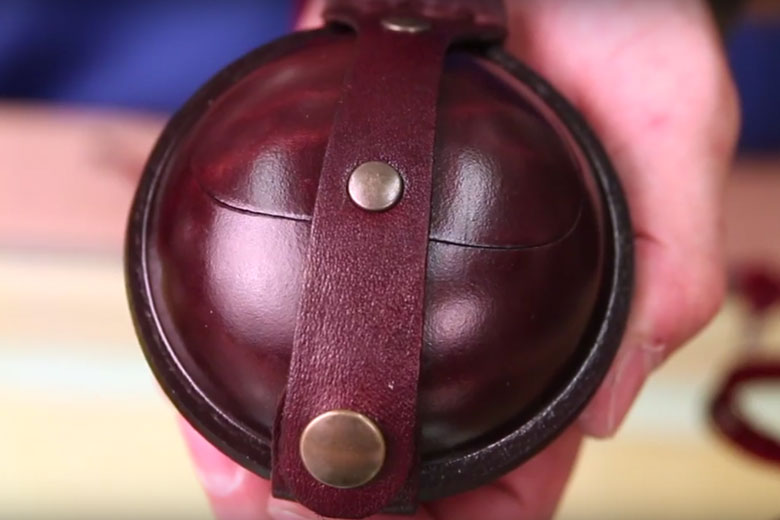
Of course, that’s the reason to decant your pellets into one of those beautiful leather Wilkins pellet pouches before you go shooting…

Let’s Talk Pellets - A Daystate Rangemaster Sovereign .22 Cal Pellet Review

And, of course, the Daystate Rangemaster Sovereign pellets are, of course, very far from the only ones that ship in push-top tins!

Summary.

Daystate Rangemaster Sovereign 15.9 grain .22 caliber pellets combine good manufacturing consistency with a below-average price.

The head diameter, in particular, was extremely consistent. These are also very clean pellets.

That’s a great combination. If you’re shooting .22 caliber and not using these pellets, they’re definitely worth trying.

But even with such good manufacturing quality, it’s clear that all pellets are not absolutely identical. If you’re looking for match-winning performance, it’s definitely worth washing and sorting your pellets, even when you’ve found the “perfect” pellet for your gun.

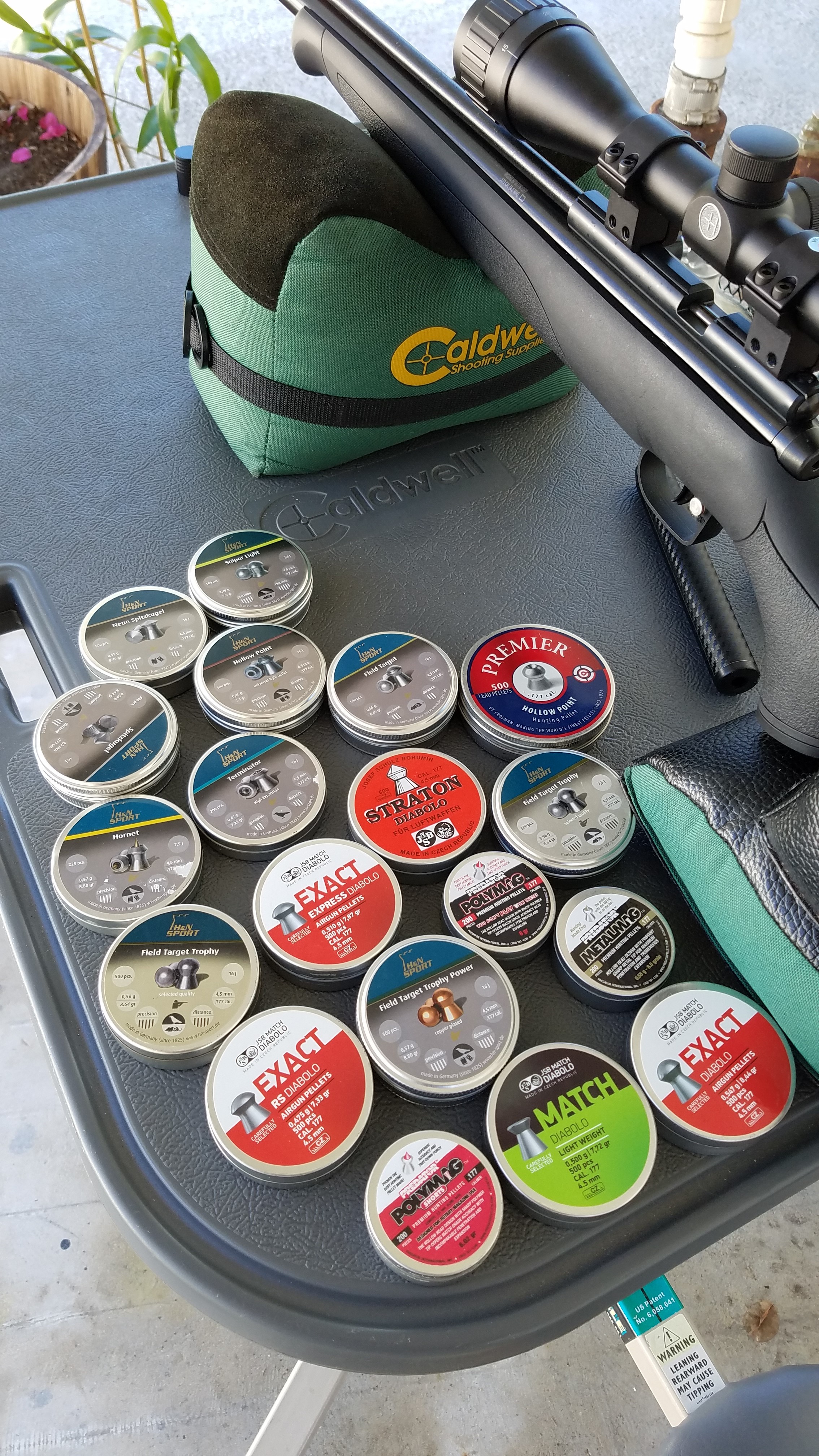
When you do a career 180 and begin to spend your work week reviewing airguns, there’s a certain phenomena and awareness that quickly turns to clarity… when seeking the one, you’ve got to try all brands and offshoots of a manufacturer’s pellet and you’ve got to cull with 10 shot groups. Yesterday for example, I spent the day getting familiar with the new Benjamin Maximus Euro, the 12fpe variant that our brethren in the U.K. have access to (and us as well). As always before shooting video, I’ll spend 2-3 days familiarizing myself with the gun’s tendencies & preferences in order to streamline my time come video day. What did I learn this week? … the branding phenomena is reality and my above discovery is true.

Take the below for example:

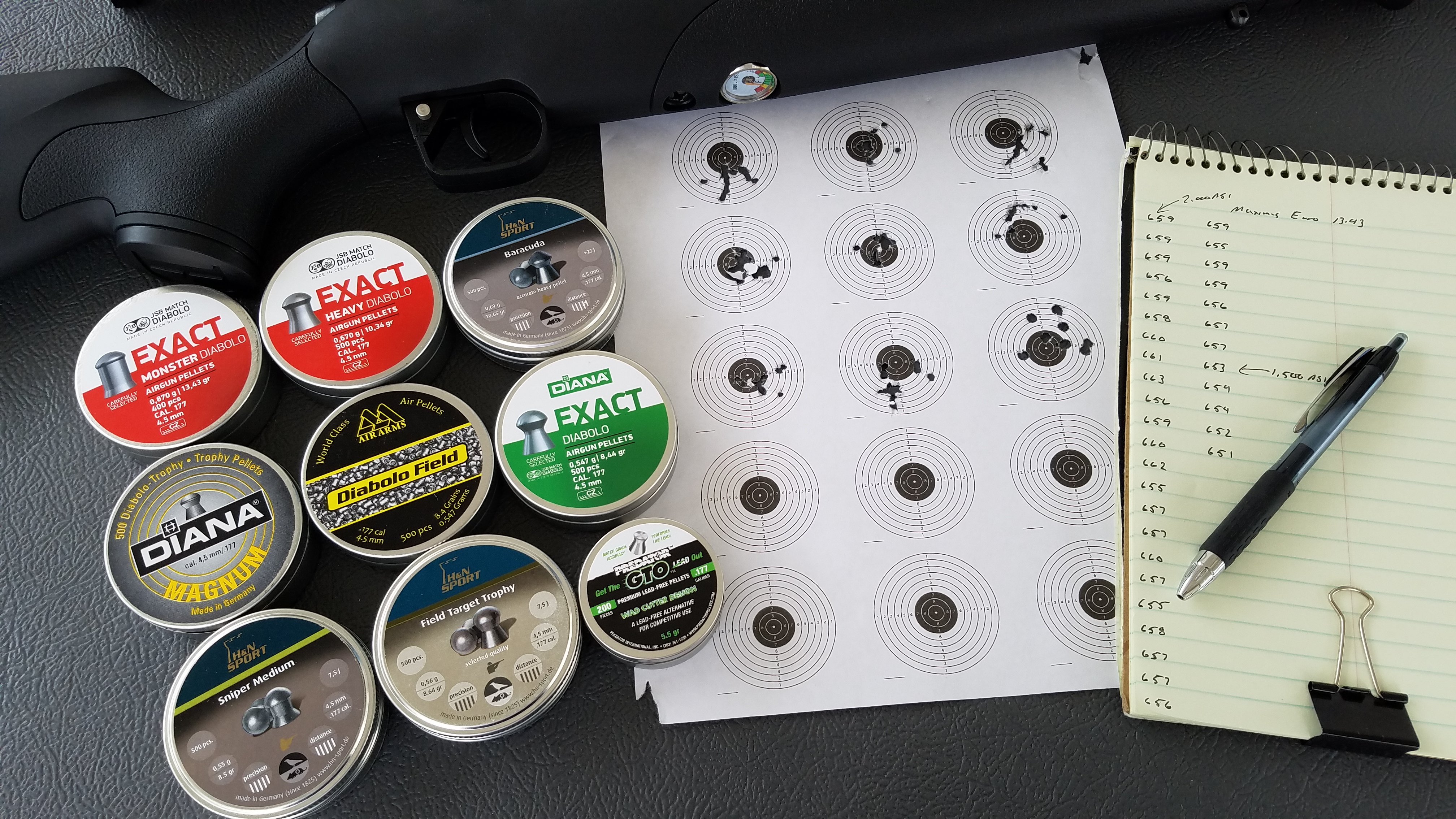
These are 5 shot groups at 25 yards experimenting with 6 different brands of pellet. I came away from the session thinking the Maximus Euro was a shooter across 4 of the 6 pellet types and in my mind, I’m starting down the path of, “This rifle isn’t pellet fussy at all… but I need to run some more brands through it to confirm.”

But is it?…

I spat all of the above through the Euro and confirmed that I could scratch them off the list. 1-2” groups at 25 certainly wouldn’t work for YouTube land… I’d be leaving this rifle’s reputation permanently scared and forever lost in the airgun graveyard. Having used up the day working through several rounds of culling and cleaning, I finally came away with 9, most of which I felt shot well enough to be consistently dangerous.

Check it out:

Now if you take a moment and study the above, you’re probably feeling fairly confident in a few of these groups, right? Don’t feel bad if you do, I did… that was until this morning when I funneled the assortment one final time and discovered the below takeaways:

Lesson 1: This rifle (and maybe yours) can keep to dime-sized groups 5 maybe 6 times across a good variety of pellets, but when you change the rules of the game, the picture begins to tell a different story. If you truly want to know what pellets your gun will be most consistent with, begin experimenting repeatedly with 10 shot groups and with lots of barrel cleaning in between batches. It’s clear to me now that Maximus Euro .177 is a dagger with the 8.4 gr Air Arms Diabolo Fields… 9/10 landed within .35” of one another. It also performed pretty well with the Diana Magnum and JSB 10.34… all three of which will accompany me on video day tomorrow.

This brings me to lesson 2: Have a another look at the above. The 8.4 gr Diana Exact is supposedly the same pellet as the 8.4 gr Air Arms Diabolo Field. JSB manufactures both and the forums will tell you they’re the same thing just re-branded… but I beg to differ. To me, it’s clear that this rifle performs better with one than the other. If that’s not enough to convince ya, have a look at the Diana Magnum and H&N Baracuda. This is the same scenario… H&N manufactures both brands and to the eye, they look the same… however, they clearly don’t perform the same out of this rifle. In yours, the reverse may be true.

What this means to us airheads is that before you give up on your rifle and call it a lemon, try all the brands and offshoots of a pellet manufacturer. JSB and H&N make most of them, and while seemingly disguised as the same thing, they are not. You’ve got to try them all. Then, once you think you’ve got things narrowed down, make your final decisions with 10 shot groups.

You’ll have a better time shooting & your prey will appreciate it.

YouTuber & Columnist
Steve Scialli

Happy New Year to our loyal readers from all the crew at Airguns of Arizona. Thank you for making 2014 a great year! We are looking forward to 2015, and already have big plans and wheels in motion for making this another great year in airgunning. Stay tuned in for up-and-coming posts, and please continue to comment with questions and feedback. We want this blog to be a service to its readers, and we welcome any thoughts or suggestions to make it even better.

Now we can not leave you without a product review of some sorts, so here ya go!

We often focus all our attention on the big items like air rifles and pistols, and in doing so, we overlook the smallest (yet possibly the largest) component to the airgun hobby…the pellets!!!

JSB is one of the premier makers of pellets today, and they are working hard to satisfy every need the market creates. Their latest design was made to focus attention on the .177 precharged market, where high power has been penalized by a lack of quality pellets in a heavy weight. The US is full of power hungry customers, but we are spoiled with an open market mostly without caliber or power restriction, so .177 is not our go-to choice when power is craved. Elsewhere in the world, however, there are limitations on caliber. India restricts all airguns to .177 exclusively, and other countries as well, so JSB was quick to respond to the growing need for a heavy .177 pellet.

For those who stay in tune with JSB’s line of pellets, you are likely saying “What about the JSB Exact Heavy .177 at 10.34 grains?” or “How about those 13.43 grains JSB Exact Monster .177 pellets?” Isn’t that enough weight for these power crazy airgunners???

JSB-Beast

JSB Beast .177 16.2gr. Pellets

Pavel Kolebac, Owner/Designer/Pelletmaster Supreme of JSB, took it even further with the new JSB Exact BEAST in .177.

JSB Beast a bit long for some magazines!

JSB Beast a bit long for some magazines!

These “little” pellets weigh in at a massive 16.20 grains and will overwhelm most magazines at an impressive 0.31 inches in length.

JSB-Beast-1

JSB Beast Cylindrical Design

The shape is what many call “cylindrical”, and is great for long range ballistics. The head is rounded, and the skirt is shallow, making them bullet-like in looks and function. Use of the Beast pellets should be limited to high power Precharged Pnuematics only, and even then we recommend use in .177 rifles designed to shoot at 25+ ft/lbs of energy. These JSB Beast pellets are good news for shooters using magnum rifles like the AirForce Condor, Daystate Air Ranger Extreme, or some of the Korean models. Each tin comes with 250 of these little beasts, and great care was given in packing them nice and secure for safe delivery.


Until Next Time,

Get Out and Shoot!