About Gordon Smith

By day I’m a mild-mannered manager of Critical Accounts at a large Enterprise Resource Planning company. By night I use my cat-like reflexes and Ninja skills to fight crime. No – wait, I’m exercising poetic license here. I don’t actually fight crime. Truth-be-told, I never had cat-like reflexes and no Ninja skills either. What I do have is a passion for all things airgun related. Over the past several years I have been dragged into the 21st century kicking and screaming, but now it is time to expand my comfort zone and jump into this whole blogging/social media business. My plan is to inform in an entertaining and enlightening way while adding to the general body of knowledge involving airgunning. A little background: My older brother had a Daisy model 25 that was well broken-in and he was an excellent shot. He taught me the basics and I coveted that rifle of his. My folks finally thought that I was mature enough to have my own air rifle by my 13th Christmas and so I became the proud owner of a Daisy model 1894 “Spittin Image”. Those were the beginnings of my life-long love affair with contraptions that sling projectiles downrange. I’ve now logged over 60 years on the planet and still have that Daisy. Actually, I believe it is in better shape than me, although it is 13 years younger… I enjoy the technical aspects of the airgunning game and tend to write from that prospective. I’ve competed in organized events a few times; however, the chance to attend formal matches is limited in my neck of the woods so competition will never become a forte of mine. Long ago and far away I taught Industrial Arts – yep, a shop teacher. I left the education game with all 10 digits intact and with my mechanical aptitude/curiosity alive-and-well and that is where my penchant for the technically oriented writing comes from. It has served me well as it led to a position as the Field Editor for Airgun Hobbyist magazine, currently the only hard copy and color format airgun magazine of U.S. origin. My articles have also appeared in a few other national publications in recent years. I appreciate the opportunity that Airguns of Arizona is entrusting me with and hope that you enjoy my humble contributions. Until next time, get out there and exercise that 2nd Amendment right! Regards, -Gordon
Posts by Gordon Smith

Happy New Year!

Every January the Shooting, Hunting and Outdoor Trades show comes to town. That is, if your town is Las Vegas, Nevada. Held at the Venetian Expo and Convention Center attached to the Venetian hotel, the show has expanded since that nasty virus hit and actually spills over into a new convention hall call the Caesar’s Forum. An elevated walkway allows attendees to traverse between the two exhibition halls.

It is a trade show dealing with all things related to shooting and hunting — whether it be firearms, airguns, bows or blowguns, etc. — or anything remotely surrounding those endeavors and includes both the military/law enforcement side as well as the civilian side of the aisle. The show is not open to the public and I consider myself very fortunate to be able to attend the show as media along with over 52,000 of my closest friends from all 50 states and 115 countries. The show boasts over 2500 exhibitors spread over 18+ acres of floor space and this year marked the 45 annual show.

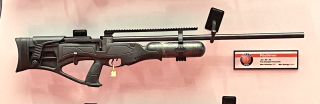
In the airgunning realm, big bore airguns are going strong with a few new items being introduced such as a new Hatsan Pile Driver in .62 caliber, Evanix’s new .50 caliber tactically-styled pistol and one you may have heard about, the AEA Zeus in .72 caliber. Umarex showed off a new .50 Hammer in a carbine configuration and indicated their Primal 20-gauge air shotgun, announced last year, will be shipping in the second quarter after running into supply chain delays.

Hatsan’s now offers the Pile Driver in .62 caliber

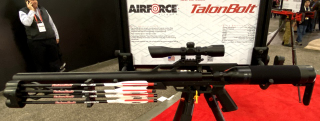
Pneumatic arrow launchers are still making inroads. Currently only legal for hunting in a handful of states, behind-the-scenes efforts are taking place to get more states to approve them. A good thing since these items are capable hunting tools. Airforce Airguns introduced their TalonBolt that uses proprietary 18-inch, 400-grain reinforced carbon fiber bolts with shatter resistant impact collars at each end and glow-in-the-dark vanes. Sending the bolts at over 400fps, this 5.3-pound PCP utilizes a 2000psi fill and adjustable velocity to accommodate different types of hunting.

AirForce’s new TalonBolt arrow launcher

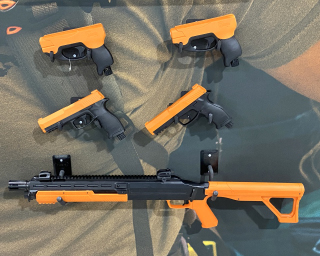
Another trend taking shape is the market for less-lethal means of self-defense against humans or animals. Umarex launched their “Prepared 2 Protect” line of .43 caliber CO2-powered launchers. Made of polymer in orange and black to help delineate them from actual firearms, they use eight or 12-gram CO2 cartridges and there is even a tactical looking rifle that uses 88-gram cylinders. The CO2 cylinders and pepperball, or other rounds, are kept loaded in the P2P device and when needed a quick tap pierces the cylinder. Byrna was at the show and has a couple of new models of their launcher, reviewed here back in August 2022. At least two other companies specializing in this segment were also present at the show this year, so the trend is growing.

Umarex opened their less lethal/LEO training line of .43 caliber guns to the civilian market this year

Of course, many other new and exciting offerings related to all things airgun were on display throughout the show. Over the course of this year watch for more posts on some of these that airgunners are going to want to know about and then we start all over again at SHOT 2024!

At a gathering during SHOT Week, our friends at AofA teased about announcements coming in March related to Daystate, BRK and their own in-house brand of Western Airguns. Alas, we were sworn to secrecy until the big reveal. However, if you poke around on the website you may find some good info!

The intro in Part I gave the nuts and bolts about the EVOL .30. As mentioned, the company behind it, American Air Arms, is dedicated to providing serious airguns that meet specific performance goals and is built in the U.S.A. It is a powerful, yet lightweight contender and with its Magpul furniture, it lends itself to easy modding should an owner decide to get creative.

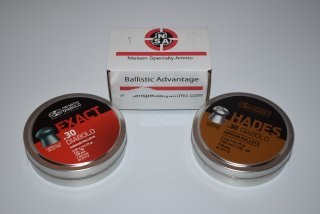
            Part II will cover my results with the sample rifle loaned by Airguns of Arizona so let’s get started. First, a shout-out to my good friend Travis at Airguns Outdoors in Parker, Colorado, for providing some JSB Hades pellets and NSA slugs in .30 to go along with the JSB Exacts provided by AofA. Knowing the EVOL .30 was built around a 44-grain wasp-waisted diabolo pellet, it was going to be interesting to see how it handled slugs.

Ammunition used in the EVOL .30 for this evaluation

The EVOL was topped with the MTC Optics King Cobra 6-24x50mm, a first focal plane scope also loaned from AofA. The King Cobra comes with side parallax adjustment down to 15 yards, locking turrets with resettable verniers, glass-etched crosshair, multi-coated lenses and is built in a 30mm body tube. It is nitrogen purged and fully water, fog, and shock proof. An excellent pairing for the long-range capability of the EVOL and worked equally as well at short ranges. Utilizing a second-generation reticle called the Small Caliber Ballistic (SCB2), the multi-stadia reticle design can be used in range finding and the center crosshair offers six brightness levels of red illumination.

Shooting from a bench at 25 yards using JSB Exact 44.75 grainers, the chrome-moly barrel and extremely light, crisp trigger made me look like a better shooter than I am by yielding monotonously consistent ragged single-hole groups. I did not adjust the regulator from its setting as it arrived (2200psi) and the Exacts were Chronographing at 825fps with a Standard Deviation of 5.3, translating to around 68 foot-pounds of energy.

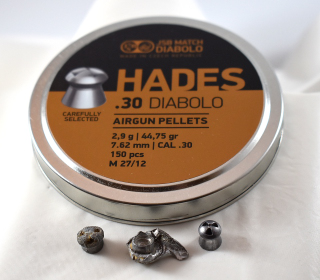
The JSB Hades, also 44.75 grains, but sporting the 3-section hollow point, provided similar results with the pellets travelling at an average of 815fps and SD of 5.4, yielding 65fpe. Accuracy, as could be expected, was spot on as the results with the Exacts. The difference will be realized by hunters wanting to make ethical shots as the Hades design has a proven track record of excellent expansion and weight retention in tissue.

Retrieved Fired Hades pellets next to an unfired pellet

I realize slugs are designed for longer ranges and the ability to bring more terminal energy, but I was set up to chronograph at my 25-yard range so I ran a string to find what they would do. Nielson Specialty Ammo has built an excellent reputation with their airgun ammo and the EVOL seemed to like these 43.8-grain hollow points very much. Average velocity ran 829fps with an SD of10.9 for an fpe result of 67. Tweaking the regulator should provide even higher velocities and foot-pounds of energy should your type of hunting and quarry require it. Even so, at 25 yards the 43.8 grainers went 1.25 inches into a 2×4 board. Accuracy, again, was excellent at that short range. However, would this combination of barrel and slug hold that accuracy potential at 50 or 100 yards? Unfortunately, that is a question for another time as the weather in my area has not been cooperative.

Penetration of an NSA slug in a 2×4 at 25 yds.

Final thoughts:  The EVOL .30 Magnon Tactical is a smooth shooting air rifle that really delivers on the promise of American Air Arms. Its barrel shroud and air stripper were extremely effective at taming the bark of this powerhouse. The reservoir gauge starts to red-line at 4000psi and I was able to get around 25 shots before a top-off was required. My only issue with the rifle was that the foster fitting was a little too deeply set into the air cylinder, making connecting the refill hose a little challenging. I did appreciate that the EVOL can be de-cocked by holding back the cocking lever, pulling the trigger, and easing the lever forward. AofA has this particular model listed on their website at $2695. Extra magazines run $98. The King Cobra scope can be found here and lists for $629. They make a fine combination so please reach out to these fine folks to get your hands on your very own EVOL and I’m sure you’ll LOVE it.

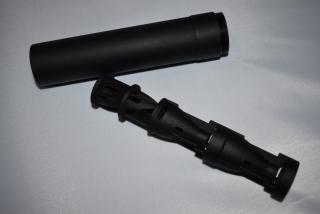
The proprietary air stripper worked extremely well
EVOL .30 from American Air Arms

This .30 caliber air rifle is the little brother carbine to the longer Magpul PRS-stocked version with minor give ups for the benefit of the lighter weight and portability in the field. It’s a tactically-styled beauty that is all business with obvious AR-15 DNA, it is no wonder that the grip and “Fixed Carbine” stock are Magpul MOE on the Magnon. Therefore, modding is the name of the game for those that want to swap parts with aftermarket AR-15 compatible components.

Thin and sporty and lightweight, the Magnon is one of several models of PCP air rifles produced by American Air Arms out of southern California. A small company started by an engineer who is an avid airgunner and airgun hunter, Tom Costan, they produce limited numbers each year. This smaller yearly output is a causal effect of the company’s mission and extreme quality. Their mission is to design and create airguns that meet specific vision, purpose and performance goals and are almost 100 percent American made. Except for the barrels, grips and bolts, all other components are designed, manufactured, and assembled in-house, allowing AAA complete control over quality. The outstanding fit and finish makes it easy to see the company is meeting its lofty goals. This airgun exudes quality with the main chassis parts and many components being made from the highest-grade aluminum and finished in matte black. The Magnon model weighs in at a mere six pounds without optics, thanks to the weight-saving benefits of a titanium air reservoir. The 250cc reservoir was made slimmer and thinner without sacrificing structural strength or safety.

Side view of the EVOL .30 with the magazine in place

Overall, the EVOL Magnon reaches a length of 32.5 inches with 15 inches of that being the shrouded, rifled steel barrel and an additional 5.75 inches for the housing containing the forcing cone air stripper which helps reduce the report. The EVOLs were built from the ground up around the available diabolo pellets and the barrels are optimized at the power levels and caliber weights to provide the best accuracy. The muzzle end is threaded to accept the proprietary air stripper unit (which will not fit other makes of airguns) and the breech end is threaded to screw into a massive lug as part of the breech block. Combined with the shroud, this produces a tensioned barrel system, far superior to barrels secured by set screws and Lock-Tite™. In combination with a chamber insert system that ensures consistent transition of pellets into engagement with the rifling, the result is a high level of accuracy due to the consistent repeatability.

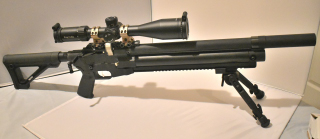
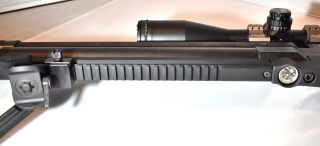
Taking a tour starting from the top – the upper picatinny rail is a two-section design that spans the magazine slot with a 2.5-inch rear section and 3.25-inch section in front for a total of 6.25 inches for mounting optics. Additionally, the upper rail incorporates a 40 m.o.a. incline to aid the long-range shooter. An all-metal, 9-round, self-indexing rotary magazine is included with the Magnon, and next up is the buttery-smooth side lever that gives good mechanical advantage for cocking the heavy hammer spring (which is adjustable). The cocking lever is held closed until needed by a neodymium magnet. Sorry lefties, but this one is not swappable. Underneath the barrel is the 14-inch titanium air cylinder incorporating a black (nice touch) QD foster hose fitting on the right side, just opposite of the easily readable one-inch, color-coded pressure gauge marked only in PSI. A fill is to 4000psi. Beneath the air cylinder is a sturdy 10.25-inch picatinny rail to which I immediately attached a UTG folding bipod with extendable legs and 360° swivel capability.  Between the bottom pic rail and the trigger guard sits the regulator pressure gauge. Factory set for optimized results, it is user adjustable and will require a YouTube search for instructions. Just above the pistol grip in a convenient location for either-handed shooters is the ambidextrous safety switch. A sliding switch, it is easily engaged by pressing upward to “Safe”, which blocks the trigger movement. Next comes the curved metal trigger blade that has been left in the white as a nice contrast to the all-black finish. A sweet, adjustable two-stage match trigger, the sample gun had more takeup than I like, but the second stage broke like glass at a feathery 11.3 ounces out of the box.  In order to adjust the trigger, the lower must be separated from the upper and an easy-to-follow YouTube video by Tom Costan is on the web. Lastly, there is the Magpul MOE fixed stock. It provides a 14-inch length-of-pull and incorporates a hole where a QD swivel for a sling can be attached.

Look at all that space on the bottom pic rail!

The EVOL comes with a three-year warranty that is transferrable. AofA is an authorized repair facility for the entire AAA line so you’d be in good hands should you need warranty service.

Building airguns really is a labor of love for AAA and I imagine that is how they came up with the name for this model (read it backwards…).  In the next installment I’ll report my results behind the EVOL .30 and hope to include some long-range results using NSA slugs depending on the weather and ability to get to the range. In the interim, check out the EVOL lineup on the AofA website.

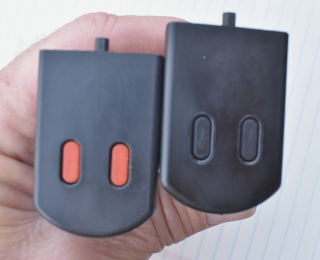
Before getting into testing results with the Byrna less-lethal projectile launcher, a couple of other background bits of information are in order. Two five-round magazines ship in the fitted, zippered case and additional magazines can be ordered through AofA. Each magazine floor plate has two slots where locking tabs engage. Forward thinking Byrna engineers had the clever idea of including orange colored locking tabs to replace the standard black tabs as a quick visual indicator of which type of projectile is currently loaded in the magazine. These locking tabs are quick to swap out and one extra of each color is contained in the kit. Caution: take care when handling the loaded magazines as it is very easy to move the bar that holds the rounds in the magazine, causing it to empty immediately and send you chasing after little round balls. Don’t ask me how I know this.

The colored locking tabs of the magazine floor plate.
Note the handy allen key built into the floor plate of the magazine.

The grip sports rubbery inserts having a “honeycomb” design which feels good in the hand. The grip is hand-filling however, when practicing with good technique even those with small hands should have no problem operating the device. Being a double-action only trigger, it is recommended that the first joint of the trigger finger be placed on the trigger to facilitate firing, as would be done with a revolver. A loaded chamber indicator on top of the unit pops up slightly if a projectile from the magazine is pushing against it. Once the magazine is removed, if a round is still in line with the barrel, simply pressing down on this loaded chamber indicator will release the ball out through the magazine well. Do not attempt to insert a fully loaded magazine if there is still one round in the breech or it can cause a jam. The safety lever disengages the trigger when activated, yet the trigger doesn’t feel that much different making it good for dry-firing practice while not activating all of the internal mechanisms. The unit also has a three slot picatinny rail located on the underside in front of the trigger guard for attaching lights or lasers as you may desire.

A big selling point to the Byrna SD (other than it’s less-lethal aspect) is that it can be stored with both a CO2 cartridge and loaded magazine in place so it is instantly ready for action since the cartridge is not pierced until it is taken off safe and the trigger is pulled fully. As with any CO2 powered airguns, the Byrna SD should never be stored with a partially used CO2 cartridge as this will deteriorate the seals. Besides, if you are going to depend on this unit in an emergency, you’ll want a fresh, full cartridge in the device. The User Manual also states not to leave a loaded launcher in temperatures below 20 degrees F or above 120 F.

To keep the Byrna SD in good working order, after every 500 shots the mechanism should be oiled. The easiest way to accomplish this is by using special oiling cartridges that oil and cycle the mechanism at the same time. There is also an optional oiler kit to accomplish this maintenance task. Please contact my friends at AofA for further information.

The Byrna SD was fun to shoot and provided good accuracy out to the suggested 60-foot range. Of course, it’s very heavy double-action trigger, non-adjustable sights and smooth bore do not promote pin-point accuracy which was as expected. However, a dog or man- sized target at that range is easy to connect with, especially since the launcher can be fired as quickly as the trigger can be pulled. I did find my sample launcher shot high and to the right. Keep in mind when shooting the gas projectiles that they will be affected by the wind. Safety glasses are always recommended anyway when doing shooting sports and especially so with the Byrna. The report of the Byrna SD is fairly loud and sharp, so if practicing indoors hearing protection would be a good idea, as well as a backstop that will alleviate the practice projectiles bouncing back toward the shooter.

My results were as follows:

Shots per 8-gram cartridge averaged19. Once the pressure was too low to discharge a round, there was still enough CO2 in the cartridge so that care should be taken to slowly remove the cartridge cap and control the release of remaining gas.

The Kinetic Projectiles, weighing 44.6 grains averaged 285.9fps at a mile above sea level on a 90-degree day. The Eco-Kinetic biodegradable rounds weighed 47.5 grains and averaged 279fps. The trigger pulls averaged 10 pounds, four ounces after the initial pull that pierces the cartridge and fires the first round. That first pull exceeded the 12-pound limit of my trigger gauge.

The warranty provided on the Byrna SD is one year to the original purchaser. Of course, should the user attempt to take it apart or use non-Byrna projectiles will void the warranty. The kit also contains a nicely done color User Manual that is very clear and easy to follow, although for us older users a larger type font would be appreciated. Also in the kit is a wallet card that indicates the Byrna SD is “Not a firearm under Federal Law” on the front and that it is TSA Approved on the back.

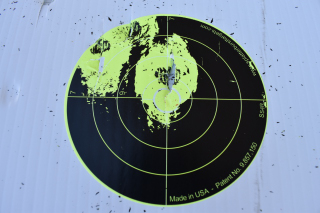
The accuracy potential of the Byrna SD at 20 yards. Note the black splatter around the target caused by the high impact of the projectiles.

All of this protection and peace of mind comes at an MSRP of $399.99. The .68 caliber projectiles can be purchased in plastic bottles containing 95 rounds. The Eco-Kinetics run $34.99, the Kinetic Projectiles at $54.99 and a Professional Training Projectile runs $79.99. The chemical agent projectiles only come in the five-round tubes and cost $34.99 for the Byrna Max or $29.99 for the Byrna Pepper Projectiles. A 10-count package of 8-gram cartridges lists at $19.99. Please check them out by clicking on the active links or connecting with the fine folks at AofA.

This post covers something a little different as it is about a less-lethal .68 caliber projectile launcher powered by CO2. Resembling a modern semi-automatic firearm, it fills a niche between lethal means of self-protection and non-lethal.

Byrna Technologies, Inc. is a publicly-traded Massachusetts technology company specializing in the development, manufacture and sale of innovative non-lethal personal security solutions to Police, Government and Civilian buyers. They sell a variety of self-defense items and have a Law Enforcement & Private Security division dedicated to providing top-notch training to these groups. This training has received national certification from the International Assoc. of Directors of Law Enforcement Standards & Training.  The launchers have been purchased for use by school security professionals as well.

The well-made and sturdy Byrna carrying case.
The Byrna SD case open, showing the contents along with a box of extra CO2 cartridges.

The Byrna SD (Self Defense) launcher can be ordered in two flavors, the Kinetic kit and the Pepper kit. Both come in a well-made zippered nylon case with padded compartments for the “gun”, an extra magazine, three tubes of projectiles, two 8-gram CO2 cartridges and manual/paperwork. Everything you need to get started and be able to practice with the SD. This particular kit only contains what Byrna calls “Kinetic” projectiles. Two of the tubes contained hard plastic Kinetic projectiles and one contained their Eco-Kinetic projectiles which are biodegradable, leaving no trace. Obviously, in today’s climate, there are restrictive jurisdictions that regulate or outright prohibit an individual from possessing or using pepper sprays and tear gas. I received the SD Kinetic kit for review, and that probably was for the best as I don’t have a ready stable of volunteers to shoot OC gas balls at…

Byrna refers to this device as a “launcher” and “un-gun” as opposed to a “CO2 gun”.  Its dimensions are: 5.62 inches tall by 7.25 inches long by 1.25 inches wide and it weighs in at a light one pound, ten ounces. An ambidextrous safety can be engaged at any time and disengages the trigger. They are made in Ft. Wayne, IN and contain 108 parts, so it is a pretty complex device. No user serviceable parts here and it voids the warranty if you take the Byrna SD apart. They also make a couple of rifle configurations however; this review is of the SD version of their pistol configuration.

This form of non-lethal self-defense tool is useful for deterring a threat from as far as 60 feet away. Initially, if you find yourself in a situation, simply presenting the Byrna SD might act as a deterrent due to its resemblance to a semi-auto firearm. Should the threat persist, pulling the heavy double-action trigger will pierce the CO2 cylinder and fire the first round from the five-round magazine. Each subsequent trigger pull fires another kinetic projectile. If carrying an extra loaded magazine, pressing the magazine release situated behind the trigger on the left side – just like a majority of semi-auto handguns – allows for a quick swap. One 8-gram cartridge gives anywhere from 15 to 20+ full power shots before exhaustion. The SD can be effective against small aggressive animals as well (but I wouldn’t rely on it in grizzly country!). Like any other projectile launcher, plan to purchase extra CO2 cartridges and ammunition so you can practice and get very comfortable with the SD before you actually carry it.

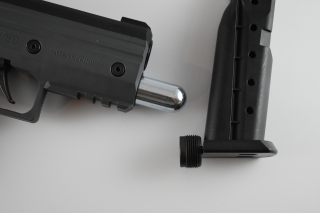
The Byrna SD uses the smaller 8-gram CO2 cartridges. An adapter is available to convert to 12-gram cartridges.

Available from AofA, the Byrna SD kit can be ordered in Gray, Orange, Pink, Tan and Yellow. While some states may restrict possession and use of the Byrna, AofA definitely will not ship to the 5 boroughs of New York City, San Francisco, and several other liberal antigun/anti self-defense enclaves. Refer to their website for the restrictions.

Not being a practicing attorney, I cannot speak to the legalities of purchasing and owning a Byrna launcher in any situation and neither can AofA. I can say, however, that it is not classified as a firearm in the United States. Due to that fact, it is possible for persons with a felony conviction to have airguns in a lot of places, however; for questions about purchasing this unit the best bet is to check with a lawyer and the police jurisdiction you live and work in.

The tube from the Byrna SD kit containing Eco-Kinetic biodegradable ammo.

More about how the Byrna SD worked for me in Part II next month.

Airguns of Arizona carries a selection of barrel adapters and cans, designed for airguns only, from a purveyor I’ve come to know for his high-quality products as well as integrity. DonnyFL is one of those “kitchen table” companies that started out as a way to fill a personal need. Donny purchased his first PCP air rifle, an Edgun Matador in 2014. The only drawback was the report of the rifle might disturb his neighbors and that started Donny on a path to make his entry into the PCP world more “backyard friendly”. While keeping a day job, Donny continued to experiment and expend funds on his goal. Even without formal training in acoustic science, he kept working at it until he had a viable working silencer for his air rifle. Others in his shooting circle took notice, which was quickly followed by requests for “could you make one for my airgun?”  Donny obliged and this led to referrals to others wanting his product so his business was born.

               Soon after that Donny started his website to grow the business and grow it did. Now, as a thriving business, DonnyFL also offers his products through dealers and distributors like AofA. Today his products are highly regarded by many airgunners to be the some of the best available. His cans are given Japanese inspired names and are well-made and effective, plus they look good and are reasonably priced.  Also, the range of adapters found on the website cover most makes of PCP airguns as well as a number of non-PCP models. In addition, they will make custom adapters based on user specifications. Prices start at $50 and can go up depending on the amount of material required. Custom adapters are not warranted the way standard adapters are, so exacting measurements are critical for you to be satisfied with the final product.

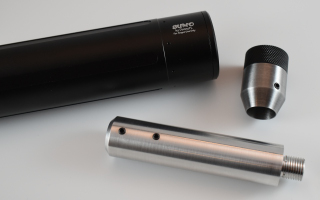
The custom aluminum adapter along with the steel adapter with the Sumo “can” that will be attached.

              Of course, all businesses claim to have good customer service, however, small businessmen like Donny have to actually back that up in the real world. I had first-hand experience with that side of it when an adapter I had ordered for an older AirForce Escape was too tight to seat properly on the muzzle. I had gotten it on far enough that I could not remove it, yet it was nowhere close to being fully seated. After communicating with Donny via email, he suggested sending the barrel with the stuck adapter to him and they would take care of the situation. Just before boxing everything up I was finally able to separate the adapter without harming the barrel. I followed through with mailing the two items to the Florida address and was expecting several weeks to go by before hearing back from them just as a normal course of specialty work taking time. To my surprise, I heard back the same day the package was expected to be delivered by FedEx! The gentleman who does machining work for them, Izzy, spoke with me about the work and we decided a new adapter was in order. I authorized the work and DonnyFL was willing to give me credit for the original adapter, however, I had heated the unit in an attempt to get the metal to expand so I could get it off the barrel and just planned to pay for the new adapter and have the old one sent back with the new one. The new adapter was ready in a day and to my surprise, they also reamed the original, steel adapter so it now fits and I have a choice as to which one I want to use! The price was $60 and that included the return postage.  To say I am pleased with DonnyFL and their service is a bit of an understatement. I highly recommend their products if you are in the market for a quieter airgun. Please check out AofA’s pages of DonnyFL products and give them a call if you don’t see what you need.

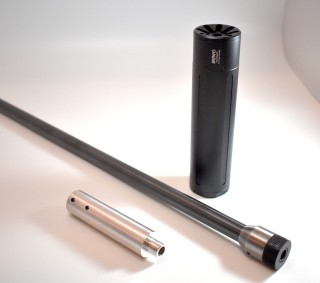
Another view with the short adapter mounted on the old Escape barrel.

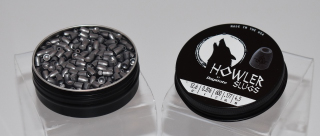
While a lot of things got put on hold during the Covid pandemic, a couple of bright spots were forthcoming. New slugs were introduced last year under the Daystate banner and are named “Howler” slugs. Made in the U.S.A., the slugs come in .177, .22 and .30 calibers for your shooting enjoyment. Specially designed to provide the best performance out of Daystate “Accuracy Research Team” rated barrels, Daystate teamed up with Nielson Specialty Ammo to create these little beauties. Utilizing a hollow-point design, the .177s weigh 12.6 grains and are packaged 600 to the screw-top tin and retail with our friends from Airguns of Arizona for $33.99. In the .22s the 20.3 gr. slugs come 375 per tin and retail at $23.99. The .30s sell for the same $23.99 price and contain 140 slugs per tin. As an added bonus, each tin you purchase comes with a cardboard token that is worth $2.00 toward your next purchase of Daystate/MTC Optic product. These tokens have no expiration date and can be saved up to accumulate up to $100.00 toward an airgun or $50.00 toward an optic.

New Daystate Howler slugs in .177

               My home range limits me to 25 yards so I am looking forward to taking them out to my gun range and trying them at longer distances through several high-powered air rifles. There is little doubt these slugs will live up to the expectations due to the reputation of NSA products and testing Daystate put them through before placing them under their brand.

A discount token is included in every tin

               The other bright spot was the introduction of a line of pellets from the famous Swedish cartridge maker, Norma. Known for their high-quality and highly respected ammunition, they have been at it since 1902 and are a purveyor to the Royal Court of Sweden. The company is always improving and expanding their line as well as keeping an eye on market trends, so it was a natural extension for them to utilize their expertise in making lead bullets to begin making quality pellets in-house.

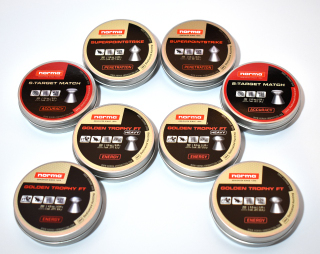
               Available now through Airguns of Arizona come four new pellets in .177 caliber and four in .22 caliber. First, for the hunters and Field Target folks in the crowd, is the Golden Trophy FT Heavy, a domed pellet designed for energy transmission to the target. At 9.1 grains in the .177 with 300 pellets per tin and 17.6 gr. with 200 pellets per tin, these are meant for use in more powerful air rifles (Norma suggests above 17fpe). Next up are the Golden Trophy FTs, a bit lighter version still designed to deliver energy on target. The .177s come in at 8.4 grains with 300 per tin and the .22s weigh 15.9 grs. and 200 pellets per tin. Again, Norma suggests an airgun that generates at least 17fpe for best results with these pellets. Take your pick at just $7.99 right now at AofA.

               Next up are the S-Target Match pellets. Designed for accuracy, these flat-nosed pellets come in 300-piece tins and weigh 8.2 grains. The .22s weigh in at 14 grains and come 200 to the tin. Norma suggests use in airguns under 12fpe and they retail for $9.99 on the Aof A website.

Norma Ammunition’s new pellet offerings

               Last, but not least, come the SuperPointStrike pointed pellets. Designed for penetration on small game and pests, the Norma suggestion is for use in airguns under 18fpe for best results. The .177s weigh 8.2 grs. and come 300 to the tin, while the .22s weigh 14.5 grs. and 200 per tin.

               Give ‘em a shot (I know, terrible pun. Just couldn’t resist.) The prices are certainly right and it is the summer season here in the U.S. so, plenty of opportunities should present themselves to get out and enjoy some shooting!

The ensuing month since the Part I post on the Cricket II Tactical (C2T) didn’t allow for a lot of additional time behind the gun due to some medical issues and totally uncooperative weather. However, I did enjoy the time I had working with this little powerhouse. Since the basics of this bullpup were covered in Part I, this installment will cover the scope used and results from range sessions.

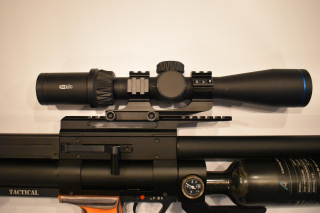
               A loaner Meopta MeoPro Optika6 was in my inventory and it provided a good fit for the power of the C2T with its 2.5 to 15 magnification. That can really make small objects look very large and clear plus the oversized zoom ring makes adjustments easy with its rubberized covering and very aggressive texturing. Meopta also includes a threaded throw lever that screws into one of four holes along the rim of the ring for fast adjustments. Extra screws are also provided to cover the remaining holes to keep debris from collecting in them. A side parallax adjustment knob having a smaller version of the aggressive texturing also eases dialing in a clear sight picture at various yardages. Speaking of clear sight pictures, this scope is made in the Czech Republic and they are renowned for their optical glass. Meopta is in its 89th year of making high quality optics, so it goes without saying you’d have a hard time finding an optic with better clarity, especially at this price point. Additional features include anti-reflective and hydrophobic coatings along with being nitrogen filled and waterproof. Aluminum caps having the same aggressive rubber texturing cover the windage and elevation turrets, which are adjustable in ¼ MOA very positive clicks. Zero can easily be reset using a coin or screwdriver once sighted in. This is a Second Focal Plane scope so the reticle remains the same at any magnification and won’t obscure a small target zone at high magnification. The reticle is a duplex type and other reticle options are available when ordering the scope. The scope also comes with lens covers connected by heavy rubber straps that hold them firmly on the scope; much better than the flimsy elastic cords used with some other lens covers. Its black matte finish blended perfectly with the finish on the C2T. Excellent glass with high magnification capability does come with a cost in weight so it did add 25 ounces to an 8.5-pound gun. Having the bottom six slot picatinny to attach a folding bipod to helped the overall weight be less concerning.

The Meopta Optika6 2.5-15x44mm scope mounted to the Cricket II Tactical

               As far as performance, as can be expected from an airgun in this price range, it was very, very good. The C2T is also a product of the Czech Republic and Europeans take their airgunning seriously. The guns action was smooth and I never experienced any feeding problems other than when I tried Predator Polymags. They were just slightly too long to work with the C2T magazines and there is no way to feed individual pellets. The safety was positive at blocking the trigger and easy to use being just above the trigger.

               I didn’t get the chance to determine a total number of shots per fill at 6000 feet altitude as I never let pressure go much below 200 bar. From 230 down to 200, shooting a variety of pellets of differing weights, I was averaging 30+ shots before topping off the gun. The User’s Manual states working pressure is down to 110 bar so it seems feasible you could get 90 or possibly more shots from a single fill. Accuracy results were excellent across a range of pellets at 25 yards. Pellet weights ranged from 14 gr. Up to 25 gr. hollow point slugs with results of five shots touching to pretty much a single ragged hole in a few cases. While H&N Field Target Trophy and Hatsan Vortex Supremes were not its favorites, they’d still get the job done if hunting with the C2T. Extreme spread and standard deviation were excellent with all of the pellets tried, opening up a bit when shooting the Argentinian-made Apolo slugs. Even so, the slugs traveled at an average 892fps having a 9.65 extreme spread and 4.12 standard deviation. For hunting that means over 44fpe!

               A shout out here has to go to the new Norma branded pellets provided by AofA. They just recently started carrying this line and I think they have a winner here. Packed 200 to a tin, they were very clean. The S-Target Match at 14 gr. is designed for accuracy, of course and has a slightly reinforced skirt. It lived up to the accuracy claim producing a ragged single hole grouping. The Superpoint Strike at 14.5 gr. is designed for penetration and was also super accurate. The Golden Trophy FT Heavy, designed for energy, weighs 17.6 gr. and this domed pellet is considered a dedicated hunting pellet. It produced five shots touching and over 41fpe having an extreme spread of 5.60 and standard deviation of only 2.23. I have some similar results through another gun as well so look forward to doing more shooting with them.

               All-in-all a great experience with a great little bullpup gun. I mentioned a couple of pet peeves with the C2T and after spending more time with it I’d prefer the grip thinned out somewhat for more comfort but by no means a deal breaker.

The Cricket II Tactical ready for work

               If interested in obtaining any of this kit or wanting to know more, give AofA a call.

The name “cricket” brings to mind small noisy insects and, depending on your age, a classic Disney character. The Czech Republic manufacturer KalibrGun may have intended a connection to either of those things when they named their awesome bullpup air rifles, or, maybe not. Nevertheless, their handy and compact pellet launchers are accurate and well-designed, plus of high-quality old-world craftsmanship.

               The Cricket is the flagship model and KalibrGun has stuck with a good thing in the bullpup configuration. More recent models have improved by relocating the cocking lever to mid-receiver. However, all manufacturers must innovate and come up with a new product to stay relevant. KalibrGun’s latest model capitalizes on the popularity of tactically designed (tacticool?) guns.

               The Cricket II Tactical models are offered in barrel lengths of 17.7-inch and 23.6-inch. The shorter version comes in .177 and .22 calibers. The longer version comes in .22, .25 and .30 calibers. My sample is the long-barreled version in .22 and has an overall length of 34 inches. It weighs 8.5 pounds, which is on the heavy side, especially when adding optics, but it does balance well in the hands even so. I selected a Meopta Optika 6 2.5-15x44mm second focal plane scope to mount on the platform, bringing the package to just over 10 pounds.

The KalibrGun Cricket II Tactical ready for business

               The receiver is made from aluminum and finished in a matte black. Two laminated wood pieces comprise the vertical grip and buttstock. My sample sported a dual color orange and grey laminate that really stands out in a crowd. Solid wood and other laminate colors are offered, of course. The vertical grip also has a nice laser-cut checkering to promote a good purchase. Having fairly large hands I found the grip filling. Those with small hands may find it a bit too large and search for a potential aftermarket option. A thick, dense rubber buttpad that is adjustable vertically. A 500cc carbon fiber wrapped bottle resides in front, under the barrel/shroud with a large, easily readable manometer marked in bars. Maximum pressure listed in the full color instruction manual is 300 bar. Since the manual covers several models, there is a mention of red, yellow and green fields that don’t exist on this manometer. Additionally, no instructions are given on adjusting the trigger, yet the specs show it can be changed between 2 and 10 newtons (approximately 7 to 36 ounces). Speaking of the trigger, it is a curved, wide, smooth-faced plastic job that is single-stage and averaged a pull of one pound, 4.1 ounces. It is housed inside a generous open-bottomed trigger guard and just above the trigger is a red safety button that blocks the trigger. Pushing the button to the left unblocks it.

Magazine storage on the Cricket II Tactical

               Two 14-shot rotary metal magazines ship with the gun along with the brass fill probe and extra O-rings for resealing. The two magazines can be stored in the wooden buttstock and are held in place by ball bearing detents. An 8.5-inch picatinny rail sits on top of the receiver with an additional 4-inch accessory picatinny rail on the bottom. The barrel has a sound dampening shroud and the muzzle is threaded to allow additional suppression to be added, although this gun is pretty quiet in .22. Adding a DonnyFL Koi suppressor took the noise down to a mouse fart, but of course, added length. Still, it made for a nice-looking package.

               Features on this gun include a swappable cocking lever, now relatively common on air rifles, making the Cricket II Tactical model truly ambidextrous; and MCL, the Magazine Control Lever. This lever allows manual indexing of the magazine in addition to loading and unloading of the magazine. There is also a red-tipped cocking indicator that projects out of the back of the rifle. Pet peeves about the Cricket are the lack of a hold-open or bolt stop after the last round is fired and the magazines cannot handle longer pellets such as the Predator Polymags. Also, a soft padded surface on the cheekrest area included for the price would have been a nice touch. Cheekrest options are available from the AofA website.

Close up of fill port, safety and bottom picatinny rail

               KalibrGun offers a 12-month warranty, however, AofA extends that to three years. MSRPs are: $1695 for the shorter (45) model and $1795 for the longer (60) version.

               More about how it shot will be in Part II, but in the meantime, you can reach out to the knowledgeable folks at AofA for any questions or to talk about the other fine models in the KalibrGun lineup.