By day I’m a mild-mannered manager of Critical Accounts at a large Enterprise Resource Planning company. By night I use my cat-like reflexes and Ninja skills to fight crime. No – wait, I’m exercising poetic license here. I don’t actually fight crime. Truth-be-told, I never had cat-like reflexes and no Ninja skills either. What I do have is a passion for all things airgun related.
Over the past several years I have been dragged into the 21st century kicking and screaming, but now it is time to expand my comfort zone and jump into this whole blogging/social media business. My plan is to inform in an entertaining and enlightening way while adding to the general body of knowledge involving airgunning.
A little background: My older brother had a Daisy model 25 that was well broken-in and he was an excellent shot. He taught me the basics and I coveted that rifle of his. My folks finally thought that I was mature enough to have my own air rifle by my 13th Christmas and so I became the proud owner of a Daisy model 1894 “Spittin Image”. Those were the beginnings of my life-long love affair with contraptions that sling projectiles downrange. I’ve now logged over 60 years on the planet and still have that Daisy. Actually, I believe it is in better shape than me, although it is 13 years younger… I enjoy the technical aspects of the airgunning game and tend to write from that prospective. I’ve competed in organized events a few times; however, the chance to attend formal matches is limited in my neck of the woods so competition will never become a forte of mine. Long ago and far away I taught Industrial Arts – yep, a shop teacher. I left the education game with all 10 digits intact and with my mechanical aptitude/curiosity alive-and-well and that is where my penchant for the technically oriented writing comes from. It has served me well as it led to a position as the Field Editor for Airgun Hobbyist magazine, currently the only hard copy and color format airgun magazine of U.S. origin. My articles have also appeared in a few other national publications in recent years.
I appreciate the opportunity that Airguns of Arizona is entrusting me with and hope that you enjoy my humble contributions. Until next time, get out there and exercise that 2nd Amendment right!
Regards,
-Gordon
SIGAir is the division created by SIG Sauer firearms a few
years ago to bring their firearms into the airgun world. The purpose was to
create exact replicas that would be useful in training scenarios as well as
appeal to replica aficionados and collectors. Manufactured to SIG’s high
standards by top makers in Taiwan and Japan, SIGAir plans to bring all airgun
production in-house to the New Hampshire facility in the future and they’ve
already ramped up with their break-barrel ASP20 rifle; 100% made in the U.S.A.
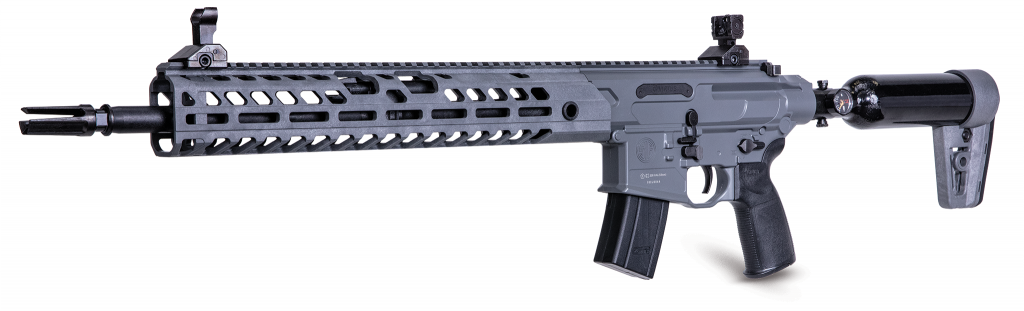
Their first foray into PCPs is a copy of their MCX Virtus centerfire AR-style firearm. On display at SHOT Show 2019, the production model was introduced at SHOT 2020. Available in .22 caliber only, the Virtus provides plenty of rapid-fire enjoyment via a double-action trigger pull supplied by a proprietary 30-round belt-fed Rapid Pellet Magazine (RPM).
The Virtus is the first venture into PCPs by SIGAir
A 13 cubic-inch tank with pressure gauge doubles as the buttstock instead of the ubiquitous multi-position AR-style stock, by clamping a separate polymer unit to the rear of the tank. While the gauge reads to 6000 psi, the Owner’s Manual states the maximum fill is 3000 psi. An internal regulator is set to 1100 psi to give shot consistency and SIGAir rates the velocity potential to 700 fps.
Using a 100cf tank from AofA to charge the Virtus
Overall length of the Virtus is 37.25 inches and it weighs 7.5 pounds. Surrounded by a polymer M-lock type handguard is a 17.5-inch rifled steel inner barrel. The cast aluminum alloy receiver has controls in the identical positions found on the firearm. However, only the ambidextrous safety and magazine release are functional. A flattop picatinny rail runs the length of the handguard and along the entire top of the receiver giving a total of 21.5 inches of available rail. Already attached when you open the box are foldable front and rear sights. The rear consists of a two aperture peep that flips between the large and small openings. It is only adjustable for windage. The front is a mil-spec post sight adjustable for elevation using a handy little 4-way tool that is stored inside the handgrip. The other three operations the tool is for are: seating pellets to the same depth in the RPM belt, turning the windage adjustment screw and for the hex head clamp screw of the buttstock unit.
The metal trigger is a non-adjustable curved, smooth-faced blade that both advances the RPM belt and cocks and releases the internal hammer to strike the valve with each pull. The trigger pull is heavy at almost 10 pounds in this sample rifle and, as with a revolver, using the first joint rather than the pad of the trigger finger is the best technique for manipulation. Quite a few pellets were put through this Virtus and while the trigger pull was smooth enough, it did not seem to lighten up over time. For long range sessions a shooting glove would also be beneficial.
Load the magazine by removing the realistic-looking plastic magazine “housing” from the rifle. Flip up the cover on the right side to reveal the 30-round linked belt. Gently remove it and place on a flat surface with the silver-gray side of the links facing down. Load pellets nose first then seat them to the same depth with the handy tool. Examine each link to be certain no pellet noses protrude even a little as this will jam the mechanism and prevent the trigger from being pulled. Feed the belt back into the housing (it only fits one way), close the cover and it’s good to go. Like any airgun, there were pellets it liked and others it didn’t. Heavier pellets above 15 grains tended to open up a little more and have a larger extreme spread. The exception was the new Predator International Hades pellet. At 15.89 grains they were accurate and yielded almost 12 fpe. Pellets it liked were all domed and, unsurprisingly, two SIGAir branded pellets worked well: Venoms (14.5 grns) and Crux (14.9 grns). H&N Field Target Trophy pellets at 14.66 grains performed very well also. SIGAir claims of 700 fps could only be achieved with 11.75 grain Predator lead-free GTOs. A couple of individual GTOs actually exceeded 700 fps with the group average at 692.8 fps. SIGAir also claims up to 150 shots per fill but my experience was closer to 110 or so.
The RPM belt being installed back into the plastic magazine housing
Flip up sights are great for general plinking and training purposes, but over 30 feet, combined with old eyes, yield more misses than hits so I mounted a Sun Optics USA 3x32mm reflex sight with red & green illuminated reticle. It worked great with this rifle and fit the military look to boot. This combo aided in shrinking 5-round groups to around .75 inch at 25 yards.
SIGAir lists the Virtus at an MSRP of $350. If you admire SIG products or are a replica fanboy, check out AofA’s price. It comes with a one-year warranty.
The need for entry-level PCPs was recognized by a few
manufacturers because, let’s face it, not all airgunning enthusiasts are in a
position to drop $1000+ on a PCP and then obtain the additional accoutrements
that are needed such as SCBA tanks and compressors. Some just want to dip a toe
in the water and know that if PCPs aren’t their cup of tea, they haven’t mortgaged
the farm to find that out.
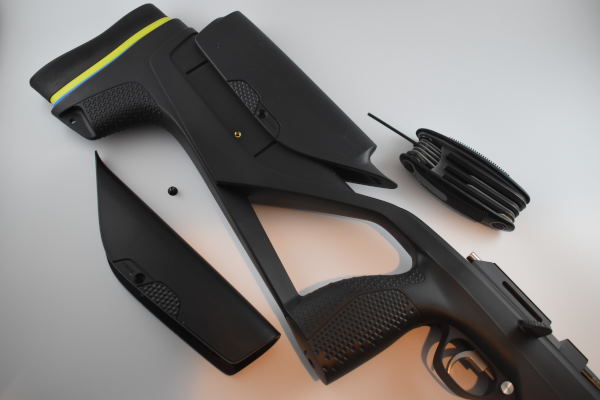
Stoeger Industries has been around almost 100 years as a firearms purveyor, publisher and gun store that began operation in New York City and was known for value-priced firearms. In the early 2000s they became part of the Benelli USA family. Benelli, known for their Italian heritage shotguns, is owned by the 500-year-old gunmaker Beretta Holdings. Over a decade ago an airgun division was formed and began importing airguns for the U.S. market and the airguns they sold were also value-priced. Seeing the burgeoning interest in PCPs a decision was made to introduce their own model to the public – the XM1. Having an Italian parent company gave them access to Benelli’s design team and it shows in the ultra-sleek and sporty lines of the XM1. Italian inspired features were incorporated like “Proadaptive Checkering”, consisting of raised “Thridion” checkering for comfort and excellent, spongier, gripping surfaces along with advanced ergonomics. Supporting this concept utilizing removeable spacers in the buttstock, various combinations can be tried to fit the gun to any individual from a small-statured youth to the maximum length-of-pull adjustment of 15 inches, fitting a large adult. Additionally, Stoeger provides each XM1 with a higher cheekpiece and larger grip insert that are easily swappable, further increasing the ergonomics of the gun. The open thumbhole style polymer stock lends this gun for use by left-handers. Not truly ambidextrous, however, as the bolt handle cannot be shifted to the left side.
Low and High swappable cheekpieces are included.
Other built-in features include a regulator to give shot-to-shot consistency, a fiber-optic front sight and a two-stage trigger that is adjustable only for l-o-p over a 12mm range, two short picatinny rail sections that mount on the sides of the forearm with one having three slots utilizing magnets to hold extra magazines, molded-in holes for sling swivel attachments and a package of assorted O-ring seals. As an entry-level PCP for a youth, the weight of just under six pounds without a scope is definitely a plus. For anyone taking the rifle into the field the lightweight will be welcome.
The XM1
provided for review was the S4 suppressed version in .22 caliber. The S4 is
Stoeger’s latest generation sound suppression which is permanently affixed to
the airgun and adds about six inches to the standard XM1 bringing the overall
length to 45.5 inches with all stock spacers installed. Baffles combined with a
decompression chamber below the shrouded barrel moderates the report very well.
Definitely checks the box for “backyard friendly”.
The XM1 comes in either suppressed or non-suppressed varieties
The rifled steel 21-inch barrel is
mated to a black anodized aluminum breech block. The air cylinder appears to be
100cc and is located under the barrel. A manometer sits at the muzzle end and
the tank is rated to a 200 bar (2900psi) fill using the supplied brass probe.
The fill opening is just behind the manometer and a stopper is supplied to keep
debris out as there is no collar or cover for the fill hole.
It’s a
bolt-action repeater using a 7-round rotary magazine. A .177 caliber version is
also available and its magazine holds 9 rounds. After the last shot, a block
rotates into place preventing the bolt from closing. A nice touch to keep you
from wasting air on empty chambers. The bolt handle is large and molded in an
unusual shape. It also sports the “Thridion” checkering for extra purchase when
working the bolt. A very natural and comfortable design, the bolt worked
smoothly right out of the box. Cocking occurs upon drawing the bolt back and the
gun can be safely de-cocked, although this is not covered in the Owner’s
Manual.
The
trigger is a wide, curved and smooth-faced metal unit, also very nice right out
of the box. The average pull weight was a light 2 pounds eight ounces, having a
long take-up but a crisp break. Surprisingly good for an airgun in this price
range. The safety is a cross-bolt located in the front of the trigger guard.
While it comes with a square-notch rear sight, it takes up some of the minimal 11mm scope rail available so I found it to be a choice between iron sights or a scope. The rotary magazine also protrudes above the breech block so higher scope rings/mounts are necessary. Going to my trusty MTC Mamba-Lite 4-16x42mm scope provided by AofA, and SportsMatch rings I had better than expected results with this modestly priced air rifle. Thinking the scope might be over-matched for what the gun could do, I found they paired nicely as I was able to shoot very tight groups out to 40 yards and 5-shot ragged holes at half that distance. It didn’t seem too picky about what I fed it, though there are always some pellets an airgun won’t like. Best accuracy was obtained with the new Predator International 15.89 grain Hades pellets. This gun also really liked the 16 grain Predator Polymags and 14.5 grain SIG Venoms. Polymags, with their polymer tip, were the maximum length that would still work in the rotary magazine. No worries using longer pellets though as a single-shot tray is also included with the XM1.
The MTC Mamba-Lite 4-16x42mm pairs nicely with the XM1. The bolt is back because it can’t be closed on an empty magazine.
Rated by
Stoeger as launching lead pellets at 800fps, I found it actually exceeded that
velocity with 18.21 grain pellets hitting 840fps at a mile above sea level.
Approximately 35 shots could be squeezed out while the manometer read in the “green
zone”, but velocity starts to drop after the third full magazine.
MSRP on the XM1 is $200. The XM1 S4 runs $229 in a kit form with a 4x32mm scope. There is also an option for a RealTree camo version, only in .22 for $250. Stoeger Airguns stands behind their products, giving the original purchaser a five-year warranty.
The XM1 has shortcomings, of course, but you get quite a bit for your money. All-in-all, if you’re looking to get into PCPs, this one is worth checking out.
The previous installment described the basics of the Concept XR and its “tacticool” features. Now for some coverage of its performance.
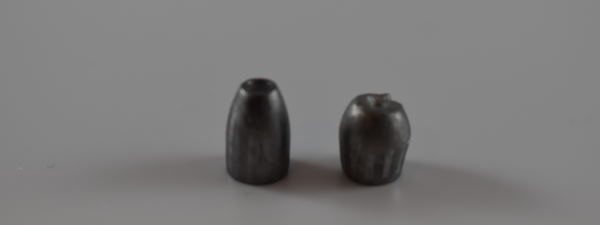
Thanks to my friends at Predator International I had a small supply of their new Knock-Out slugs to try through the XR. The XR has a slightly choked barrel to better handle the new slugs and I had both the .216 and .217 diameter slugs to try out [AofA pellet offerings]. The sample XR worked the best with the .217 slug and was consistently accurate. I did have to re-zero the scope because at the highest power setting they shot flatter and were hitting higher than regular pellets. The slugs will definitely fit the 10-round rotary magazine without a problem, however, tipped pellets like the Polymag were just a hair too long for the magazine but will work just fine using the single-shot tray included with the XR.
Knock-Out slugs; unfired on the left, fired through drywall on the right.
The lowest power setting yielded 65 regulated shots on one fill shooting 14.66 grain Vortex domed pellets. Accuracy at 25 yards was excellent. Other pellets I tried are listed below:
Low Power Setting:
Predator GTOs at 11.75 grains averaged 631fps with Extreme Spread of 2.25
JSB Exact Jumbos at 15.89 grains averaged 561fps with Extreme Spread of 20.28
Crosman Hunting at 14.35 grains averaged 575fps with Extreme Spread of 6.59
RWS Super H-Points at 14.2 grains averaged 564fps with Extreme Spread of 7.49
Hatsan Vortexs at 14.66 grains averaged 574fps with Extreme Spread of 11.31 — gave better accuracy at low power setting
At the High Power Setting:
Predator GTOs at 11.75 grains averaged 960fps with Extreme Spread of 12.03
JSB Exact Jumbos at 15.89 grains averaged 864fps with Extreme Spread of 8.46
Crosman Hunting at 14.35 grains averaged 834fps with Extreme Spread of 19.3
RWS Super H-Points at 14.2 grains averaged 878fps with Extreme Spread of 10.77 — gave the best accuracy of the group shot at high power
Hatsan Vortexs at 14.66 grains averaged 885fps with Extreme Spread of 6.68
The MTC optics Mamba-Lite 4-16x40mm scope I paired with the XR required me to shim the front mount as I ran out of elevation adjustment. Once I had it dialed in the combination worked great. With higher powered scopes it might be wise to check out the selection of adjustable mounts available from my friends at AofA to avoid problems when moving a scope from one platform to another. The Mamba-Lite has a graduated reticle that can be illuminated at five brightness levels with the touch of a button located in the center of the parallax adjustment turret on the left side. It made a great combination for this awesome carbine.
Light weight in air rifles is
always a plus, especially if taking it into the field going for small game.
With the number of regulated shots that the XR can give on one fill it should
not be necessary to carry an air supply into the field. The company rates the
XR at an energy output of up to 28 foot-pounds. My results yielded 25.54fpe
with the Vortex 14.66 grain domed pellets and Knock-Out slugs delivered more
than 22fpe with their 25.39 grain weight. Another plus is the XR can be
de-cocked when needed. Simply hold back the cocking lever and depress the
trigger while slowly letting the cocking lever go back to rest.
The Concept family includes variations in style and it can be accessorized very easily, even by a novice. Calibers available are: .177, .22 and .25. Please refer to this link (insert here) to gather more info. It is a very sweet shooter made by a well-known name in airguns. If it could be done without driving costs up too much, my wish is future versions have an anti-double feed mechanism. The MSRP starts at $1300 and Brocock has a two-year warranty that covers the original owner.
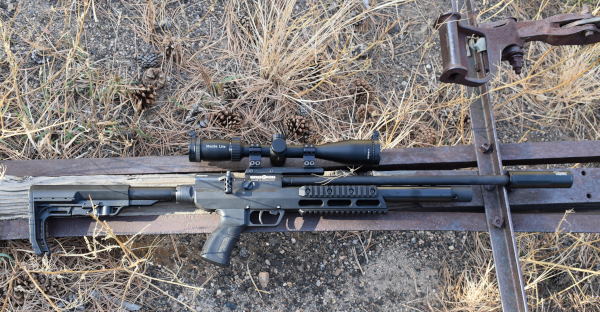
At first glance the Concept XR comes across as “tacticool”, however,
this updated Brocock PCP is more than that. New for 2020, this British-made air
rifle is a modified bullpup design. The name “Concept” comes from its modular
platform capability and the modifications that the end user can easily adapt to
this handy, lightweight and powerful PCP.
Updates
that make this new for 2020 include replacement of a bolt-action with a
side-lever cocking mechanism, a new floating hammer mated to a HUMA regulator
and 150cc air reservoir for weight reduction, putting this whole package at
around 6.5 pounds without optics. The black anodized receiver is machined from
a solid billet of aircraft aluminum and houses a power adjustment knob on the
right side. A 10-round rotary magazine is inserted from the left side between two
2.75-inch long 11mm dovetail rails. Because the magazine sits about one-half
inch above the rails, a riser rail is provided and mounted in front of the
magazine opening in the receiver, providing multiple optics mounting options.
Besides the obligatory collapsible stock (having six stops), there are three picatinny
rail sections mounted at the three, six and nine o’clock positions and an AK-47-style
grip. Of course, the furniture can be swapped out for after-market parts at the
owner’s discretion.
The barrel
on the Concept XR is 17 inches long and of German manufacture. The bore is
slightly choked and I understand it has a “precision finish” to it. The barrel
is free-floating as well as shrouded. The muzzle is threaded in case additional
suppression is desired and a thread protector is included. Under the barrel
resides a 150cc air reservoir with a manometer built into the front. The
reservoir is filled to 200 bar (2900psi) using a brass probe. A rotating collar
keeps debris out of the fill port.
The Concept
XR’s trigger is a curved, smooth faced style and two-stage, user adjustable. Factory
set for what is considered optimal for a clean break and safety, the sample gun
trigger broke at an average 2 pounds, 1.6 ounces and was very crisp and clean.
The safety is a small paddle located directly in front of the trigger so it is
easy to disengage with the trigger finger.
My sample
rifle arrived without optics or a suppressor, so I outfitted it with an MTC
Mamba Lite 4-16x42mm illuminated reticle scope on Sports Match medium rings. I also
installed a DonnyFL suppressor to further quiet the already low report of this
airgun, giving it a working weight of 8.25 pounds. The overall length with the
buttstock fully extended was 36 inches without a suppressor attached.
The power adjuster on this .22 caliber model has four positions and can be switched on the fly. The full-color owner’s manual indicates diabolo pellets work best, however, with the adjustable power levels and slightly choked barrel, it will be interesting to see how it handles slugs. Magazine loading is easy and straight-forward and it is deep enough to handle longer pellets/slugs. Additionally, a single-shot tray is provided with the gun. Caution must be exercised to avoid double-feeding pellets.
Solidly built and handsome to look at, the results of how well this airgun did will be in Part Two. In the meantime, to view the Brocock lineup available from AofA, click on this link.
I’d like to take you on a little Wayback Machine trip to the
mid-1960’s. I was lucky enough to be a “child of the sixties” when the dangers to
youngsters didn’t seem to be lurking around every corner and our parents gave
us some long leashes as to how we spent our time during the summers. I lived in
a suburban area and nobody gave a second thought when young males walked down
the street carrying airguns. It was an easy time where summer break went all
the way through Labor Day and was full of lazy days exploring and playing with
my friends.
Just like Ralphie from ‘A Christmas Story’, I bugged my parents for my very own BB gun. My older brother had his Daisy Model 25 pump action – which I was never allowed to touch. “All my friends have one, Mom!” – not exactly true, but I was trying to build a case. You can imagine my delight when a long, narrow box was found leaning against the wall behind the tree that Xmas morning of my 13th year. In it was my dream-come-true brand-new Model 1894 “Spittin’ Image” BB airgun!
Two Model 1894s. My old friend from 1964 is on the left.
A lot of
good memories come to mind when handling this old BB gun. The same is probably true
for some of you reading this if you are fortunate to have your old airgun still
in your possession. Taking it out recently to find what shape it was in; my expectations
were not high. I would’ve liked to swab the barrel before shooting it, but the
only way is from the muzzle end. I’m afraid to run a cleaning rod down the
barrel even though I know decades of crud is lurking there. It would only serve
to push gunk down into the breech area. The kind of gunk we’re talking about
here would include stuff left behind from the practice of shooting “tracers”,
better known as strike-anywhere matches, dropped into the barrel head first.
They never failed to ignite when the friction of the BB behind the matchhead
launched those matchsticks. Obviously, at 13 I wasn’t considering the long-term
effect on the airgun. A wonder it is still in one piece and that we never
started a grass fire!
It sure
felt good to get behind this old companion for some shooting time. Of course,
it is pretty anemic in its old age (as am I) and even though I periodically
drip some airgun oil into the oil hole when I handle it, the seals are unable
to do the job. For fun I chrono’d the 1894 using 5.4 grain Hornady Black
Diamonds. I chose them because of their added lubricity, hoping it would help.
Unfortunately, while the mechanics of the gun appear to be in good shape, the
Black Diamonds rolled out of the barrel at a paltry 89fps.
Luckily, a
few years back, I was fortunate to find another Model 1894 at a garage sale and
snapped it up. Too bad it exhibits the same anemic behavior. At least now I
have a spare for parts. My plan is for a winter project where I disassemble the
1894 and attempt to get this old gun back to its former glory. If I am successful,
I will do a future blog about it.
The name rollmark on my trusty Daisy “Spittin’ Image”.
I’ve known Dick and Jay with Predator for about a decade and
they are a couple of the nicest guys you’d want to meet. Also, their dedication
to the airgunning world is unquestionable as well as their support of shooting
and hunting in general as it pertains to the protection of the right to keep
and bear arms. And, that passion and commitment that has led them to become a
major player in the airgun pellet industry.
Their story starts out in the 1990s when a gentleman named Tom
May from Buena Vista, Colorado came up with a lead pellet married to a red
polymer tip. Tom trademarked the new pellets under the name Polymag and began
working with JSB out of the Czech Republic to produce the base pellet. Tom had designed
and built equipment that would install the red tip once the pellets were in
Colorado and called his company Predator International. By 2007, Mr. May wanted to move on to other
things and was looking to sell his company. Dick and Jay were business partners
with decades of experience in manufacturing and sales in search of a new opportunity
and purchased the venture.
As a long-time distributor of the line of JSB pellets, they
continue to work closely with JSB to bring new pellets, and now slugs, to the
marketplace. The line has expanded to various calibers and styles of the well-respected
Polymags to include Metalmags (metal instead of polymer-tipped), Short Polymags
to feed in airguns that won’t accept regular Polymags; and their line of
lead-free wadcutter pellets called GTO, for Get The (Lead) Out — originally
designed for Junior ROTC competitions where lead pellets are restricted, as is
the case on all military installations. The introduction of the Hades Diabolo
in .22 and .25 came at the 2019 SHOT Show, followed by the new .177s released
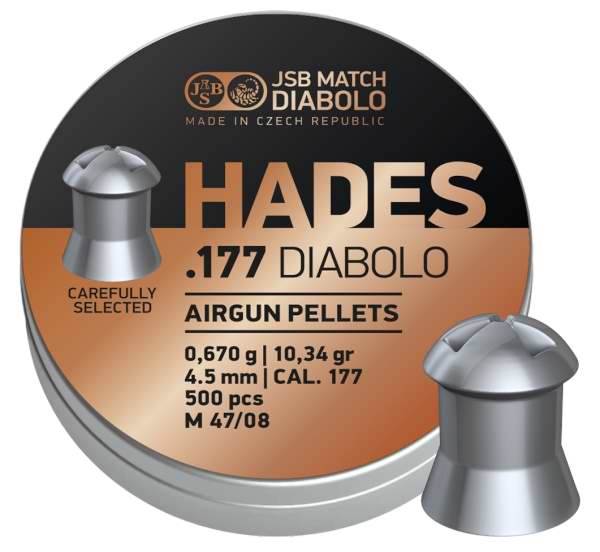
this year. If you haven’t heard about these little beauties, they are frangible
pellets designed for hunting. They have a long skirt and triangular cuts in the
head dividing it into three sections resembling the international symbol for
radiation when looking down on the pellet. The purpose of these cuts is to
create greater expansion/mushrooming upon contact with game. Acting similar to a
mechanical broadhead arrow tip the design creates a larger wound channel and
internet chatter has been very complimentary regarding these newcomers.
Much speculation and discussion occurred in 2019 about JSB
coming out with an airgun slug. Wanting to preserve their stellar reputation in
the industry, JSB was unwilling to enter this market unless they could produce
a high-quality product within cost-effective mass-production parameters. Then,
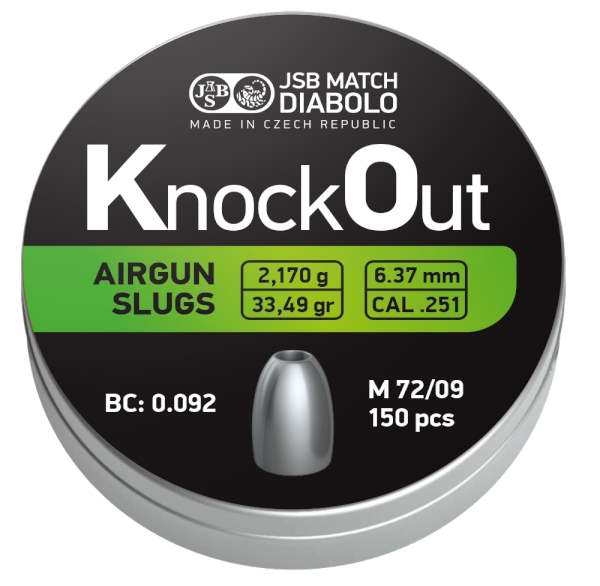
at 2020 SHOT Show, enter the KnockOut lead slug for airguns in .22 at 25.39
grains. There are actually two versions of the .22 slug, a .216 diameter and a
.217 diameter. Since then the KnockOut in .25 at a weight of 34 grains, has
been announced and should be available in the November timeframe. SAFETY NOTE:
Keep in mind these slugs are ballistically like regular bullets when fired and can
travel much further than a typical diabolo pellet of the same weight.
The JSB, Polymag and GTO lines reflect an unparalleled quality so no apologies are made for the higher cost of their products. Quality usually costs more, plus factoring in the heaviness of lead increases the transportation costs, so the higher retail price is understandable.
P.S. – Another plus for airgunners is the long-awaited changeover
to screw-top lids on all of their pellet tins!
Check out this link to be taken to the AofA page showing Predator International and JSB products and contact them for availability. The .25 caliber slugs should be listed there as we get closer to November.
At the Crosman booth during the 2020 SHOT Show an attractive
little .177 caliber pellet rifle was part of a display of new offerings. It was
colorful with its red box magazine hanging down from the stylish grey polymer
stock. The black barrel, trigger guard and buttpad made a striking contrast along
with the red trigger and red lettering on the right side. It looked familiar
though and it turns out this new CO2 rifle was actually the reimagined
1077 RepeatAir, one of Crosman’s best-selling models. Designed to appeal to a
younger demographic and folks looking for a fun family activity through spending
time at the backyard or basement range, this inexpensive little rifle can fill
the bill.
With its 13.25-inch length-of-pull,
it can be a great trainer for youngsters, and is still long enough to be
comfortable for a full-sized adult to shoot informally. The internal steel
barrel is 20-inches long and rifled, which makes this little plinker quite
accurate at 10-meters. Touted as being able to launch a pellet at up to 780fps,
it is capable of being accurate out to at least twice that. Its double-action trigger
pull is fairly heavy at an average of nine pounds and takes some getting used
to, plus was somewhat stiff until the gun was more broken in. The long trigger
pull advances the rotary magazine to line up the next pellet chamber and loads up
the internal hammer, finally tripping the hammer, releasing the CO2
and launching the pellet.
Using one CO2 cartridge
loaded neck first into the front of the forearm, the piercing tube cap is turned
down until it is snug. All that is needed at this point are .177 caliber
pellets, safety glasses and a good target/backstop. Loading the pellets is a
two-stage process as the pellets actually go into the 12-round rotary magazine
(referred to as a “pellet clip” by Crosman and two are included) which is then
inserted into the box magazine and loaded into the bottom of the rifle. The
front sight has a green fiber-optic pipe and the rear sight is a square-notched
type, adjustable for both windage and elevation. Additionally, there is a short
11mm dovetail rail should you like to attach a low power scope to the FreeStyle.
A manual cross-bolt safety is built into the trigger guard. The noise generated
by the shot is minimal; easily backyard friendly.
Inserting a full “pellet clip” into the box magazine
My granddaughter has limited
shooting experience and having this sample FreeStyle rifle delivered in the
middle of summer was serendipitous. She is left-eye dominant but right-handed and,
being a strong-minded young lady, I was not going to convince her she should
actually shoot left-handed. She had learned to shoot using a Crosman 1377
pistol and it is relatively easy for a left-eye/right-handed shooter to make
the necessary corrections with a pistol. A rifle is a bit harder so we set her
up at a shooting bench to start and she persevered until she was regularly
hitting her target. A selling point for using the FreeStyle 1077 to introduce
someone to the shooting sports is its very light weight. At only 3.75-pounds,
it doesn’t weigh down a new shooter and at our next session we will get her shooting
from a standing position.
Currently, AofA only lists the 1077 RepeatAir on their website and shows it as out-of-stock because it has been replaced by the new 1077 FreeStyle which is now shipping. As a bonus, two metal turkey silhouette targets are included and we all know how much fun reactive targets are! MSRP is expected to be in the $100 range. My friends at AofA will surely be able to help you if you would like to obtain one of these fun little rifles, along with pellets, CO2 and a pellet trap so you can start your own backyard range and get the family outside to shoot.
Another sport shooting enthusiast joins the ranks!
So, besides the
all-out kick-butt fun of slinging a bunch of .25 caliber lead downrange at
reactive targets, what else does the SK-19 bring to the table? As mentioned in
Part I, the SK-19 is quickly tunable in two ways, at the regulator and with a “velocity
adjuster” knob at the rear of the buttstock. At its full power setting, the
SK-19 is capable of 60 foot-pounds of energy, perfectly acceptable for hunting
various critters with the added advantage of rapid follow-up shots. Set at the
factory to an optimal 150 bar, the regulator can be adjusted further however, above
150 may lead to wasted air and very little gain. Instructions provided with the
gun indicate that adjusting the regulator below 150 may lead to magazine
malfunctions and jams.
No sights come
with the SK-19 and in order to quickly get to the full-auto fun I mounted a
no-name, non-magnifying sight with illuminated reticle onto the generous 8.5-inch
upper picatinny rail. Recoil with this bullpup is negligible and I would not be
testing at any extended ranges so this arrangement was adequate for my needs.
Obviously, with the capabilities of the SK-19 it deserves a better optic
solution if taking it afield or shooting longer distances. Additionally, it
comes with a 7.5-inch bottom rail, perfect for mounting my vertical foregrip
that includes extendable bipod legs.
The air reservoir
is a removeable carbon-fiber wrapped 29 cubic inch (480cc) bottle with a
maximum rated fill pressure of 250 bar (3625psi). A gauge on the left side just
below the foster-style fill nipple relays the remaining tank pressure and there
is a built-in slow-fill valve. Designed for dry HPA only, do not attempt to use
any other gases.
There are two
safeties on the left side of the SK-19, one directly above the trigger that blocks
it and the other at the rear of the stock. This safety is also the switch for
semi or full-auto operation. As mentioned in the first installment, get in the
habit of utilizing both safeties and make doubly certain to fire the SK-19 in a
safe direction before putting it away to make sure the gun is totally empty.
The curved metal
trigger is pinned in place to the round trigger post and with this particular
hammerless design, no adjustment of the trigger pull by the user is possible. My
sample trigger broke at a very light 1 pound, 8.5 ounces in semi-auto mode.
The first
installment had a still photo from a video capture showing pinecones being
cleared off a hay bale. However, the SK-19 is quite capable of excellent
accuracy in both the very controllable full-auto or semi-auto mode with its 23-inch
Lothar Walther barrel. In semi-auto, I was punching 5-shot groups at .5-inch
from 20 yards all day long using Predator GTO lead-free pellets and the JSBs.
This gun did not appear to be finicky about its diet and the magazine is deep
enough to handle any of the longer pellets/slugs on the market today. The
barrel is shrouded by a carbon-fiber tube and capped with a matching
carbon-fiber look 4.75-inch long moderator that is very light and provides
excellent suppression of the report.
Results with a full-auto burst at 20 yards
Close up of the 19-round magazine on the SK-19
Results with JSB
Exact King Heavies, MKII at about the medium setting of the velocity adjuster
yielded 876fps with an extreme spread of 11. Rotating the velocity adjuster
counter-clockwise 5 clicks increased the average fps to 924.5 with the ES
jumping to 33 and more adjustment was available. At this power level, whether
firing rapidly in full-auto or in semi-auto mode, the shots per fill averaged
72. Using Predator’s 16.54 grain GTOs the results were 1057fps with ES of 19.6
and 1100/13.4 respectively.
A new company with
a new product on the market, they will find ways to reduce the cost or provide
more features as time goes on. For my two-cents I’d like to see a little thicker
buttpad that is also adjustable for vertical position and cant plus a soft
cheekpad to soften placing your face on the hard plastic stock.
Check it out at AOFA and contact them if you are in the market for an American made, accurate bullpup that can also sling lead in full rock n’ roll fashion.
When you hear the word airgun, do you think of the BB/pellet
gun you had as a kid? Fond memories, huh? If you were lucky, it might have even
been a semi-auto CO2 BB launcher. That was incredible fun, right?
Jumping
forward to today the airgunner has tons of options and every year they seem to
be getting better and better. In the past couple of decades, Pre-charged
Pneumatics have come on strong and opened up a whole new world for airgunners.
Semi-auto PCPs had been around for a while, but early ones tended to be
finicky. With time they became reliable and now there are some very powerful
ones on the market that are designed for hunting applications. As airguns are
not currently heavily regulated in the good ol’ US of A, the next logical
progression, then, was for manufacturers to delve into the full-auto side of
things. Who doesn’t love to rock n’ roll occasionally? Especially if the ammo
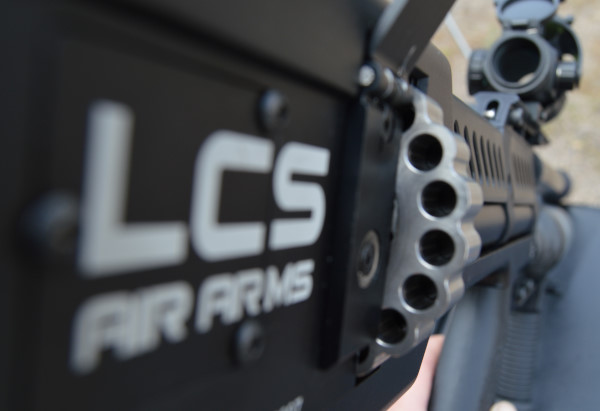
is cheap. Well, move over fans and make room for the new SLS Air Arms SK-19, a
select-fire PCP capable of delivering 19 rounds of .25 caliber downrange in
under 3 seconds!
Clearing the deck with the SK-19 in full auto mode
Manufactured
in the U.S. in both .22 and .25 caliber, this 35-inch long tactically styled
air rifle sports a Lothar-Walther 23-inch barrel in a bullpup configuration. Its
7.75-pound weight feels lighter due to the compactness and balance of the
rifle. It does require an optic and provides an 8.5-inch long picatinny rail on
top. Another rail of 7-inches is located on the bottom. A removeable 480cc
carbon-fiber wrapped tank capable of 250 bar pressure sits up front and
provides up to 75 shots per fill. This varies because the SK-19 is highly
tunable with two options to adjust; a regulator adjustment up front above the
bottle, (although this is factory set and the manual discourages adjustment), the
second is a power knob located on the bottom of the buttstock, just below the
magazine housing. At full power the SK-19 is rated for up to 60fpe.
A
hammerless design is what helps the SK-19 work as a full-auto air rifle.
However, there is a trade-off because this design and the tolerances required
for everything to work properly does not allow for a removeable magazine. It
has to be loaded in situ and this slows down the full-auto fun somewhat. My bet
is the SLS engineers are working on ways to keep the SK-19 reliable while
making the magazine removeable so quick swaps to full magazines will be
possible. Another drawback with the captive magazine system in that the shooter
must be absolutely certain to always use the two on-board safeties and at the
end of a shooting session, point the SK-19 in a safe direction and fire to make
sure the magazine is totally empty. The owner’s manual indicates you should not
dry-fire the SK-19 but that is hard to control because in full-auto, the
magazine is emptied practically before you can release the trigger plus this
issue of not being able to tell if the magazine is totally empty.
The sleek SK-19 select-fire bullpup
It comes with a hard-side
plastic, foam-lined case and extras seals. It retails for $2089 and is
supported by a 3-year warranty. Airguns of Arizona is the exclusive distributor
and is currently taking deposits for a new supply arriving later this month.
So, besides the cool and fun
factors, is the SK-19 accurate in semi-auto mode? You bet. More on that in my
next installment.