Posts Tagged ‘Airguns’

Recently I had the opportunity to play around with a pistol that I had been curious about for some time: the FX Ranchero.

Right off, I’ve got to tell that I liked the Ranchero a whole lot, and we’ll get to the reasons why in just a little while, but first let’s take a walk around the Ranchero.

It’s a big pistol, stretching 18 inches from end to end and weighing 3.3 pounds without scope or red dot. The version that I tested had a beautiful sculpted walnut grip with a stippled pistol grip, palm shelf, and walnut trigger guard. The two-stage match trigger is adjustable, and just forward of it, underneath the forend, you’ll find a gauge that tells you how much air pressure is left in the reservoir.

Moving forward again, there’s a lip at the end of the forend. Above that is the air cylinder which can be unscrewed when it runs low and replaced by another so you can keeping on shooting during a day afield. At the end of the air cylinder is the quick-fill charging port, and you can fill the cylinder on or off the Ranchero. Above the air cylinder is the shrouded Lothar-Walther with a threaded muzzle for mounting a silencer where those are legal.

Moving back along the barrel, you’ll find the receiver, which is handsomely finished in gloss black and has scope dovetails along its full length except for the breech opening. At the mid point of the receiver is the breech, where a removable 8-shot magazine slides into place (in only goes in one way, so you can’t get it in backwards).

The left side of the Ranchero, showing the cocking lever and the power adjustment lever.

On the left side of the receiver, just forward of the breech, is a small power adjustment lever. Push it all the way forward, and the Ranchero is on low power (around 8.5 fp for the .177 version, about 9 fp for the .22). Put the lever in the middle, and the pistol is on medium power (12 fp for .177; 13 fp for .22, and when the lever is all the way back – bingo! – high power (15 fp .177, 16.5 fp .22). Unlike many other power adjustment systems, which rely on changing the loading on the hammerspring, the Ranchero varies power by changing the size of the transfer port through which air flows to the barrel. The result is very high shot-to-shot consistency, regardless of what power setting you select.

On the left side of the receiver just aft of the breech is the cocking arm. Pull it straight back, and it cocks the pistol and rotates the next pellet in the magazine into position. Push it forward, the action closes, and a bolt probe pushes the pellet into the barrel. At the tail end of the receiver, you’ll find two brass disks. The first slides back and forth as you activate the cocking arm. The second you pull back to allow the magazine to be removed from the breech. On the right side of the breech is a forward-and-back safety lever.

Next time, we’ll talk about shooting the Ranchero.

Til then, aim true and shoot straight.

– Jock Elliott
A while back, I mentioned the good luck I had trying Dynamic SN-1 non-lead pellets in my Beeman R7 air rifle and RWS P5 pistol. A while later, I had the opportunity to chronograph the SN-1 pellets shot out of the P5 pistol, and I found that they were averaging 532 fps and varying no more than 2 fps from shot to shot! When you realize that the P5 is a spring-piston pistol, all of a sudden the light bulb comes on that this is truly astounding consistency.

Emboldened by this success, I decided to try the Dynamic SN-1 and TM-1 pellets in my recoilless RWS 54 .177 rifle. I set up the range in my yard at 39 yards (the farthest distance I can safely shoot at home). Shooting from a rest, I banged off a few shots with Crosman Premier Heavies (CPH, nominally 10.5 grain), the pellet that had produced the best accuracy with this rifle in the past. Then I shot the TM-1 pellets (9.5 grain) and the SN-1 pellets (7.95 grain).

Measuring the groups, I found the three different pellets produced very similar results. The groups from the CPH and TM-1 pellets measured 25/32”, while the group from the SN-1 pellets measured 26/32”. When I chronographed the three pellets from the same rifle a few days later, I got the following results. CPH: high 813 fps, low 798, average 804. SN-1: high 989, low982, average, 986. TM-1: high 835, low 825, average 832.

Okay, I thought, how will Dynamic pellets work in another of my favorite guns, a Steroid Sheridan Blue Streak? I shot groups at 13 and 25 yards with both JSB .20 pellets (the pellet that the Steroid ‘Dan “likes”) and Dynamic SPC-5 and got very similar accuracy results at both distances. When I got to the chronograph, I forgot to bring the JSB .20 caliber pellets (shame on me), but here are the results I got. At eight pumps, the Steroid Sheridan was sending Benjamin .20 cylindrical pellets (14.3 grain) downrange at 672 fps average (high 677, low 669). It was launching .20 Crosman premiers (14.3 grain) at 673 fps average (677 high, low 671). And it was blasting the SPC-5 pellets (12 grain) through the traps at 721 fps average (high 724, low 717).

I got excellent accuracy from the Dynamic pellets in my R7 rifle, P5 pistol, RWS 54 rifle and Sheridan Blue Streak, but not every airgun shoots them well. I got just awful accuracy shooting SN-1 pellets in my FWB 150 match rifle, and, oddly, the same thing happened with my modern vintage Sheridan Silver Streak.

From my small experiment, I conclude that some air rifles and pistols will shoot the Dynamic non-lead pellets very well, producing good velocity and higher penetration than lead pellets. While they are more expensive than conventional lead pellets, compared to match grade rimfire ammunition, the Dynamic pellets are a downright bargain and worth experimenting with.

Til next time, aim true and shoot straight.

— Jock Elliott

About a half mile from me there lives a fellow whose mailbox says “The Lawnmower Guy.” I contacted him about tuning up my mower and when he brought it back, he noticed the pellet trap with a target on it in my garage, so he asked me if I was a member of the gun club outside of town.

I told him I was a member, but what he really needed was an air rifle or an air pistol, and then he could shoot in his back yard whenever he wanted. All he had to do, I told him, was reassure the neighbors that he would shoot safely into a pellet trap and not plink at their cat.

Pretty soon, I started dragging out some air pistols for him to try, and one of them was the new Beeman P11. His eyes nearly bugged out of his head. “Wow, that’s cool,” he said. I loaded it up for him and let him draw bead on a tiny chipmunk target printed on a piece of paper.

The Beeman P11 looks great and is a lot of fun to shoot.

He steadied the P11 in both hands, aligned the sights, squeezed the trigger, and – whap! – nailed the chipmunk dead amidships. “Wow, those sights really light up! Where can I get one of these?” he asked. I wrote http://www.airgunsofarizona.com/ on a piece of paper for him, and he scurried off.

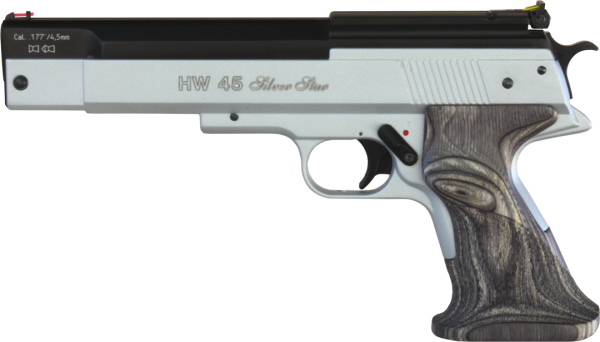
The P11 is, indeed, a cool air pistol. It’s the younger brother of the Beeman P1 but sports a two-tone color scheme, snazzier laminated grips, and fiber-optic sights. The P1 is available in .177 and .20 cal, while the P11 is available in .177 and .22. The picture doesn’t really do the P11 justice; the lower half of the ambidextrous laminated grips are stippled for a better grip and the bottom of the grip flares, providing a little bit of a palm shelf. In any event, I like the way the P11 looks and feels. The overall fit and finish of the matte-gray receiver and black “uppers” are, in my opinion, excellent.

If you’ve never handled a Beeman P1 or P11, there’s some stuff you have to know. First, this is a spring-piston air pistol. That means when you trigger the shot, it’s not going to behave like a Daisy 747 or a Crosman CO2 pistol. Instead, you’re going to get the whiplash recoil that is typical of a spring-piston powerplant. So don’t be surprised when it doesn’t act like a docile single-stroke pneumatic match pistol.

In addition, loading the P11 (or P1) is unusual. You start by flipping the safety (accessible from either side of the pistol) on and pulling what appears to be a hammer at the rear of the receiver. This releases the rear upper half of the receiver where the barrel is housed – the black part on the P11. Grasping the loose end, you pull it up and forward until it latches to cock the pistol. The cocking effort requires pulling the barrel assembly away from you as you open the action of the pistol, and it takes about 18 pounds of effort. Once the action is fully open and latched, slide a pellet into the breech end of the barrel and return the receiver back to its original position, snapping it locked into place.

Now, you’re ready. Just flip the safety off, ease the first stage out of the trigger, and let the good times roll. And The Lawnmower Guy was right: those fiber optic sights really light up like a neon sight . . . and that makes it sooo much easier to align the sights than the plain-old metallic sights on the P1. The P11 that Airguns of Arizona sent me to play with was the .22 version, and I find it smoother to shoot than the .177 version I once owned. I don’t know why that is. Certainly the velocity of the .22 is lower than the .177. For example, you might expect 415 fps with 14.3 grain .22 Crosman Premier pellets and around 520 fps with 7.9 grain .177 Crosman Premier Light pellets (on high power – the .177 version offers two cocking positions for two different levels of power.)

Whatever the reason, I find the P11 in .22 to be one of those “salted peanuts” guns – you can’t stop with just a few shots. You say to yourself, “Just five more shots, then I’ll go in.” The next thing you know, an hour and a half a tin of pellets has magically disappeared. But somehow you don’t mind.

Til next time, aim true and shoot straight.

PS There will be a follow up Blog on the UJ Challenge in the near future.

Jock Elliott

The Beeman R7 is a classic air rifle well loved by many airgunners.

When I first began to get interested in adult precision airguns nearly 10 years ago, I remember reading a quote from an airgunner who said, in effect, “Of all the airguns I own, the Beeman R7 would be the last one I would sell.”

At the time, I didn’t really “get” what he was saying, but now that I’ve owned an R7 for a few years, I understand what he meant completely. The R7 is a true classic, an air rifle that just about all airgunners love.

Here’s why — the R7 is a relatively small and light air rifle that generates around 6 fp of energy (the same energy level usually found in Olympic match air rifles). The R7 measures a hair over 40 inches from end to end and weighs 6.1 pounds. The upshot is that there is roughly one pound of weight per foot-pound of energy, and that makes the R7 extremely easy to shoot well.

(An aside: there are two versions of the R7, one in .177 cal., the other in .20 cal. I have experience only with the .177 version. A casual survey of some of my shooting friends indicates you can’t believe the 700 fps velocity figure that Beeman puts out for the .177 version; most untuned R7s shoot in the high 500s, say, 560-590 fps, with “normal” weight pellets.)

To get the R7 ready for shooting, you crank the barrel down until it latches (it takes less than 20 pounds of cocking effort), stuff a pellet into the breech, return the barrel to its original position, click off the safety, and you’re good to go. The R7 is equipped with Weihrauch’s famous two-stage Rekord trigger which is very crisp and nicely adjustable.

My experience – and that of many R7 shooters I’ve spoken to – is that the R7 is remarkably UN-finicky about how you shoot it. You can hold it loosely or hold it tight; shoot it off a rest or from a sitting position. Whatever you do, it seems, the R7 shoots well. One shooter I met said, “Why do I pull my R7 tight into my shoulder like a powder-burning rifle? Because I can!”

And there is a whole lot you can do with an R7, like shoot field target or defend the birdfeeder. My brother-in-law won the Hunter Class at a Field Target match while shooting an R7. He beat me, and I was shooting another R7, and so was the fellow who took fourth place. We’ve spent many happy hours doing high-accuracy plinking with our R7s.

Recently Greg at Airguns of Arizona asked me to try some Dynamic SN-1 non-toxic “air bullets.” “I think you’ll like them,” he said. “We’ve had very good luck with them.”

Frankly, I had my doubts. I had tried some ultra-light non-lead pellets previously and while they were very fast (nearly 100 fps faster than CPLs in my R7), the accuracy was dreadful at anything beyond close range.

Nevertheless, the SN-1 pellets arrived, and I brought them with me the next time I visited my brother-in-law to do some shooting with our R7s. I shot for a while with Crosman Premier Lights (CPLs) and then gave the SN-1 pellets a try. The SN-1s weigh (nominally) 7.95 grains, which is roughly the same as the CPLs. I was shocked to find that, at 50 feet, not only did the SN-1 pellets group very well, they were hitting the same point of impact as the CPLs!

Emboldened by this experiment, I tried the SN-1 pellets in an RWS P5 spring-piston pistol. This time, I did get a point of impact change, but the SN-1s grouped very well, better in fact than the pellet the P5 previously “liked.” Casual experimentation with metal cans indicates that the SN-1 pellets deliver much better penetration than conventional lead pellets.

The bottom line is that I was very pleasantly surprised by the Dynamic SN-1 non-lead pellets and plan further experimentation with them.

Til next time, aim true and shoot straight.

Jock Elliott

We all crave power in our airguns, even though we also enjoy shooting quietly in our neighborhoods. There have been many attempts at bringing these worlds together, but none have worked perfectly in both areas. That is, until now. Enter the Air Wolf, Daystate’s latest advance in the electronic CDT firing system. By controlling the firing cycle electronically, Daystate has managed to not only increase efficiency by cutting off the valve-dwell duration, but they have tweaked the electronics to allow for consistent shot strings at power levels ranging between 12.5 and 40 ft/lbs! Via the 16-step electronic power adjuster, the user can adjust the power on the Air Wolf in about 1 minute’s time. You will need two tools, which Daystate conveniently included with each rifle; the safety catch and the trigger. The following is a brief summary of how to perform the power change with the rifle in hand:

Step 1: Power off the safety catch.
Step 2: Pull and hold the trigger, and power the safety catch on. (The rifle will beep once)
Step 3: Continue to hold the trigger back as the rifle completes several series of beeps, 2 beeps, 3 beeps, and so forth.
Step 4: After the rifle completes a series of 6 beeps, let go of the trigger. The rifle is now in power adjuster mode.
Step 5: For every pull of the trigger at this point, the rifle drops down one power setting. If you power the safety catch off without pulling the trigger, the rifle will set at full power.
Step 6: After you pull the trigger to the desired setting turn the rifle off.

That’s all. The rifle is now reprogrammed to the desired level, and will remain until you reset it. And, knowing that someone, somewhere would get mixed up and do something they did not mean to do, Daystate left a default sequence to reset everything back to the high power default. To default the rifle, simply power the safety catch off, pull the trigger back, and plug in the power charger (connected to the wall outlet). When you let the trigger go, the rifle makes a series of beeps and the default settings are restored. The user can rest assured that nothing can go wrong when adjusting the features.

Now, for the test, a .22 Air Wolf was used. The 16 steps gave the following results using the Beeman Kodiak 21.1 grain pellets:


Pulls of the Trigger = Power Output (ft/lbs)
0 = 38.47
1 = 38.21
2 = 37.96
3 = 37.70
4 = 37.37
5 = 37.12
6 = 36.29
7 = 34.98
8 = 33.70
9 = 31.20
10 = 28.88
11 = 26.08
12 = 23.23
13 = 20.11
14 = 16.42
15 = 12.57


Notice how the first-half of the settings are close together. Daystate did this so that the user can tune the rifle to the pellet of choice without losing much power. So, if your JSB Exact’s are a tad bit too light to perform down range, simply drop the power a bit and you are set. Then, if you decide to bring the Air Wolf indoors or into a backyard with nosey neighbors, you can dial the rifle down to the lowest setting and it becomes a silent plinker. And here is where Daystate’s CDT system shines above other power adjusters on the market. When powered down, the Air Wolf is not choking the air traveling through the valve; instead the rifle is actually firing as if tuned to the reduced power setting. This translates to better consistency from shot to shot, and better efficiency at the lower settings. When you dial it down to 12.5 ft/lbs, it shoots like a UK specification rifle through and through.

The fully functioning barrel shroud works great at maximum power, and gets better with every step down. At minimum power the rifle is mute. Add these features to the long list of features like pressure gauge, quick fill connector, zero-effort cocking, phenomenal trigger out of the box, and a whole host of electronic features and you have the most complete factory airgun on the market. When it comes to versatility, Daystate has the market cornered. Meanwhile, other brands will have to be customized one feature at a time to get close, and even then they fall short.


To read up on all the great features of the Daystate Airwolf, click here!

Is this a spicy southwestern breakfast, or a really cool new pistol? Yes, I know, it’s a pistol. Picked up my pair Saturday morning, all that I could hope for and more. The brainchild of AOA, basically the action of the FX Cyclone with a shortened barrel and a diminutive air cylinder, set in a custom pistol stock designed by all the guys at AOA. When I first ordered mine from drawings, about 6 months ago, I envisioned a pistol shooting at 32 ft/lbs with about three shots. Yes, I could have lived with that, just enough shots for the wily pigeon. But, thankfully, they outdid themselves. With a new valve system and three power settings, 3–6–and maybe 8 of the eight-shot magazines are possible. The barrel is shrouded, with a ½” UNF threaded end. (The usual power wheel), and a gauge so you know what’s left in the cylinder. I mounted a Burris Compact riflescope on one, and a compact Leupold on the other (mine). As this pistol is not the slender, light 10-meter type, it has a substantial grip and stock to hold the basically full size action. For me, this doesn’t leave a straight-arm stance for a pistol scope, thus the riflescopes. I hold the pistol grip with my right hand, and a comfortable thumb rest, and cock the left hand flipper bolt with my left. Then, it is necessary for me to support the front of the gun with my left hand or use the left arm as a rest. The pistol has a modest pop with just the shroud. I mounted a compact Daystate C/F mod on one, and just a “phuuut” is heard. I mounted a full size mod on the other, and nothing is heard. As I only have a 30-yard range along side my house, I sighted them both in at that range. Within a few test shots I had them both making more or less the same hole. As I wanted to see what the pistol could do, I used a rest, and the pistol shoots better than I can. Nice…REALLY Nice! It’s like shooting my Cyclone, but in a much smaller package. I plan to carry it in the car…you never know!

Availability??? Ten units came in Friday PM; ten were gone by Saturday AM. Get on the list for the next shipment; I’ve already got mine, so go for it! Prices, pictures, and Chrono shot data should be coming from AOA. My Chrono died and I’m waiting for the replacement.

This is the ONLY pistol of its kind!

Best to all – ART SR. – HAPPY-ADDICT

As the new Mk3’s and Air Wolf’s arrive, the new concept of what Daystate refers to as ” Lean Charge” is leaving some in the dark about what exactly is so great about the new electronic firing system which Daystate has developed for their Electronic Series of airguns. The following is a brief explanation from David Snook, one of the instrumental minds behind the CDT system found inside the Daystate rifles:

“The original CDT units used a 7ms pulse where the voltage was adjusted to vary the power. This results in the valve being opened in a similar manner to a hammer and weight, where the valve is opened by the potential energy contained in the moving armature. I call this a “ballistic” valve.

Lean charge uses a different concept, it uses the maximum voltage level (approximately 70V) and adjusts the energy using the applied current pulse length, this can be between 1200us to 5800us depending on power level and solenoid design. This uses a combination of ballistic and magnetic valve opening and timing. The potential “ballistic” energy of the armature “knocks” open the valve and then the magnetic field sustained by the current pulse length determines how long it is kept open for. This has the following advantages:

1. The initial acceleration of the armature is greater due to more current being applied to the solenoid.

2. In turn the valve opens faster giving a steeper barrel pressure rise time.

3. The solenoid is then switched off allowing the valve to close rapidly under the air pressure behind it, rather than waiting for a ballistic hammer to decelerate and then close. This action allows the natural self-regulating properties of the valve to be more effective and gives a sharp pressure fall time saving air use.

4. The valve is opened and closed when the pellet is still in the barrel, this is difficult to achieve with a totally ballistic valve operation.

5. Muzzle energy can be tightly controlled using this technique.

The overall benefits are very fast lock times (typically less than 7ms), excellent air economy with attendant large shot capacity and reduced muzzle blast giving a very much quieter gun. The most surprising benefit is accuracy, where reduced blast lessens destabilisation effects on the exiting pellet.

Shooting a high powered lean charge gun is a culture shock, even with a very modest silencer it is a fast, quiet and very accurate gun.”

Shrouded Air Ranger in either 35 or 50 ft/lbs with the newly designed walnut ambi thumbhole stock.

Daystate has responded to customer request by fitting a very nice thumbhole walnut stock to the Air Ranger as standard. This stock is a very nice grade of walnut with an ambidextrous cheek piece and a thinner profile for increased comfort and decreased weight. Laser cut checkering and finely a curved buttplate add to the overall increased comfort.Daystate has also installed a factory-baffled shroud to the Lothar-Walther barrel. We now have a combination of high accuracy, high power, and ultra quiet report in the 35 & 50 ft/lb versions. The 80 ft/lb version sports a heavy unshrouded barrel with a 1/2″UNF threaded muzzle. The 35 & 50 ft/lb models are free floated wile the 80 ft/lb model has a barrel support.

80 ft/lb Air Ranger with barrel support in Daystate's newly designed walnut ambi thumbhole stock.
These improvements to what has been a proven performer come at no increase in price, making the Daystate Air Ranger factory-built with NO need for extra tuning and customizing! We are certain that you will agree that Daystate has designed a winner with the Air Ranger!For more information on the Daystate Air Ranger, please click this link!