Posts Tagged ‘Weihrauch’

Earlier this year Airguns of Arizona announced that they would be importing the Weihrauch HW35E. The HW35 has been in continuous production for over 50 years, and the “E” version is the Export version of this gun. The HW35E is available in .177 and .22 caliber, stretches 43.5 inches from muzzle to buttplate and weighs 7.8 pounds.

At the aft end of the HW35E, you’ll find a brown rubber butt pad which is separated from the walnut stock by a black spacer and a white spacer. On the left side of the buttstock, there is a modest cheekpiece. The comb on the buttstock is quite low, which aids shooting this air rifle with iron sights. Underneath the buttstock is a swivel for attaching a shooting sling.

Moving forward, there is a pistol grip, which is checkered and trimmed with a white spacer and a black cap. Forward of that is a black metal trigger guard which houses the silver-colored metal Rekord trigger and its adjustment screw. Forward of that, the forestock is relatively unadorned, with the exception of finger grooves on either side and a screw that secures the action in the stock. At the forward end of the forestock, there is a cocking slot that provides clearance for the action with the break barrel is opened.

If you look at the HW35E from the right side, it looks pretty much like any break barrel air rifle. But from the left, you’ll notice something unusual: a semi-circular cut-out on the right forward edge of the forestock. This cut-out provides clearance for a breech latch that is secured to the breech block. The breech latch makes sure the barrel and breech always return to the same position after loading for greater accuracy.

Forward of the breech block is the barrel, and about halfway to the muzzle, another sling swivel is attached. On top of the barrel at the muzzle end is an R1-style front sight with interchangeable inserts, and a typical metal rear sight is mounted on top of the breech block. Moving further aft, you’ll find the receiver is equipped with dovetails for a scope and three holes for anti-recoil pins. At the aft end of the receiver is a push-button safety.

To ready the HW35E for shooting, place your left hand on the barrel just forward of the breech block. With your left thumb, pull the latch release toward the muzzle, then pull down gently on the barrel. The action breaks open about an eighth of an inch and stays there. Now, slide your left hand out to the front sight and pull the barrel down and back until it latches. The cocking stroke is incredibly smooth and noise free, and the cocking effort is definitely moderate – I estimate it to be in the mid to high 20-pound range. Insert a pellet in the breech end of the barrel, return the barrel to its original position, and you’ll hear the breech latch click into position.

Next, take aim, click the safety off, ease the first stage out the trigger and squeeze just a bit more. The action goes “tunk,” and the shot goes down range. There is no twang, no vibration, and very little recoil. In short, the sample that I tested cocked and shot like a professionally tuned air rifle. The report is also very neighbor-friendly.

I found the .22 caliber HW35E launched 14.35 grain JSB pellets at 626 fps average (about 12.4 footpounds of energy).

The accuracy of the HW35E was excellent. I found it was really easy to put 5 JSB pellets in a group at 30 yards that I could hide with a nickel. A skilled springer shooter could probably do even better.

Straight out of the box, the HW35E is easily the nicest to shoot unmodified spring piston rifle that I have shot to date. I give it my hearty personal recommendation.

Til next time, aim true and shoot straight.

– Jock Elliott

The HW50S Stainless is handsome and weather resistant.

Some years ago, I got caught in a rain storm with a finely made German air rifle. I dashed back to the car as quickly as I could, swabbed off the water with my bandanna, and stashed the rifle in a gun case. When I opened the case that evening, I could see that a tiny bit of rust was already beginning to form in a couple of places on the metal. Frankly, it annoyed me, and it put me on the lookout for an air rifle that could withstand wet weather.

Fast forward a few years, and I managed to obtain a Beeman R1-AW. This was a special version of the legendary Beeman R1 with electroless nickel plating on the metal parts and a black composite stock. Available only as a .20 caliber carbine, it was a beautiful gun, designed to withstand the elements, but jeez-Louise, it was heavy – fully 9.7 pounds just as it came out of the box. The one I bought had a muzzle break on it, which meant a scope was mandatory, raising the ready-to-go weight even more. Eventually I sold the R1-AW because I didn’t want to tote around all that weight.

In 2007, I tested the Weihrauch HW50S in .22 caliber and found it to be a lovely spring-piston air rifle. So imagine my delight when the good folks at Airguns of Arizona surprised me the other day with an “extra” rifle packed in a shipment. It was a Weihrauch HW50S Stainless.

The “Stainless” looks a whole lot like a scaled down version of the R1-AW. It has a stainless metal finish on the action (I suspect it might be the same nickel finish used on the AW) and a black synthetic finish on the wooden stock. The end result is an air rifle, available in .177 or .22, that ought to withstand inclement conditions pretty darned well.

What makes the HW50S Stainless particularly nice is its very manageable size and weight. It’s only 40.5 inches long (the same size as a Beeman R7) and weighs only 6.8 pounds (less than an HW35E or HW85 and nearly 3 pounds lighter than the R1-AW.)

In terms of looks, the Stainless is a study in functionality. You won’t find checkering or other decoration anywhere. At the extreme aft end, there is a brown rubber butt pad with a black spacer and a slight swell for a cheekpiece on the left-hand side of the stock. The forestock extends over the two-piece cocking linkage and breech block, giving the HW50S a more finished appearance rather like a Beeman R1. The two-piece cocking linkage allows the action to be anchored by a single big screw in a steel seat underneath the forestock.

The trigger guard is black metal and fastens to the stock with two screws. Inside is a silver metal Rekord trigger and a silver adjustment screw. . (With the factory settings on the Rekord trigger, the first stage will come out between one and two pounds, and the second stage will go off between three and four pounds, but the Rekord trigger can be adjusted much lighter than that.) The barrel and receiver look like stainless steel. The barrel is 15.5 inches long, and on top of it at the muzzle end you’ll find a black metal globe sight with interchangeable inserts, just like on the R1. The receiver has three holes for anti-recoil pins, and you’ll find a bright red push-button safety at the rear, which looks really snazzy against the silver and black of the rest of the gun.

To get the Stainless ready for shooting, grab the barrel near the front sight, pull it down and back until it latches (I estimate this requires about 32-34 lbs of effort), slide a pellet into the breech, and return the barrel to its original position. Take aim at your target, click the automatic safety off, and ease the first stage out of the trigger, squeeze a bit more, and the shot goes down range. The shot cycle is pretty smooth, with a bit of vibration, but the vibration is more heard than felt. The HW50S Stainless launches JSB Jumbo Exact .22 pellets (15.9 grain) at around 560 fps, which works out to about 11 foot-pounds of energy at the muzzle. I wouldn’t want to take on a charging cape buffalo with this air rifle, but it is plenty potent enough for defending the garden.

To my way of thinking, this is an air rifle that just begs for a peep sight.

For accuracy testing, I mounted a scope on the Stainless and found I could easily shoot ragged one-hole groups at 13 yards with the JSB Jumbo Exact pellets. The HW50S is no slouch when it comes to accuracy. Shooting the non-stainless version couple of years ago, I entered a Hunter Class Field Target Match and placed second. Another approach to a sighting system for this gun would be to keep it as lean, mean, and utilitarian as possible and mount a peep sight instead of a scope. I understand Airguns of Arizona is now carrying the full line of Williams sights and can fit the Stainless with a peep sight that will meet your needs.

The bottom line is that the HW50S does a number of things well, and I think many airgunners will really enjoy this versatile and weather resistant air rifle. I know I did.

Til next time, aim true and shoot straight.

– Jock Elliott

Weihrauch HW25L Rifle

The HW25L is light, handy, and lots of fun.

The other day I was running some errands when I saw one of those miniscule “Smart” cars. They are about half the length of a normal car, and every time I seen one, I can’t resist the urge to look underneath to see if there are feet pushing it – Fred Flintstone style – down the roadway.

When I got behind the Smart car, I found the owner had taken his or her visual statement to the max: the vanity plate said “2KYOOT.” Get it – too cute.

Well, I’ve gotta say my initial reaction to the Weihrauch HW25L was the same: 2KYOOT. I looked at the tiny air rifle inside the Weihrauch box and thought: “You’re kidding, right?” After all, I had been conditioned by years of cracking open HW boxes. Out of them come manly, stalwart air rifles, and here was this diminutive version of one. It was as if someone had gone to the Weihrauch factory and said I like everything about your air rifles, but I want one smaller and lighter, and the Weihrauch folks said, Okay, we’ll do it.

The result is a very nice small air rifle. The HW25 stretches just 37 inches from end to end, weighs only 4.4 lbs, and the length of pull is 13 inches.

The HW25 has a completely unadorned hardwood stock. At the aft end, you’ll find no butt pad, just a butt plate formed by the end of the wooden stock. There is the slight swell of a cheek piece for righthanded shooters, but lefties ought to be able to shoot this rifle equally well. The comb of the stock is very low, so even guys with wide cheek bones (like me) can get themselves in position behind the sights.

The pistol grip has no checkering, and ahead of that is the wide black trigger guard, inside of which you’ll find a rolled black sheet metal trigger. Moving forward, there is a screw under the forestock that helps to hold the action in place. At the end of the forestock is a short slot that allows room for the cocking linkage.

Moving forward again, you’ll find the breech and the 15.5 inch .177 caliber barrel. At the end of the barrel is the front sight, which houses a red fiber optic rod. Moving back along the barrel, you’ll find the breech block, on top of which sits the micro-adjustable rear sight, which is fitted with green fiber optics.

On top of the receiver, toward the back end, there is a dovetail for fitting a scope, but there are no holes for anti-recoil pins. At the very aft end of the receiver is a push-pull resettable safety.

To get the HW25L ready for shooting, grab the barrel near the muzzle and pull it down and back until it latches (I estimate this requires about 20 lbs of effort, and you hear a tiny bit of spring noise when cocking), insert a .177 pellet into the breech, and return the barrel to its original position. Take aim (put the red dot between the two green dots and put the sight picture on the target), push the safety forward to click it off, and squeeze the trigger. It takes about 1 lb of effort to pull the first stage out of the trigger, and at about 5.5 lbs, the shot goes down range.

Despite its small size, the HW25 doesn’t skimp on velocity. It will launch very light pellets at nearly 600 fps and 7.9 grain Crosman premiers at 487 fps average. I did not test the HW25 for ultimate accuracy, because I feared that, lacking anti-recoil holes in the receiver, a scope would slide backward off the dovetail and ruin the finish on this loaner rifle. I did try shooting at some silhouette targets (pigs, rams, turkeys, etc.) scaled for 10 yards, and found that I could hit what I was aiming at most of the time. I suspect the accuracy will prove to be comparable to the HW30S.

In the end, my “you’re kidding, right?” attitude toward the HW25L changed to one of solid admiration. It seems to be the nearly perfect rifle for an afternoon of plinking in the back yard. It’s light, easy to cock, and won’t wear you down in a day of shooting. Yet it has the power and the accuracy to defend the birdfeeder and eliminate pests in the garden at modest ranges. Best of all, it has Weihrauch quality built right into it.

Til next time, aim true and shoot straight.

– Jock Elliott

Rumors swirl around the Internet and around the airgun industry, but I have it on pretty good authority that Beeman Precision Airguns, the airgun company that many of us knew and loved, is no more. I have heard that one company has bought the rights to the low-end Beeman products while another may have bought the rights to use the Beeman name for high-end products for a few years, but I have received no official announcements to that effect.

During my experience as an adult precision airgunner (as opposed to the BB gun days of my youth), I knew the Beeman company primarily as a purveyor of high-quality spring-piston air rifles – mainly German-made Weihrauch rifles – that had been given the Beeman brand.

It’s a sad thing to see a well-respected company fade into oblivion, but for those of you who wish to own the kind of high-quality spring-piston air rifles that Beeman once sold, there is good news: you can! Airguns of Arizona is importing the equivalent German models directly from Weihrauch.

What once was the Beeman R9 is now available as the Weihrauch HW95 Luxus. Available in .177, .20, .22, and .25, the R9/HW95 is truly one of the classic air rifles of all time, and I suspect that a very large number of them have been sold over the years.

I had never owned an R9/HW95, so Airguns of Arizona sent me one to evaluate. After playing around with it for a while, it’s easy to understand why they are so popular.

The HW95 stretches 42.32 inches long and weighs just 7.5 pounds. At the extreme aft end is a soft brown rubber buttpad, connected to the ambidextrous hardwood stock by a black spacer. The pistol grip is checkered on either side, and forward of that you’ll find a black metal trigger guard. Inside the trigger guard is the world-famous Rekord trigger, which is adjustable for second stage weight.

Moving forward, the forestock has checkering on either side, and there is a slot underneath to accommodate cocking the break barrel action. Forward of that is the Weihrauch barrel, on top of which is a globe front sight with interchangeable inserts. On top of the breech block is a micro-adjustable notch rear sight with a choice of four different notches for sighting.

Moving back along the receiver, you’ll find dovetails for mounting a scope and three recesses for accepting anti-recoil pins from a scope mount. At the extreme rear edge of the receiver is a push-button safety.

To ready the HW95 for shooting, grab the barrel near the front sight and pull it down and back until it latches. This requires about 40 lbs of effort. Stuff a pellet into the breech and return the barrel to its original position. Take aim, click the safety off, and pull the trigger.

Making no adjustments to the Rekord trigger as it came from the factory, I found that the first stage came out of the trigger at 1 lb, 3 oz, and at 3 lb, 8 oz, the shot went downrange. But note well: the Rekord trigger can be adjusted much lighter than that.

The .177 sample I tested launched 7.9 gr. Crosman Premier Light pellets at 879 fps average, for about 13.5 foot pound of energy at the muzzle.

Well, what about accuracy? I’m glad you asked! I didn’t actually test this sample for accuracy, because I already knew what an R9/HW95 could do. For example, I know of one highly place national field target competitor who uses an R9/HW95 as his backup gun. I shot it one day (to be fair, it had been lightly tuned and had a custom stock) and easily dropped a one-inch field target at 40 yards. I also know a pest control professional who relies on a .177 R9 for controlling birds inside supermarkets. His selection of the R9/HW95 is very high praise indeed; there are lots of things in supermarkets that you don’t want to inadvertently shoot while you are controlling unwanted wildlife, so he is betting his professional reputation on the accuracy of the gun.

You might say that the R9/HW95 is a professional’s workhorse – what better recommendation do you need?

Bottom line: while it is sad to say Goodbye to the Beeman company, it is very good news to know that the high quality Weihrauch air rifles that Beeman offered are still available.

Til next time, aim true and shoot straight.

– Jock Elliott

The Weihrauch HW97 is one of the world’s classic underlever spring-piston air rifles. It has been around for a number of years and has a devoted following who think very highly of this German made tackdriver.

For a while now, I’d been hearing rumors that there was a factory thumbhole version of the HW97, and recently the good folks at Airguns of Arizona sent me a sample in .177 caliber to check out. I can tell you straight up that I really don’t want to send it back.

Before we get into the particulars of the HW97K (the K stands for Karbine) thumbhole, I should explain that several years ago, I owned a Venom-tuned HW97K with the standard stock. It had “stout” cocking effort, a very quick firing cycle, and was very accurate if you did everything just right. But I had never shot an untuned HW97, so I wasn’t really sure what to expect from the fresh-out-of-the box HW97KT (the T, of course, stands for thumbhole).

According to the factory specs, the HW97KT is a tenth of an inch longer than the HW97K, and the HW97KT weighs 9.37 lbs, compared to 8.8 lbs for the HW97K, but there are lots of other differences as well.

Starting at the aft end of the HW97KT, you’ll find a soft rubber recoil pad. In the center of the pad, there is a screw. Loosen the screw, pull the pad back a bit, and you can move the butt pad up and down to fit your anatomy. There is a metal plate attached to the recoil pad and another metal plate on the buttstock. Each has metal teeth that engage with each other when the screw is tightened so that the adjustable butt pad will not slip out of its intended position.

The stained beech stock is truly ambidextrous. There is a slight cheek swell on either side of the buttstock and a modest cheek piece. Below that is the thumb hole. Forward of the thumb hole is the pistol grip which has stippling on either side. At the top of the pistol grip are grooves on either side of the stock to accommodate the shooter’s thumb and forefinger.

Moving forward again, you’ll find the metal trigger guard, inside of which is the Rekord trigger and trigger adjuster, both of which are gold colored. Forward of the trigger is the forestock which is laser checkered on either side. The end of the forestock is swept backward slightly, complementing the sleek looks of the the thumbhole stock.

The cocking lever protrudes from the forestock, the free end of which is captured by a latch that is attached to the muzzlebrake/silencer at the end of the barrel. Moving back along the barrel, you’ll find the receiver and the silver colored breech plate. Moving aft again, there are scope dovetails on top of the receiver with sockets for anti-recoil pins toward the back of the receiver. At the extreme back end of the receiver is the small push-button safety.

Overall, I’m very impressed with the fit and finish of the HW97KT. The stock looks very streamlined and purposeful, and the finish on the metal is what you would expect from an adult precision air rifle in this price range.

To ready the HW97KT for shooting, press the small black button just under the muzzlebrake. This releases the cocking lever. Pull the lever down and back until it latches. This cocks the action and also slides open the breech plate, exposing the breech. Thumb a pellet into the breech and return the cocking lever to its original position. Take aim at the target, click off the safety, and ease the first stage out of the trigger. Squeeze just a bit more and – tunk! – the shot goes down range.

I really, really liked shooting the HW97KT. The report was remarkably subdued – not dead quiet, but certainly low enough to keep the peace with the neighbors. I could hear just a touch of vibration when the shot goes off, but I couldn’t feel any of it through the stock, so basically the vibration becomes a non-issue for me. I particularly like the fit of the stock for me, and I found it very easy to shoot this gun well. At 13 yards, I was easily able to shoot ragged one-hole groups where all the pellet holes overlapped each other. It strikes me that this is an air rifle that, with the addition of your choice of scope, could easily be campaigned in field target competition.

The powerplant in the HW97KT is identical to the powerplant in the HW97K, and typically should deliver around 850 fps with Crosman Premier 7.9 gr. Pellets. The HW97 is also an incredibly accurate air rifle. A few years ago, Brad Troyer sent me a target he had shot at 50 yards from a sitting position with his HW97. The five pellet holes I saw there could be covered with a dime.

Til next time, aim true and shoot straight.

– Jock Elliott

Let’s suppose, just for fun, that in a moment of high spiritedness you decided you’d like to really turn some heads the next time you visit the range or go out slinging lead with your airgunning pals.

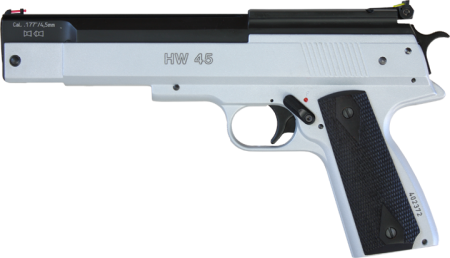
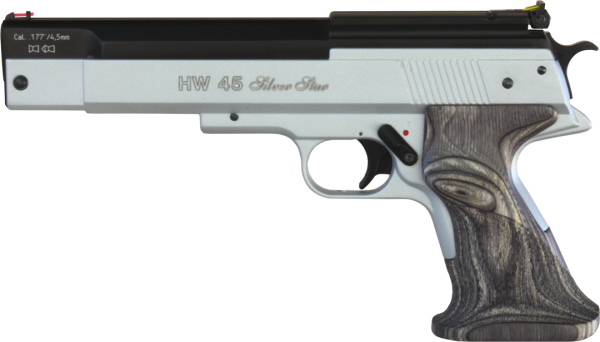
The HW45 STL is just flat gorgeous.

Let me humbly suggest that an HW45 STL might just be the item you need to do the trick. The STL is the two-tone version of the HW45/Beeman P1 pistol, and – to my eye, anyway – with its black upper, stainless-look lower, and black grips, is one gorgeous piece of goods. In addition, the STL has those micro-adjustable fiber optic sights that I found so useful on the .20 cal P1 pistol.

The STL is available only in .177 caliber and is functionally identical to the Beeman P1 and P11 in .177. That means you can probably expect an STL to launch Crosman Premier 7.9 gr. pellets at around 520 fps. With Beeman Laser 6.5 gr. pellets, you might see velocities around 550 fps and with Dynamic SN1 7.95 gr. non-lead pellets, about 490 fps.

I was chatting with classic airgun collector Mike Driskill, and he pointed out some things about the HW45/P1 and its variants that I hadn’t really thought about before.

“If you look at the HW45,” he says, “the piston works backwards. A pistol like the RWS P5 is like a scaled down breakbarrel rifle. You crank the barrel down to cock the gun, and you’re driving the piston and spring back, toward the palm of your shooting hand. When you trigger the shot, the spring and piston rocket forward, just like a break barrel rifle.”

Driskill added, “But cocking the HW45 or P1 is totally different. You pull back the ‘hammer’ to release the rear of the upper, and then you pull the rear part of the upper up and forward to cock the pistol. While you’re doing that, you’re actually dragging the spring and piston toward the muzzle of the pistol until they latch.”

“Now, here comes the really interesting part,” Driskill says. “When you trigger the shot, the spring and piston leap toward your hand . . . and you remember what Newton said about equal and opposite reactions . . . that means this will tend to push the nose of the HW45 forward. Since the action sits above your gripping hand, this in turn rotates the muzzle downward. When the piston comes to a stop, the nose of the gun pops up, which is all you really notice when firing since it all happens so quickly. But the pellet already left the muzzle when it was being shoved down.”

He adds, “If you view the HW45 from the side, you’ll notice that the rear sight is higher than the front sight. That’s to compensate for the pistol’s tendency to shove the nose down. And if you happen to have one of the Beeman P1s with the two cocking slots for dual power levels, you’ll notice that it shoots higher . . . a lot higher . . . if you use the lower power cocking position. That’s because, at lower power, the nose of the pistol isn’t being pushed down so much. So be careful, very careful, if you decide to experiment with lower power.”

While we were on the phone, Driskill told me an anecdote that underscores the need to respect the power of the HW45. A friend of Mike’s one day discovered he had a possum in his attic that was in urgent need of removal. He figured he would use his HW45 to stun the possum, thereby making the eviction process easier. He took careful aim at the shoulder, triggered the shot, and killed the possum instantly.

Now don’t get me wrong; I’m not recommending the HW45 STL for routine possum hunting, but it’s worth remembering it can pack quite a wallop.

Til next time, aim true and shoot straight.

– Jock Elliott

Every fall, as the temperatures start to drop, uninvited guests show up at El Rancho Elliott. Mice, in particular, decide it’s oh so much more pleasant inside the walls of our house than outside in the freezing cold.

So when the temperature drops below 40, you can expect to hear the occasional scratching in the walls at our house. We become accustomed to it after a while, and our cat thinks it is high quality entertainment. Sometimes he gets sufficiently motivated to go on the hunt. It’s at this point that you have to be careful, because you never know where you will find a “do it yourself mouse kit” left by our cat as a trophy someplace in the house. I can tell you with absolute certainty that if you happen to be padding barefoot across the kitchen floor in the middle of the night, you really don’t want to step on the remains of kitty’s latest victory.

Anyway, from fall through winter to early spring, odd noises in the Elliott house are simply part of our acoustical landscape. As a result, I thought it unremarkable when my wife announced, “I think there’s something in the ceiling over the upstairs bathroom.”

“It’s probably a mouse,” I said absentmindedly while pecking away at an assignment.

“I think it’s bigger than a mouse,” she said. “Maybe you should come up here and have a listen.”

I trudged upstairs and stuck my head in the bathroom. It sounded like Seal Team Six was conducting close quarter combat drills overhead, complete with Pointy Objects of various sorts.

Outwardly, I tried to sound casual: “Yeah, it sounds bigger than your average mouse. I’ll take a look.” Inwardly, I was flipping out. It sounded waaaaaaay bigger than your average mouse.

Now at this point, you need to understand something about the layout of our house. It’s small cottage with two bedrooms and a bathroom on the second floor. At the top of the stairs, there’s a small landing with a bedroom to the right, another to the left, and the bathroom dead ahead. To access the attic, there a small hatch directly over the landing. You push the hatch up, slide it to one side, and then, standing on a chair or stepladder, you can look around the attic.

Standing on a chair, I pushed up through the hatch and shined a flashlight toward the attic above the bathroom. There, just under the edge of the roofline, was the culprit: a squirrel. Not just any squirrel, mind you, but a highly successful squirrel, judging from the plumpness of his physique and his glossy coat.

As I trained the flashlight in his direction, Mr. Bushytail stopped what he was doing. He looked at me. I gave him my best Clint Eastwood “this attic ain’t big enough for both of us” stare and slowly retreated back down through the hatch, pulling the cover in place behind me.

My mind was racing. Clearly this squirrel needed a pneumatically-induced “retirement.” An air rifle would be too cumbersome. Getting it through that 2’ x 2’ hatch with me and then drawing a bead on the squirrel would be laborious and time consuming, but at the same time, I didn’t want to take the chance of wound the squirrel and having it go berserk in the attic.

The Beeman P1.

Finally, I grabbed my red-dot-equipped .177 cal Beeman P1 pistol and loaded it with Gamo Raptor PBA ammo. Even though the distance was less than a dozen feet, I wanted a flat trajectory and excellent penetration. I pushed my way back through the attic hatch and flipped on the flashlight.

The squirrel was gone. Now what?

To be continued.

Til next time, aim true and shoot straight!

– Jock Elliott

I generally have the most fun when I am shooting an air rifle that is really, really accurate. Whether I am competing in field target competition or simply plinking in the back yard, it’s more fun when the gun is a tackdriver.

And when I say “really, really accurate” I mean three things. First, that, once you find the right pellet for the rifle, it will shoot very tight groups consistently. For me, anyway, in field target competition, I’ve found that confidence in the gun is critical when you get to the shooting line. If I know that the gun will do its job – if I do mine – that gives me assurance I need to do my best. By contrast, I’ve had the experience of having an air rifle produce “mystery shots” that missed the target, but I had no idea why. That is a pure nightmare and no fun at all.

Second, the rifle has to maintain a consistent correlation between point-of-aim (where I am aiming) and point-of-impact (where the pellet actually lands), so that I have confidence that the gun will shoot where it is aimed each time I use it. This is not a trivial matter. I once owned an air rifle that had to be re-sighted-in each time I used it. It drove me nuts. Some guys like to fuss, fiddle around and tweak their equipment all the time. Not me – I’m a shooter. I want take the gun from the case, shoot a couple of shots to confirm it’s still “on,” and get to work.

Third, the air rifle has to be easy to shoot well. Some air rifles (springers in particular) are notorious for requiring that you do everything “just so” for them to deliver their best accuracy. Some folks call this “hold sensitivity” while others insist that there is no such thing as hold sensitivity, there are only “shooter problems.” Okay; I’ll concede the point and rephrase: for an air rifle to be really accurate, it has to be tolerant of my mistakes.

The HW97 MkIII delivers excellent accuracy in a handsome package.

Just a few days ago, I had opportunity to shoot an air rifle that fits my definition of a tackdriver, the Beeman HW97, MkIII. Weighing 9.2 lbs and stretching just over 40 inches long, the HW97 is a fixed barrel, underlever air rifle. It has Weihrauch’s excellent Rekord trigger and a Weihrauch barrel. At the end of the barrel is a handsome muzzlebrake. The righthand hardwood stock has a rubber recoil pad at the back, a raised cheekpiece, and checkering on the pistol grip and forend. The HW97 is available in .177 and .20 cal. I shot the .177 version.

To get the HW97 ready for shooting, you push a button on a latch just under the muzzlebrake. This releases the underlever for cocking. Pull the lever down and back until it latches. The cocking effort is around 35 pounds, and the cocking stroke is very smooth. The cocking stroke slides open the breech and also activates the automatic safety. The sides of the breech are cut down on both sides, so it is easy to slide a pellet into the aft end of the barrel from either side.

All that is left is to return the underlever to its original position (which also closes the breech) and push the button, located at the rear of the receiver, that de-activates the automatic safety. The HW97 is now ready to shoot.

Ease the first stage out of the trigger, and you’ll feel a distinct “wall” where the second stage begins. Squeeze a bit more (how much depends on how you adjust the Rekord trigger) and the shot goes down range. On the sample that I shot, the shot cycle ended with a tiny hint of vibration – tungggg – but it was vibration that was heard and not felt through the gun. As a result, that slight bit of vibration was a non-issue for me.

The HW97 is wickedly accurate. Some time ago, a nationally ranked field target shooter sent me a target he had shot at 50 yards from a sitting position with his HW97. You could cover the five-shot group with a dime! The HW97 launches 7.9 grain Crosman Premier pellets at 847 fps, producing 12.6 foot-pounds of energy.

When I shot the HW97, it had been quite a while since I had launched any pellets with a recoiling spring-piston air rifle. I was delighted to find that HW97 made it easy to produce pleasingly small groups.

In my opinion, the HW97 is an excellent choice for any shooter who wants to have some fun with a bona fide tackdriver.

Til next time, aim true and shoot straight.

– Jock Elliott

One of the great things about doing a blog like this is that it lets me give free reign to my curiosity. If an airgun looks interesting, I give the good folks at Airguns of Arizona a call. If they have a sample of the airgun I’d like to see on hand, pretty soon it’s on the way to me. (Some of the extremely popular guns are just about impossible to keep in stock, so for those I’m on a waiting list.)

The HW90 is one smooth-shooting air rifle.

One of the air rifles I’ve had a hankering to shoot is the Weihrauch HW90, which is an air rifle equipped with a Theoben gas ram powerplant. I had seen a lot of favorable comments on the airgun forums about the RX-2 (which is the Beeman equivalent of the HW90), so my curiosity was on high alert.

My first impression on taking the HW90 out of its box was: “Boy, this looks very, very familiar.” And indeed it does. The HW90 is extremely similar in appearance to the Weihrauch HW80, which is one of my favorite air rifles. Both the HW90 and the HW80 are just a bit over 45 inches long, weigh 8.8 pounds, and have a 20-inch barrel. And both are extremely pleasing to look at.

The HW90 is available in .177, .22, and .25 calibers. Of course, what really sets it apart is the gas ram system. But what is a gas ram? Well, if you’ve ever seen a “lift back” truck or automobile that had pneumatic struts that lift the back hatch and hold it open, you’ve seen the basic working innards of a gas ram. That pneumatic strut operates on the same principle as a gas ram: compressing and decompressing gas within an enclosed space.

On the practical side, a gas ram air rifle works exactly like a spring-piston air rifle. With a spring-piston you break the barrel or pull a lever that drives a piston back and compresses a spring until it latches. When you pull the trigger, the latch is released, the spring and piston go rocketing forward, compressing air in the compression chamber and launching the pellet down range.

With the gas ram, when you cock the gun, you’re compressing the gas ram, increasing the pressure inside of it, instead of compressing a spring. When you pull the trigger, the gas inside the ram is allowed to expand, pushing the piston down the compression tube, compressing air in the compression chamber, and sending the pellet toward the target.

From a shooter’s perspective, the HW90 feels different. When you cock the rifle, there is no spring noise whatsoever. Further, unlike a springer, where the cocking effort tends to increase toward the end of the cocking stroke, the effort to cock the HW90 feels constant throughout the stroke at around 46 lbs.

When you pull the trigger on the HW90, the action feels quick – super quick – and smooth, a bit like a custom-tuned springer on 28 cups of coffee. I tested a .22 cal. version of the HW90, and I really enjoyed shooting it off-hand with the iron sights that came with it. Even though I wear old-guy glasses (no-line bifocals), I had no trouble with the sight picture, and when I triggered a shot standing up, the HW90 just felt supple. When I was shooting from a sitting field-target position, I felt more of a jolt from the gas ram action, but I still really liked this air rifle.

If this were my air rifle, I’d keep it simple and shoot it with the iron sights or perhaps fit it with a peep sight. It seems like the perfect airgun for a stroll in the woods and fields. Slip a tin of pellets in your pocket, and you’re good to go.

Til next time, aim true and shoot straight.

– Jock Elliott

About a half mile from me there lives a fellow whose mailbox says “The Lawnmower Guy.” I contacted him about tuning up my mower and when he brought it back, he noticed the pellet trap with a target on it in my garage, so he asked me if I was a member of the gun club outside of town.

I told him I was a member, but what he really needed was an air rifle or an air pistol, and then he could shoot in his back yard whenever he wanted. All he had to do, I told him, was reassure the neighbors that he would shoot safely into a pellet trap and not plink at their cat.

Pretty soon, I started dragging out some air pistols for him to try, and one of them was the new Beeman P11. His eyes nearly bugged out of his head. “Wow, that’s cool,” he said. I loaded it up for him and let him draw bead on a tiny chipmunk target printed on a piece of paper.

The Beeman P11 looks great and is a lot of fun to shoot.

He steadied the P11 in both hands, aligned the sights, squeezed the trigger, and – whap! – nailed the chipmunk dead amidships. “Wow, those sights really light up! Where can I get one of these?” he asked. I wrote http://www.airgunsofarizona.com/ on a piece of paper for him, and he scurried off.

The P11 is, indeed, a cool air pistol. It’s the younger brother of the Beeman P1 but sports a two-tone color scheme, snazzier laminated grips, and fiber-optic sights. The P1 is available in .177 and .20 cal, while the P11 is available in .177 and .22. The picture doesn’t really do the P11 justice; the lower half of the ambidextrous laminated grips are stippled for a better grip and the bottom of the grip flares, providing a little bit of a palm shelf. In any event, I like the way the P11 looks and feels. The overall fit and finish of the matte-gray receiver and black “uppers” are, in my opinion, excellent.

If you’ve never handled a Beeman P1 or P11, there’s some stuff you have to know. First, this is a spring-piston air pistol. That means when you trigger the shot, it’s not going to behave like a Daisy 747 or a Crosman CO2 pistol. Instead, you’re going to get the whiplash recoil that is typical of a spring-piston powerplant. So don’t be surprised when it doesn’t act like a docile single-stroke pneumatic match pistol.

In addition, loading the P11 (or P1) is unusual. You start by flipping the safety (accessible from either side of the pistol) on and pulling what appears to be a hammer at the rear of the receiver. This releases the rear upper half of the receiver where the barrel is housed – the black part on the P11. Grasping the loose end, you pull it up and forward until it latches to cock the pistol. The cocking effort requires pulling the barrel assembly away from you as you open the action of the pistol, and it takes about 18 pounds of effort. Once the action is fully open and latched, slide a pellet into the breech end of the barrel and return the receiver back to its original position, snapping it locked into place.

Now, you’re ready. Just flip the safety off, ease the first stage out of the trigger, and let the good times roll. And The Lawnmower Guy was right: those fiber optic sights really light up like a neon sight . . . and that makes it sooo much easier to align the sights than the plain-old metallic sights on the P1. The P11 that Airguns of Arizona sent me to play with was the .22 version, and I find it smoother to shoot than the .177 version I once owned. I don’t know why that is. Certainly the velocity of the .22 is lower than the .177. For example, you might expect 415 fps with 14.3 grain .22 Crosman Premier pellets and around 520 fps with 7.9 grain .177 Crosman Premier Light pellets (on high power – the .177 version offers two cocking positions for two different levels of power.)

Whatever the reason, I find the P11 in .22 to be one of those “salted peanuts” guns – you can’t stop with just a few shots. You say to yourself, “Just five more shots, then I’ll go in.” The next thing you know, an hour and a half a tin of pellets has magically disappeared. But somehow you don’t mind.

Til next time, aim true and shoot straight.

PS There will be a follow up Blog on the UJ Challenge in the near future.

Jock Elliott