Most shooters think about three core features when choosing scope rings…
First – and most basic – is the diameter of the scope’s main tube. Typically these will be 1-Inch or 30mm, although other diameters such as 34mm are starting to appear on some high-end scopes.
Next is the type of mounting system that is on the gun. Nowadays this is typically a Picatinny rail. However, there’s also the very similar – but not identical – Weaver rail system. Meanwhile, dovetail rails still feature on some .22s and a number of airguns.
Then there’s the scope ring height. Mostly scope rings are graded as “medium” or “high”. However there are also “low” and “extra high” rings available. Although there is – to my knowledge – no standardization of measurement between manufacturers to match these descriptions, they all relate to the height at which the scope is carried above the action.

So what height scope rings to choose? This will be a combination of factors. One will be the diameter of the scope bell (front). Scope ring height will need to be chosen so that the scope does not contact the rifle in any way except via the rings. (If it does, that’s a sure way to ruin accuracy).
Now the shooter’s personal physique comes into play. How high does the scope need to be mounted in order to achieve a strong, consistent cheek weld when the rifle is shouldered?
Leapers provides a lot of information to help you make an informed decision on the profile of P.O.I rings. This includes the maximum objective diameter that can be accommodated, the saddle height and the center height for the rings.

For that extra personal touch, the experts at AoA will be happy to advise further when you phone-in your order.
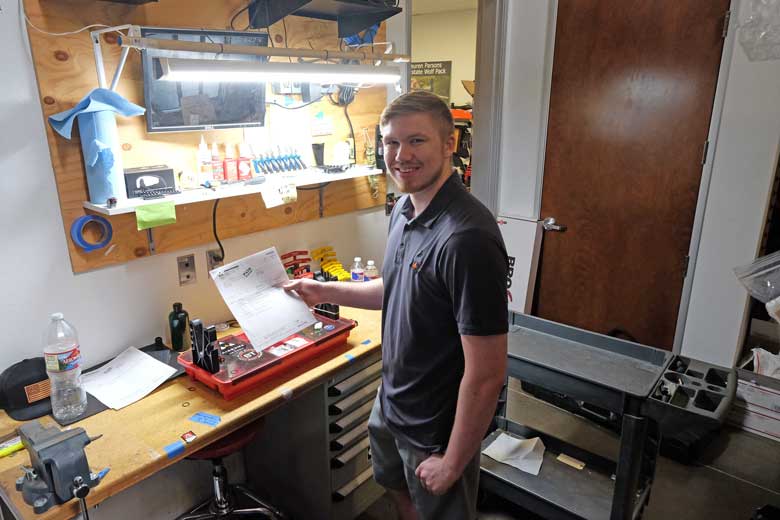
To find out more, I visited Leapers, Inc. This company is based in Livonia, Michigan and they produce their P.O.I scope rings right here in the USA!

“P.O.I” is an abbreviation for “Precision Optics Interface”. To find out more, I visited the company to talk to the experts and find out some key features that should be considered when configuring your new air rifle.
The Director of Product Management at Leapers is Nick Lee. His advice was clear and valuable yet actually amazingly simple.
Nick explained that there are very precise specifications for the Picatinny rails. So, scope rings for these rails also must be designed to Picatinny specs. He directed me to the official specifications: MIL-STD-1913.
Although that’s a pretty basic statement, it’s clear that there are scope rings out there that are designed and manufactured to a somewhat “generous” interpretation of these specifications. Yes, they fit Picatinny rails, but they may do so rather more loosely than is ideal for that basic requirement of supporting a scope consistently and accurately.
To make his point, Nick pointed to the recoil stop bar that’s machined into the base of P.O.I rings. This bar is designed to be a solid fit in a Picatinny rail. And it’s rectangular in shape. There’s one in each ring. (See below).

Low cost scope rings often use a standard, mass-produced circular rod as the bearing surface against the “teeth” of the Picatinny rail. This is because it’s cheap. “But how,” asked Nick, “could that ever provide really long-term, consistent positioning for the scope against the battering the rings take from recoil? Particularly as they are often not a perfectly tight fit!”
Then there’s the material the rings are manufactured from. Leapers’ P.O.I rings are manufactured primarily from 6061-T6 Aluminum. That’s aircraft-grade material.
Why not steel? Nick explained that 6061-T6 Aluminum is plenty strong enough for this application. P.O.I rings are even qualified for use with .50 cal BMG! It also has outstanding corrosion resistance.

Plus, the light weight allows for a wide bearing area against the scope tube (it’s 22 mm for P.O.I rings). This minimizes the possibility of distorting the scope tube while also keeping the weight down.
We all expect to remove Picatinny scope rings from the gun and re-mount them later with minimal Point-Of-Impact change. So design and manufacturing precision also has to extend to the side plate: the part that clamps the rings in place onto the rail.

The locking side plate of P.O.I rings features dual spring-loaded guides to ensure that required secure and repeatable zero. They also prevent any tilting and mis-alignment. Again, another feature to consider as you choose your scope rings and an additional reason why Leapers labels these rings as P.O.I (Precision Optics Interface).
Leapers manufacture its P.O.I Scope Rings in-house in its “UTG PRO” facility on the company’s campus in Livonia. Manufacturing Director Kevin Jin showed me how P.O.I rings are manufactured.

At one end of a long conveyor belt system, strips of 6061-T6 Aluminum are loaded for delivery to whichever CNC machine is designated to produce the next batch of rings. As the P.O.I rings have a surprisingly complex shape, with many subtle curves to prevent snagging in use, they are manufactured on high-specification, Aerospace CNC-MAZAK 4-axis Horizontal machines.

Both Pictinny rail and inner bore hole for the scope are machined during the same set-up as this provides superior concentricity of the scope rings when mounted onto the gun. After that, the rings are cut horizontally into two pieces.

Particular attention is paid to the scope interface surfaces, Kevin explained. In order to secure the scope in place uniformly and without damaging the tube surface, the inner diameter is bored and finished with an endmill. Finally, there’s a final finish from a reamer to the precise diameter required.

After machining, the result is double-checked by Leapers’ extremely thorough Quality Assurance team.
Surface finish is provided by matte black, Type III hard coat anodizing. This gives a high-quality, non-reflective and long-lasting appearance to these scope rings. It’s a great match for the high quality airguns and scopes that AoA sells!

Kevin’s Manufacturing Team really cares about the quality of their products and you can see that when you look at P.O.I rings.
By investigating Leapers P.O.I rings, we’ve learned that there’s more to scope rings than meets the eye. We also found out some of the reasons why P.O.I scope rings are special.
Sure, you can buy cheap scope rings for $10.00 a set, or thereabouts. But a pair of high quality scope rings like P.O.I can be had for around $55.00 at AoA.
When you’re spending hundreds – maybe thousands – of Dollars on a new rifle like a Daystate Alpha Wolf, it just doesn’t make sense to skimp on scope rings!