

Sometimes I hunt the same country with a different approach. Rather than still-hunting, I’ll walk the tops of a wash and glass the opposite slope. I’ve found that a jackrabbit, spotting danger across the wash, will often hold tighter and longer than it would if I were at the same distance on its side. Often, a jack will sit tall with its ears straight up, fully alert, offering a clean shot. I usually prefer a head shot, especially with a .177, though I’ve taken plenty of jacks with a well-placed chest shot. Over the last few years, I’ve opted to use a .25- or .30-caliber rifle for added knockdown power.
-
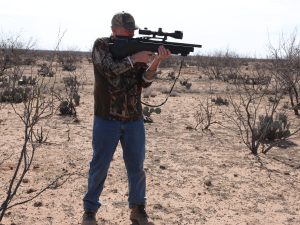
- Shooting offhand with the Daystate Rengade BP, a solid offhand shooter!
-
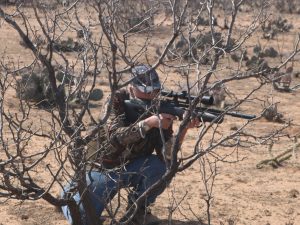
- My Brocock Bantam is a great compact hunting rig.
-
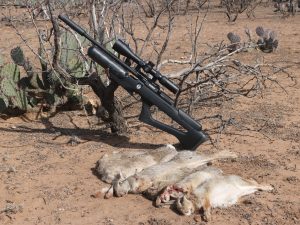
- bagged a few rabbits for the Chili-pot!
Another productive method is cruising dirt backroads until you spot a jack tucked into his scrape. Once located, I’ll park and slip out quietly, then start the stalk using the same slow, deliberate approach as before. Unlike firearm hunting, when I’m carrying an airgun I won’t shoot at a running jack. They spook easily and will often sprint a long distance before settling again, and unlike cottontails they rarely circle back. In thicker cover, I’ve had jackrabbits quietly backtrack like wary whitetails, slipping through the brush with surprising caution.
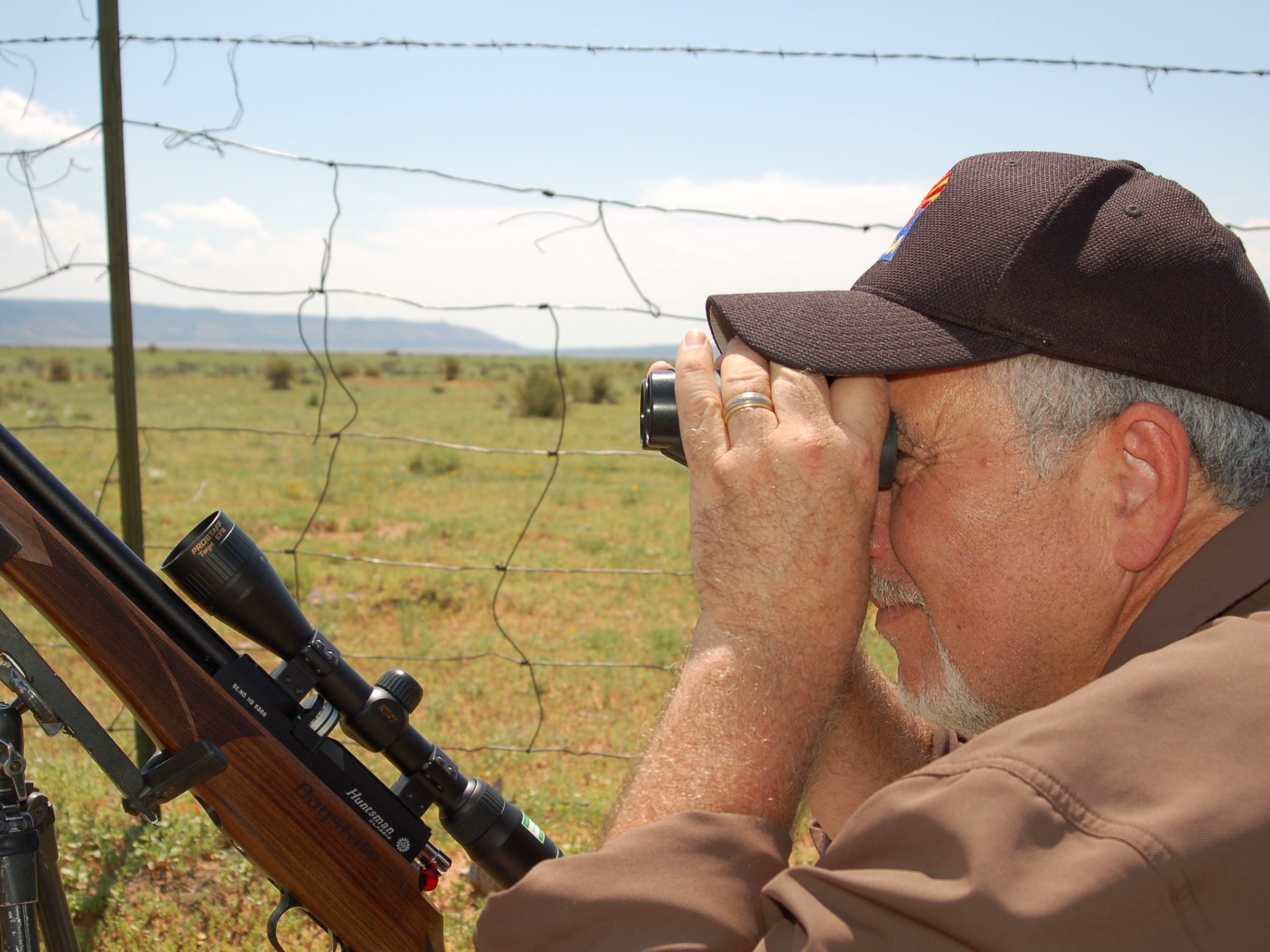
Glassing the area looking for bedded rabbits
I’ve hunted jackrabbits with a variety of spring‑piston rifles over the years, but the one that continues to stand out is the Weihrauch HW95 in .22. It has that ideal balance of power, accuracy, and carry weight that matters when you’re covering miles of rough desert country. The .22 caliber performs well on big, tough jacks, delivering clean, confident hits with a smooth shooting cycle that this rifle is known for. After many years in the field, it’s one of the springers I trust most when chasing these long‑eared desert hares!
Having used just about every type of air rifle you can carry into the desert, PCP rifles have become my primary tools for this game. When you’re covering miles of rugged country, dealing with wind, and needing fast follow‑up shots, a well‑tuned PCP is the right tool. The combination of power, consistency, and shootability is hard to beat. For jackrabbit hunting, I’ve come to prefer larger calibers, specifically the .25 and .30. These calibers offer a meaningful increase in frontal area and retained energy, which translates directly into cleaner, more decisive hits. Jackrabbits are not particularly fragile animals; they’re big and capable of covering ground at impressive speed. A pellet or slug that hits with authority makes all the difference when you’re threading a shot through brush or taking a longer poke across a wash. The .25 is a versatile caliber, flat‑shooting and efficient, while the .30 brings a level of impact that ends the conversation with authority.
Among the rifles I’ve carried, two have risen to the top as my current go‑to jackrabbit guns: the Brocock Ghost .30 and the American Air Arms Sidewinder .30. The Ghost is compact, well‑balanced, and highly tunable. When I’m hiking ridge lines or slipping through mesquite, the Ghost carries well and comes to the shoulder quickly. Its adjustability lets me tailor the power to the projectile being used, whether I’m taking close‑range shots in thick cover or stretching things out across open desert. In .30 caliber, it hits with a satisfying thump that anchors jacks cleanly.
-
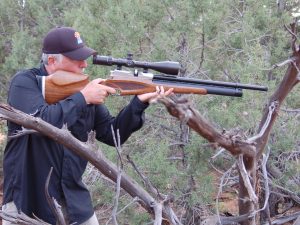
- The first Daystate .30 to hit the market. The Wolverine was an impressive rifle for hunting desert jacks!
-
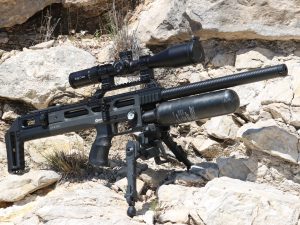
- More recently, I’ve been using the Brocock Ghost .30 quite a bit.
The Sidewinder, on the other hand, is pure precision and power. The semi-auto action delivers fast follow-up with consistency and a level of accuracy that inspires confidence even when the wind is swirling. In .30 caliber, the Sidewinder is a hammer, flat‑shooting, stable, and devastating on impact. When I’m hunting big, wary jacks in the sun-baked back country, this rifle gives me the reach and terminal performance I want.
Ammunition choice matters just as much as rifle choice, and for most of my jackrabbit hunting I still favor a round‑nose Diabolo pellet. The classic waisted shape stabilizes well in flight, and the round nose provides a balance of penetration and controlled expansion. But airgun slugs have earned a place in my kit as well. Their higher ballistic coefficients and heavier weights make them incredibly effective at longer ranges, especially in .30 caliber. When tuned properly, a PCP shooting slugs becomes a long‑range tool that can handle wind and distance far better than traditional pellets.
Hunting jackrabbits with an airgun appeals to me because it turns the pursuit into a precision‑driven, skill‑based hunt rather than a simple shooting exercise. Air rifles require careful stalking, smart shot selection, and an understanding of wind, distance, and terrain. I appreciate how air rifles demand disciplined marksmanship. Jackrabbits are tough, fast, and alert, so every shot must be deliberate.
