

A frequently asked question is if a feral hog can be taken with a standard caliber air rifle, and in this weeks entry Jim shares his thoughts.
As long as I’ve been working with airguns, I’ve had people asking if their smaller caliber and standard powered air rifle can be used to take feral hogs. The water was muddied in previous years by media airgunning “experts” making videos of taking pigs with a spring piston .177 rifle; at the same time, Wildlife Management Organizations were deciding if they would allow airguns to be used for hunting in their states. Those who knew airguns and those with a deep understanding of hunting and wildlife management clearly understood that the idea of using a .177 spring piston air rifle to hunt larger game or pest species was unethical at best, but more over not a very bright thing to do. It compromised the legitimacy of airguns as a valid method of take. In my view, these companies and their sponsored hunters harmed the efforts to legalize hunting with airguns more than any other single factor.


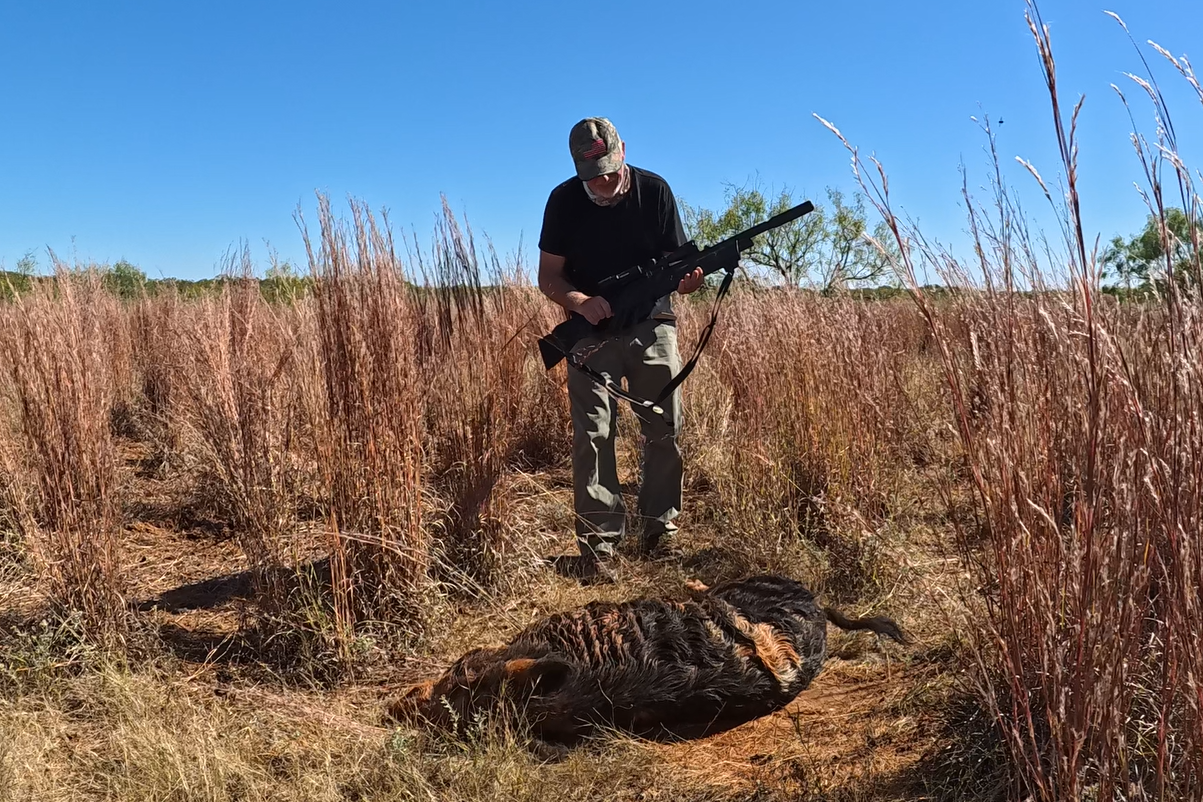
For this reason, I was very conservative with my public comments. When asked “can you kill a hog with a .25 caliber gun doing 50 fpe’? My response would be something like, in certain scenarios you could, but it’s not the right gun for the job. I still don’t feel like that would be the right gun for most hunters in most situations, however, I do believe it could be used ethically and efficiently in the right conditions and by the right hunter.
What do I mean by the right conditions? The first criterion is the ability to make the right shot placement. If using a gun of marginal power, the placement needs to be a headshot, which, for a hog in my experience, means right between the eyes if the pig is looking down, dropping the pellet down the ear, or placing the pellet/slug between the ear and eye.
It also means getting into the appropriate range, I would say 50-60 yards is about as far as you’d want to go. But the range limit, be it 30, 50, or 70 yards, is a function of how far you can reach out and still consistently drop the pellet on target. And remember, this is shooting from field positions, not off a rest. But for me, this is the essence of airgun hunting, using your fieldcraft to close the range is what makes airgunning such an exciting approach to hunting.


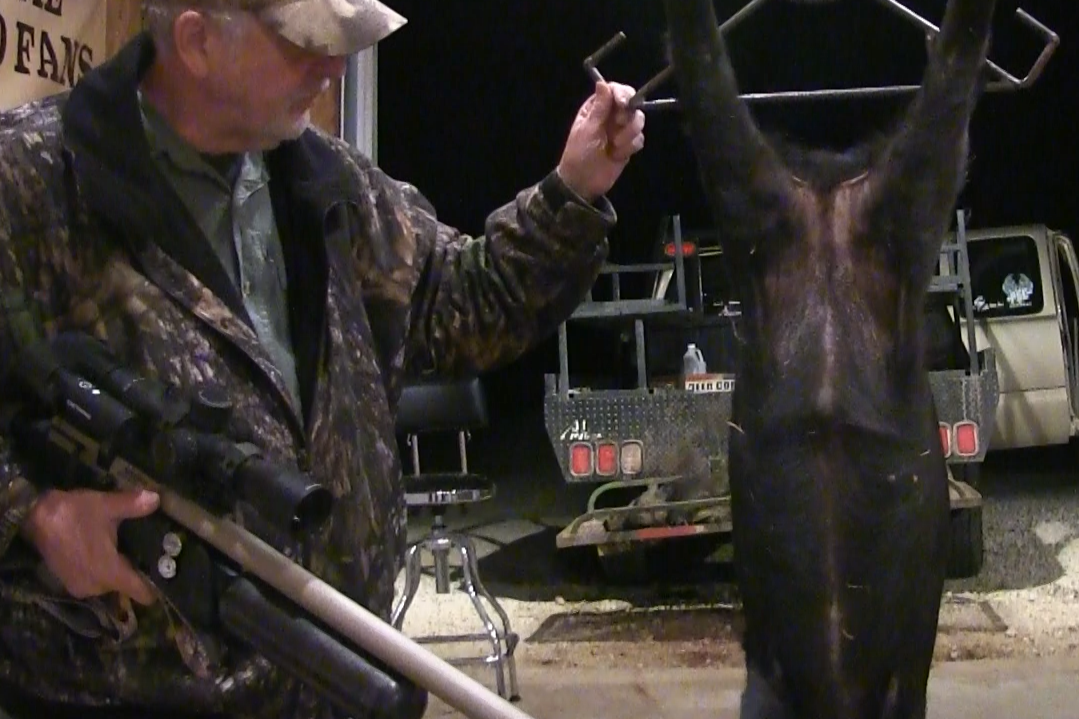
To expand a bit on the hunters ability to make the right shot; remember that a .25 caliber air rifle generating 50 fpe is about half the power of a .22 LR rimfire, with a slightly larger diameter. That is why shot placement is so important. I have hunted with air rifles many times alongside traditional firearm hunters. It is more common than not for me to have the same number of shots fired as pigs on the ground. This is rarely the case for the centerfire hunters, whose guns are an order of magnitude more powerful. Yet I am constantly surprised at the sloppy shooting that often accompanies the powder burners, with missed or wounded animals the result. Their expectation seems to be that if the shot is in the ballpark, the animal will go down.
I think that I’m a pretty good field shot, but not exceptional. The difference is primarily one of mindset: what’s always in the back of my mind when squeezing the trigger is that if the shot is not perfect, the animal won’t go down. Therefore, if I don’t feel I have the perfect shot, I will not shoot. Instead of taking the marginal shot, I will either wait for a better opportunity or move to make one.
So, back to the initial question about using a smaller caliber 50 fpe gun for a larger quarry. My opinion these days is, yes, you can. But I would make 40-50 fpe my power floor, limit shots to 50 yards providing a ½” target can be hit from a field position almost every time utilizing field positions, I would only recommend head (brain) shots, and stipulate that the hunter has the discipline to wait for a better shoot rather than taking the marginal one, or walk away if that doesn’t happen.
I will often take a 50-90 fpe gun in .25 or .30 caliber out stalking for hogs, with the expectation I’ll have to work my way in close, and follow all the aforementioned guidelines. If hunting from a blind where the ability to change position is limited, I will usually use a big-bore with a lot more power, which allows a heart-lung shot from a bit further away. But my opinion is that if you pick the right shot, at the right range, have the capability with your gun to place the shot on target, and the discipline to walk when it doesn’t line up, It can be done ethically and efficiently.
