

Pellets or Slugs For Hunting
Airguns have evolved dramatically over the past decade. What used to be a world dominated entirely by traditional diabolo pellets has expanded into a new era of high‑BC airgun slugs capable of long‑range precision and improved knockdown power. But with this evolution comes a natural question: Which projectile is better—pellets or slugs?
The truth is more nuanced than simply declaring a winner. Each projectile type has strengths, weaknesses, and ideal use cases. Let’s break down the differences so you can choose the right ammunition for your rifle and your shooting goals.

Projectiles I use in my Sahara, spans the range from slugs to specialty pellets.
Traditional Ammunition for Airguns
For most of airgun history, the diabolo pellet has been the undisputed king. Its unique shape—waisted midsection, hollow skirt—was designed specifically for airgun velocities and rifling. Pellets are accurate, stable, and forgiving, especially at moderate power levels. Additionally, the variety of pellet heads, which include domed (or roundnose), hollow points, pointed, and flathead configurations, allows optimization for various applications, such as hunting, competitive target shooting and plinking.But as PCP rifles became more powerful and shooters demanded greater range and wind resistance, a new projectile emerged: the airgun slug.
Diabolo pellets are the classic airgun projectile. Their defining characteristics include awaisted shape for aerodynamic stability, a hollow skirt that flares to engage rifling, a lightweight construction for efficient acceleration, but with a lower ballistic coefficient (BC) compared to slugs
Pellets are designed to be inherently stable due to drag. This makes them extremely accurate at short to medium ranges—typically out to 50–60 yards, though the right rifle/pellet combination can reach out further under the right conditions.
The strengths of pellets include excellent accuracy at moderate distances, they work well in nearly all airguns, they require less power to stabilize, they are less sensitive to barrel twist, and they are widely available and affordable. This is still my preferred ammo in virtually all spring piston guns, and for hunting, I generally prefer a round-nose pellet.
The weaknesses of pellets, especially in high power PCP rifles, is they tend to have poor long‑range performance, are affected by wind, and have a lower BC limits energy retention. This can be especially limiting for longer range hunting with more powerful PCP air rifles.
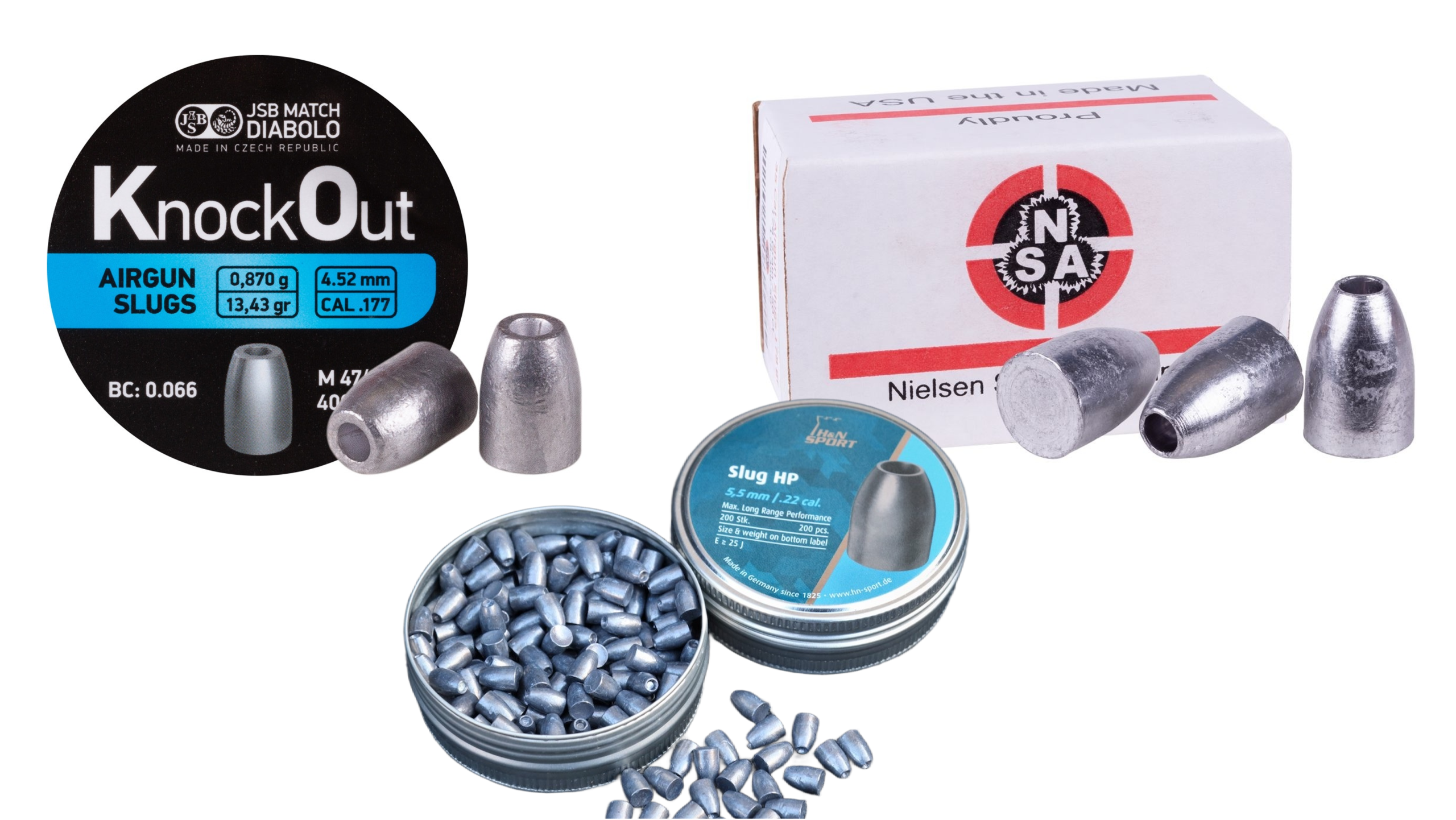
Three of the slugs I’ve used that have had excellent field results.
What Are Airgun Slugs?
Airgun slugs are essentially scaled‑down bullets designed for airgun velocities. They are generally, but not always, heavier than pellets, and are primarily solid-bodied with no hollow skirt, though some designs do have a concave cavity that tends to be less pronounced than a pellet’s skirt. In most cases, slugs have a significantly higher BC than pellets, resulting in improved performance in windy conditions. Slugs are more demanding in terms of the power a rifle can generate and are primarily designed for high power PCP rifles. But even with a powerful PCP platform, slugs often perform better with a higher barrel twist rate optimized for these projectiles. Slugs really come into their own at longer ranges—100, 200, even 300 yards—where pellets cannot perform well in energy retention, wind drift, accuracy, and terminal performance.
Many standard air rifles can provide decent performance with slugs, however, to achieve the optimal performance requires high power, usually 40+ FPE, in my experience, and a kit that includes a purpose-designed slug barrel with the appropriate twist rate. I think there are a couple of conditions to consider when thinking about pellets vs slugs for your guns. First, not all rifles can shoot them well; they cost significantly more than pellets, and in many applications, they do not provide a practical advantage.
-

- The Sahara was desinged for standard pellets, but does well with NSA slugs.
-

- One of my favorite scopes for long range shooting these days is the MTC King Cobra FFP scope.
-

- The Ghost kit with slug barrel
When to Use Pellets vs. When to Use Slugs
Caliber plays a major role in projectile performance: .177 and .20 is most commonly (but not only) found in spring piston guns these days and is almost exclusively pellet territory. I think that in .22 – .30 caliber PCP rifles, pellets perform well at sub-60 yards, while slugs tend to shine past the 60-yard line.
However, coupled with the gun/ammo pairing and range at which I’ll be shooting, the application and need for terminal performance will also help me decide which projectile to use. For instance, when I’m hunting squirrels in the woods, Eurasian collared doves in a dairy, or cottontails on a farm, I think pellets are just fine and don’t see an advantage to slugs that offsets the cost. On the other hand, if shooting prairie dogs at 100 yards in windier conditions, slugs offer an advantage and are worth the added costs. Also, if hunting larger and tougher game such as predators or feral hogs, I’ll generally opt for a slug for better penetration even at closer range. Again, the added costs of slugs are easily justified in these applications.
-

- I use slugs on medium sized gamne when reaching out to greater distances.
-

- Or when shooting tougher quarry where deep penetration is required.
I’d suggest that if you have a PCP rifle that is doing over 40 fpe, and are curious about how pellets will fit into your hunting repertoire, give them a try in your gun. I’ve had success with NSA, H&N, and JSB Knockout slugs in many of my guns, even those without a specialized slug barrel. They come in several weights, and you can probably find something that works for you. Once you find the slug that pairs with your gun, then you can consider the other factors we discussed to help decide which fits your requirements.
