

I’ve mentioned that I like to use shooting sticks and bipods in the field because they let me quickly stabilize my gun in virtually any required shooting position. An advantage of using sticks rather than a naturally occurring structure is that if you need to make an adjustment or move, you can simply take them with you and reset them. There are many variations on shooting sticks and bipods available on the market, and I’ll share what has become my go-to solution.
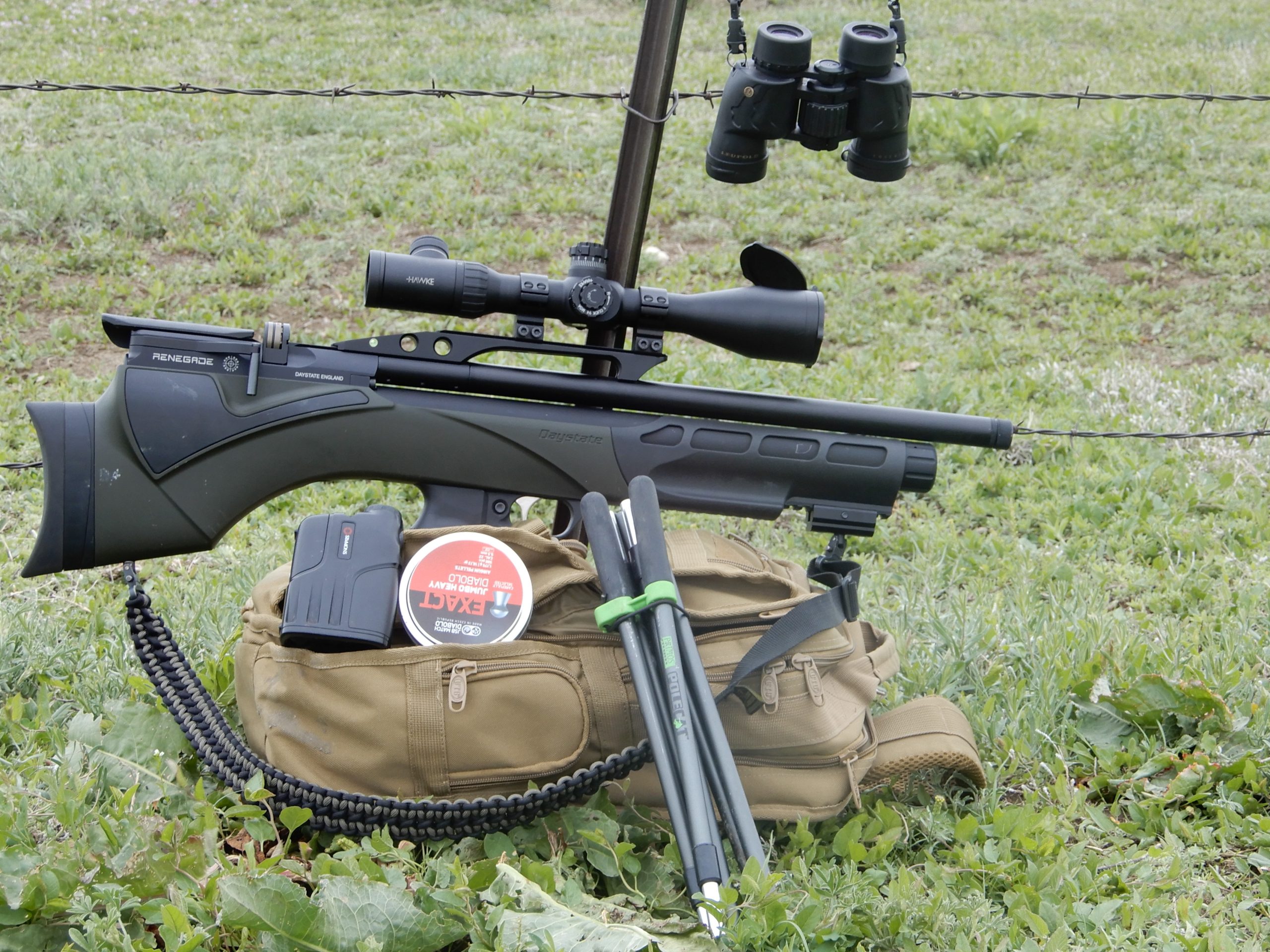
My gear for a day out for prairie dogs. A good set of shooting sticks is a must for long range shooting.
Shooting sticks generally come in three configurations: a single stick with a rest; two sticks that cross near the top, allowing the shooter to grip the joint for added stability; and a similar three-stick design. Many models are made in two or three sections with various locking mechanisms so they can be used at different heights or broken down when not in use.
I have used a telescoping single pole with a padded V-shaped rest in the past. Although it is the least stable stick design, it is very light and compact and deploys fairly quickly for nearly any shooting position; I have used them while standing, kneeling, and sitting. For prone shots, I prefer using my pack because it provides much better stability at the right height. When stalking through the woods or closing in on game, I usually set the stick to the proper height for a standing shot before I need it, so I am not fumbling with setup when I should be focusing on getting into position. I especially like this setup for desert hunting, where there is little natural support, and the brush height often requires a standing shot at thirty-five to forty yards. Double- and triple-stick models work much the same way; they are much more stable, but they are more cumbersome to set up and less portable when you need to shift position.
-
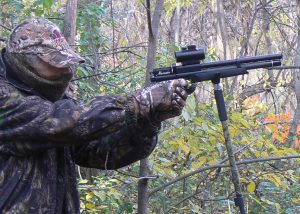
- A single stick is fast to deploy but not as stable
-
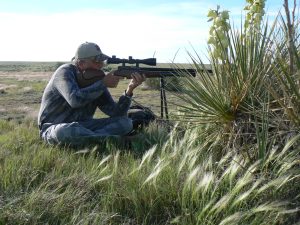
- I’ll often use a shorter bipod for sitting shots
-
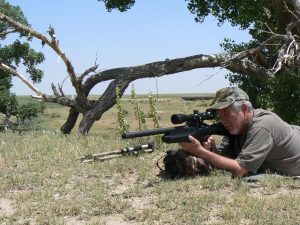
- I’ll often lay my sticks aside and shoot off my backpack for long range shots
Bipods are another option if you need a portable rest to shoot from. Most models, such as Rockchucks or Harris Bipods, are telescoping and usually snap onto the sling swivels or a forestock mounted rail, folding up when not in use. Because these bipods are mounted to the gun, they are shorter than an unattached bipod shooting stick. These devices are used from a prone or perhaps sitting/kneeling position if they are longer versions, but are of limited use if you will be shooting from a standing position. I often use bipods when hunting prairie dogs on the open grasslands, as the shots are frequently at long range from a sitting or from a prone position. But with most small game, the shots tend to come with less warning and at closer range, and a standing shot is required. When hunting small game with airguns my preference is to use a shooting stick. However, for pest control, where I have time to set up my shooting position, I will sometimes use a bipod instead.
-
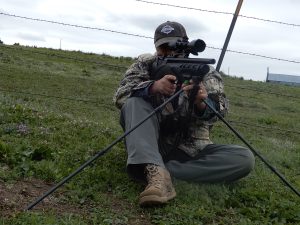
- It’s easy to adjust height
-
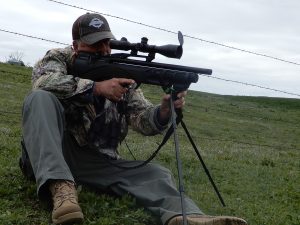
- or change direction with sticks
-
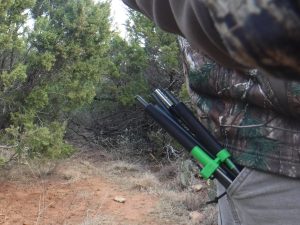
- The Polecats are very compact for carry when time to move.
Besides the many commercially available shooting sticks, you can build your own quite simply. Here’s how you go about making them: Go to your local hardware store and buy two one-half-inch hardwood dowels, 30 inches to 46 inches long; wrap twine horizontally around the sticks about 4” from the top, then spread the sticks apart and do a few vertical wraps, then tie off the string. However, my absolute favorite shooting stick is the Primos Polecat, which are lightweight, adjustable aluminum field sticks designed to give hunters a fast, quiet, and steady shooting rest, using a rubberized V‑yoke and telescoping legs (in monopod, bipod, or tripod versions) that adjust smoothly for sitting, kneeling, or standing shots, making them durable, weather‑resistant, reliable, and very fast to deploy. I find that these sticks (I mostly use the bipod version) hit the sweet spot: they are very compact and can be easily folded and carried in my day pack or in a holster worn on my belt or attached to my pack. These sticks deploy very quickly; they offer simple, quick rifle mounting, and once the gun is mounted, the shooter has considerable maneuverability while maintaining a stable hold.
