

People who have watched my videos or read my articles have noticed that I sometimes use a rangefinder while hunting and have asked whether it is truly useful in the field. My answer is: yes and no. I do not use one on every hunt. For many hunts, such as squirrels in the woods or rabbits in thick brush, shots are close enough that a rangefinder adds little to targeting. However, when taking longer shots at groundhogs or prairie dogs, it can be invaluable. Even though I do not always use a rangefinder, I almost always keep one in my daypack, and I’ll explain why.
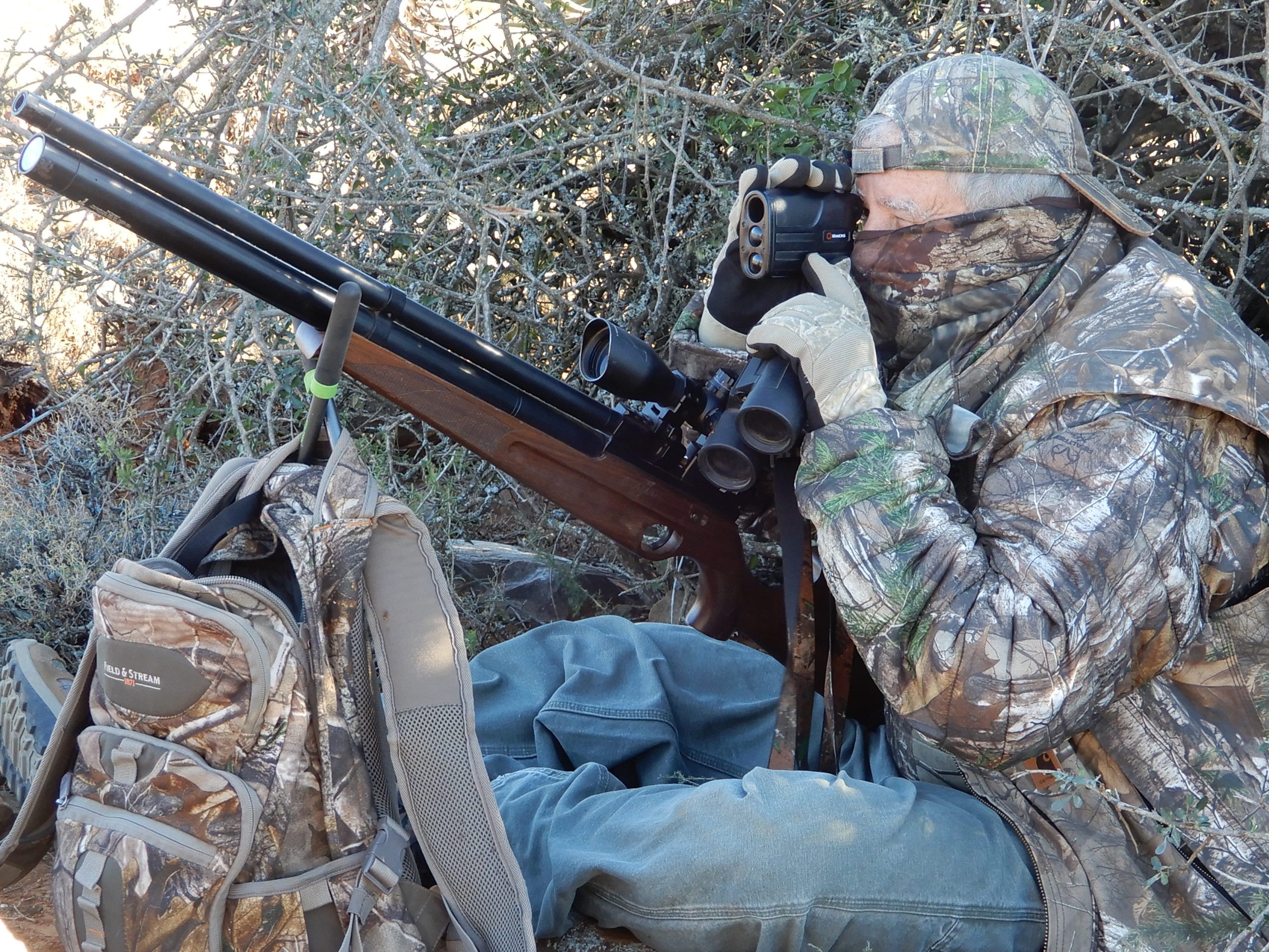
Using a rangefinder to hone in on a 100-yard shot in S. Africa
The most important factor for harvesting/hunting small game with an air gun is shot placement. Long-distance shooting calls for a scope to achieve precise shot placement and quick, clean kills. Range estimation is especially important when using an air rifle, because in these guns the flight trajectory of the pellet will be significantly arced. Most of us are pretty good at making gross observations of distance; is an object close or far away? However, telling whether an object such as a plump bunny is sitting thirty or forty yards away is somewhat more difficult. If you hold the crosshairs on the rabbit’s head at thirty yards, you will hit him in the head, while with the same hold on the rabbit at forty yards, you will end up shooting him in the foot. Because of the importance of accurately ranging your shots when hunting with an airgun, many hunters use scopes with an AO correction, mil-dots, and a laser rangefinder to be sure of distance.
-
- My prairie dog rig, with everything I need for a days shooting
-

- Preped for a squirrel hunt in bear country up north.
Laser rangefinders work by sending out an invisible beam of infrared energy that will reflect off the object it’s aimed at. A high-speed internal clock measures how long it takes the beam to return and calculates the distance from that measurement. Since the propagation velocity of the transmitted signal is known, it is relatively simple for the onboard computer to determine the distance. How well they work depends on the target’s reflective properties and environmental conditions. Color, surface finish, size, and shape of the target all affect performance. Highly reflective surfaces or colors are easier to “read,” and a small target is harder to read than a large object.
Using a rangefinder effectively during your hunts is easy if you follow a couple of rules. If you simply carry it around in your pocket until you see a distant target and then try to measure the range, you have complicated the shot. The method that works best for me is to pick an object close to your prey, such as a rock or a tree, and use it as a reference. When hunting from a set area, my approach is to range several landmarks when I first reach the stand so I can reference them when an animal arrives, as there is not always time to recheck the distance. When setting up at an ambush site to shoot prairie dogs, I’ll use my range finder to map the distance to surrounding mounds, so when the dogs start popping up, I already have them ranged.
So, what should you look for in a range finder to carry in your airgun hunting kit? First off, I’d say that just about any range finder is better than the naked eye, but there are some features to consider that genuinely affect your hit probability with sub‑1000 fps projectiles. Airgun shots are usually 20–90 yards, sometimes out to 100. Most general hunting rangefinders are optimized for 200–800 yards and can be sloppy at close range. You want accuracy of ±0.5 yards inside 60 yards, the ability to range as close as 5–10 yards, and a fast return time for moving small game. Airgun hunters often shoot up into trees, down from blinds, or across uneven terrain. Pellet drop can be extreme, so a readout in true horizontal distance, not just line‑of‑sight, is useful.
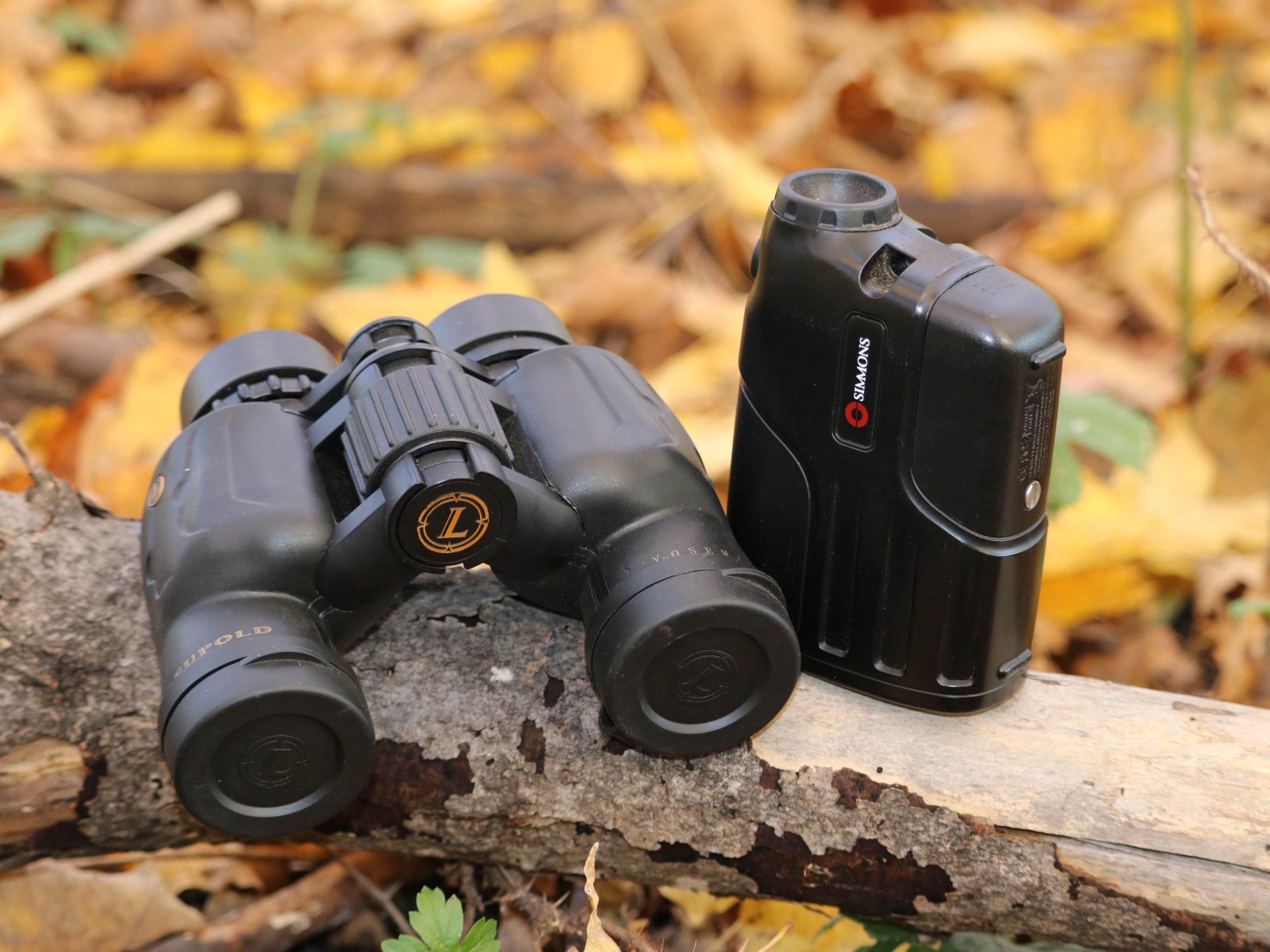
Range finder paired with some good glass will let you zero in on long shots>
Some of the more advanced features include small‑target ranging modes such as “Small target mode”, “Bullseye mode”, and “Close‑range priority”. These prevent the rangefinder from locking onto branches behind the animal. I have found that archery-designed rangefinders work best for airgunning, as they are designed for similar ranges and with similar features.
Durability and weather resistance are important; airgun hunting often means damp mornings, crawling through heavy brush, tree climbing, and cold, wet weather. Look for a range finder with water resistance, rubber armor, and one with good battery life in cold temps. Keep the range finder compact and lightweight, and make sure you can use it one‑handed and while wearing gloves.
Back to the original question: I think range finders are very valuable for long range shooting, not so much for close-range applications, but since an opportunistic long-range shot can always present itself, it never hurts to
