

Modern airgunners have plenty of gear, but when the wind picks up, none of it matters as much as knowing how to read the air. You don’t learn wind-doping from a chart or a video, it’s learned outside, rifle in hand, paying attention and practicing….. a lot.
Back at the bench, life is simpler. Clip a windicator to your rifle, and you’ll get a tidy snapshot of what the breeze is doing at your shooting position. A squeeze bottle of talc will show you the faintest drift in the field. Handy tools, for sure, but they only tell you what’s happening at the muzzle. And the muzzle isn’t where your pellet makes its impact.
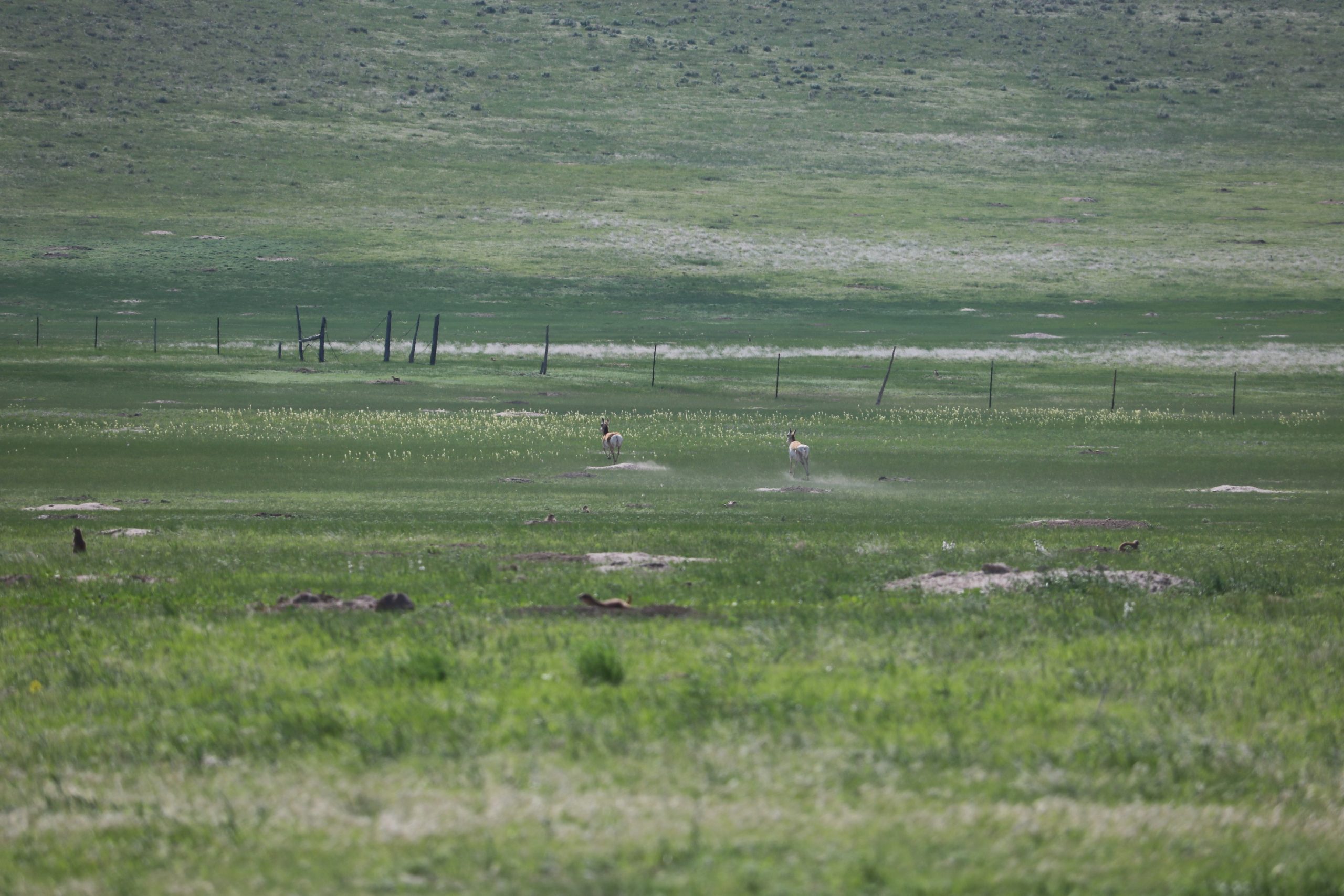
See the wind kicking up dust as these pronghorns run behind the prairie dog town I’m hunting
Out in the field, the real story is written between you and the target. That’s where the wind bends, swirls, and turns a hit into a miss. If you want to make hits when the breeze starts to kick up, you need to start reading the country.
The woods are full of clues. Leaves fluttering, twigs twitching on the edge of your vision, branches swaying, all tell you something about the winds direction and strength. Hunters who pay attention start to see patterns long before they shoulder the rifle.
Out on the prairie, the signs are even clearer. Grass leans. Dust lifts. The whole landscape becomes a real-time wind map. Prairie dog shooters know this better than anyone: if the grass is lying flat to the left or right, your pellet is about to take a long walk sideways. These natural indicators help you figure out how the wind will affect your pellet or slug.
Once you’ve sized up the wind, the next step is figuring out what it’s going to do to your pellet. And here’s where picking the right projectile can help: light pellets drift more, drift faster, and drift unpredictably.
-

- locking in for the long range shot!
-
- I was watching the grass along the shot pathways. Say the grass blowing away from me.
-
- Prairie dog down, and you can see the dust blowing straight away.
For long shots out to 75 yards and beyond, a heavy pellet or airgun slug is worth its weight in hits. Something with real mass and a decent ballistic coefficient. Think of something like the AEA Center Punch .25 33.9gr Diabolo Pellets, or the 33.95 grain JSB Exact King Heavy MKII designed for high-power PCP airguns. These pellets offer excellent long-range performance, solid power retention, and accuracy. I also use various air slugs for longer-range shooting, especially in the wind. One that I use more than any other in my .25 caliber guns is the Nielsen Specialty Ammo .250 Caliber 33.5 Grain Hollow Point. Push them at 850 fps, and you’ve got a projectile that fights the wind instead of surrendering to it. Will it eliminate drift? Absolutely not! But it can cut it down enough to keep you in the game, if the wind is not too bad. If the wind is truly ripping, though, do yourself a favor: pack it in and find another chore. Some days the wind wins.
When shooting prairie dogs in windy conditions, I like hunting with a spotter. Even skilled wind readers can be off in real field conditions; that first shot can be a SWAG. That’s why experienced hunters often work in pairs: one shoots while the other spots. You can do this on your own, spotting through the scope. However, a partner with a high-magnification spotting scope is better at calling impacts, tracking drift, and guiding follow-up shots onto the target. If the wind is steady, you can eventually get dialed in. If it shifts, you’ll at least learn how it is changing. Wind doping isn’t about perfection; it’s about adapting on the fly.
Ask anybody who has gone after prairie dogs or woodchucks with an air rifle, and they’ll tell you: reading the wind is part science, part instinct, and part black magic. You learn it by missing. You refine it by watching. You master it by paying attention to the “tells” around you, the leaves, the grass, the dust, the way your pellet flies. And when you finally make that long shot in a stiff crosswind, when you hold off just right and watch the pellet land exactly where you intended, you’ll understand why wind doping isn’t just a shooting skill. It’s a woodsman’s craft and a critical part of a hunter’s skill set.
