

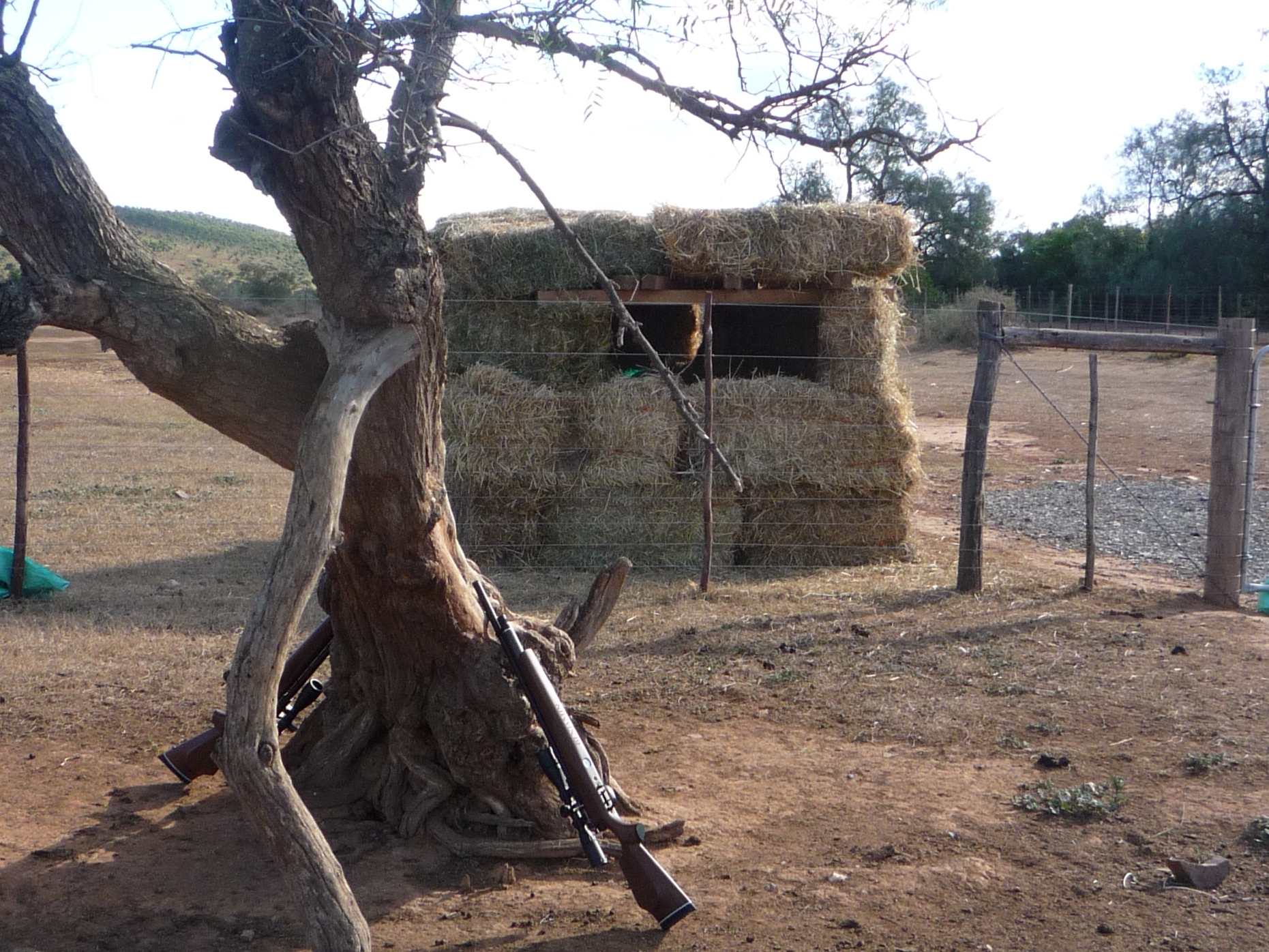
We built this blind on a farm in S. Africa where thousands of pigeons, guinea fowl, and monkeys were coming in to raid the feed lots.
One strategy for getting into range with your quarry is by using a hide or a blind. A blind can be used with or without accompanying camouflage clothing. The advantage of a hide is that it gives the hunter cover, allowing them to move around a little without spooking their quarry. You can cock the gun, reload, and look around without blowing your cover. The two main types of blinds are natural and man-made, but there are many variations on the theme. These range from wearing a 3-D poncho and sitting next to a clump of native vegetation to a mini-house on stilts, and each has its pros and cons.
-
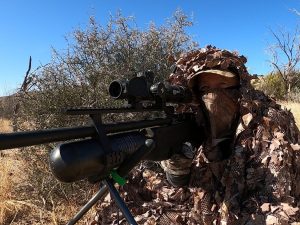
- At the minimum, a 3D leafy poncho is a portable blind, that can be worn or thrown over a clump of brush to form an insta-blind!
-
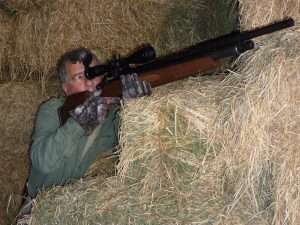
- Or it can simply be hiding in an existing hide such as behind a hay bale.
A natural blind is constructed using vegetation you find in the field, such as gathering downed limbs and tree branches to form a leafy shelter. It is important to position yourself in proximity to food, water, or roosting locations, and ensure that there are adequate shooting lanes to permit game to be taken from any direction. The advantage of this approach is that the natural materials blend into the surroundings and can be set up and left standing, so that on later excursions, they can be touched up and reused. Additionally, the quarry has a chance to acclimate to the structure in its environment and is more likely to come into range. The disadvantages are that this type of blind is not as comfortable or waterproof as manmade blinds and tends to take longer to set up. It’s a good idea to carry a ball of green or brown twine to tie everything securely together, and a pair of clippers for trimming back shooting lanes.
There are several types of man-made blinds, but two designs that I’ve come to favor are a large camouflage pop-up tent and a chair with a built-in tent cover. These are both relatively light and easy to carry, but best of all, they deploy quickly and work well. The chair allows me to hike through the woods, find a likely-looking spot, set up in less than a minute, and sit in comfort, waiting for a squirrel to saunter into range. On a recent small-game hunt, I walked to a spot within 30 yards of a den tree, set up the chair blind, cycled my rifle, and popped two squirrels as they moved through the trees to feed. I reloaded and took another one a few minutes later. I sat in this spot, with drizzling rain coming down, warm and dry, while filling my five-squirrel limit.
-
- You can also build a permenant bling using a mesh cage and sticking in natural growth
-
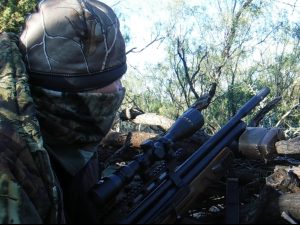
- This one is set over a feeder, for a permenant blind you need to draw the animals in.
You can place blinds along game trails, near natural food sources or watering holes, or over feeders to draw game within range. Some may argue that hunting over a feeder is not “true” hunting, but it is unquestionably effective. I find spot-and-stalk, or still hunting, more challenging and generally prefer it. However, hunting from a blind over a feeder is no less ethical than hunting over a natural water hole or feeding area. In many areas, hunters are limited to small properties, where attracting game may be the only practical option. Where hunter density is high, blinds can also be safer than having several people moving through the same area. In South Texas, I have hunted brush so thick that moving through it was impossible, making a blind and feeder set up over a sendero the only practical approach. For me, the ethical standard is whether the hunter can make a precise, effective shot. If the method is legal, how you hunt is largely a matter of personal preference. For example, shooting a hog from a blind at 60 yards with a .45 air rifle fits my idea of a good hunt better than shooting one at 400 yards with a .30-06 after glassing it from a distant hillside. In my view, the long shot is unrelated to hunting and is simply shooting. My ideal hunt, though, would be to spot a hog from afar, stalk within 50 yards, and take it cleanly with a big-bore air rifle. But any of these scenarios is acceptable if it is legal, productive, and the hunter is confident in the outcome.
-
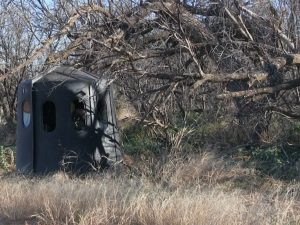
- A manufactured blind can be set up along feeders, waterholes, or trails used by game.
-
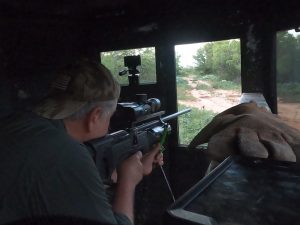
- This one is set up along a dirt roads pigs cross to access a waterhole.
If you’d like me to go into more detail on portable blinds, or how I build natural blinds, let me know! I’m getting ready to pack my new Daystate BlackWolf and some camping gear on my e-bike for a couple days of hot weather summer camping, and look forward to reporting back on that trip!
